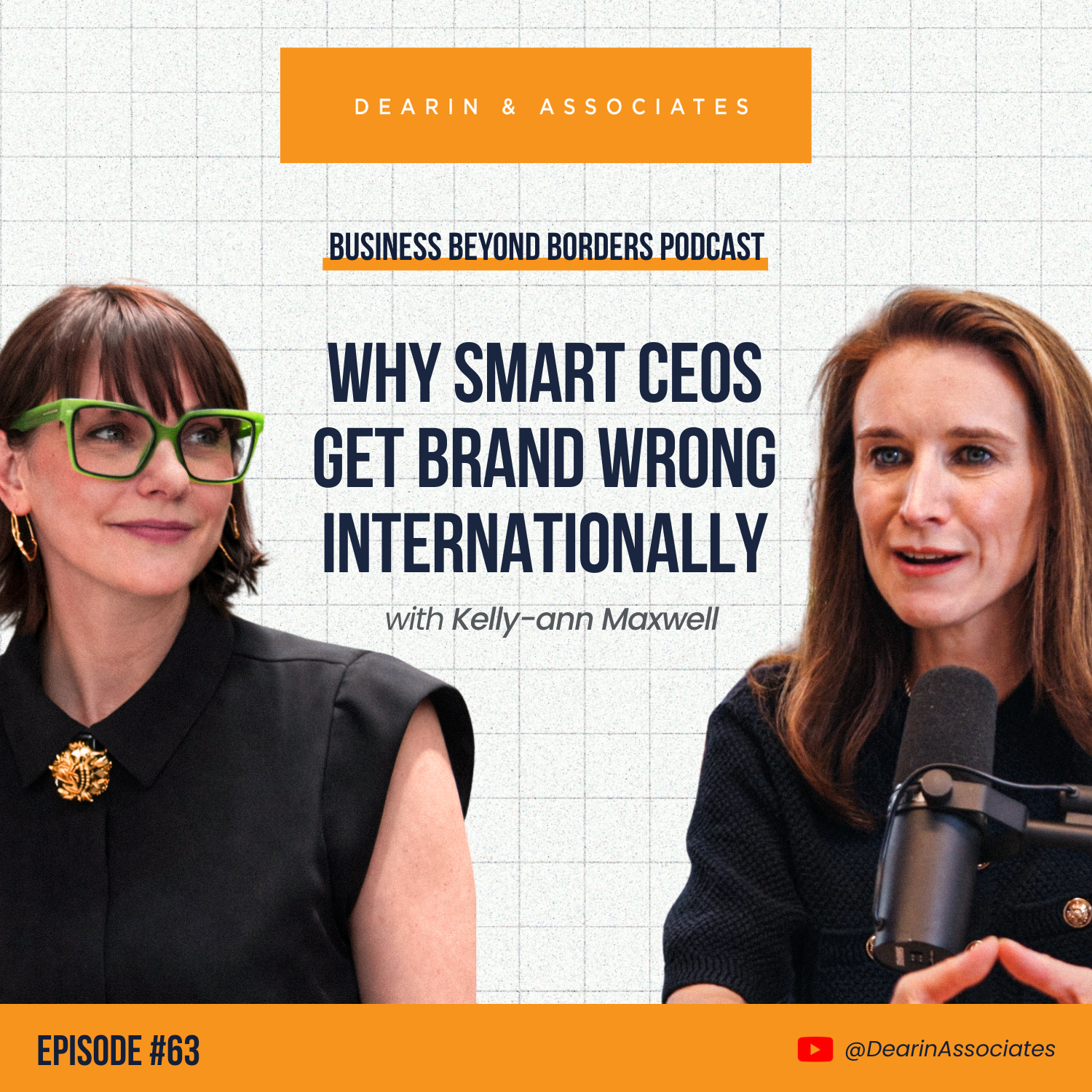
[00:00:00] Speaker A: Welcome to Business Beyond Borders. I'm Cynthia Deeran. We talk a lot about market entry, strategy, compliance and go to market execution. But one of the biggest make or break factors in international growth is simpler than many leaders think. It's how your brand shows up in a new market.
Today I'm joined by Kellyanne Maxwell, or CAM as we like to call her, our brand and marketing strategist here at Dear and Associates. CAM helps companies translate global vision into positioning, messaging and brand systems that actually work. Work across borders. So I want to know, how does a girl from South Africa end up in Auckland via London?
[00:00:38] Speaker B: Yes, it is an exciting adventure.
So I, I grew up in South Africa and I trained as a journalist. So language has always been very, you know, front and center in terms of clarity of language for me and research and understanding.
And then I straight out of uni, bounced into the UK and got into creative advertising, marketing, creative tech companies.
And so my career basically grew up in, in agency land. And the biggest thing about agencies is that it's all about clarity. It's all about taking brand to market in a way that customers really, you know, resonates with customers. And I, I love that, I love the creativity of it, I love the science behind it because the reality is if it doesn't translate or reach roi, then what's the point of doing it?
And the saddest part is, is that the place that gets cut the quickest and the fastest when brands are under pressure or businesses under pressure is the marketing team and the marketing budget. And so having your brand work hard for you is really important.
So yeah, so I grew up there from an agency perspective and then bounced, met a Kiwi boy and we headed over to the, to the islands of New Zealand. And yeah, it was a big learning for me coming into a brand design agency because it is incredibly specialist and I think a lot of businesses just don't realize how specialist brand is and can be. And it is more than a logo, it is so much more than just your identity. And I think that's the biggest thing is a lot of brands have a brand identity but what they don't have is a brand strategy and they are quite different things.
So yeah, so when I left the corporate advertising world I wanted to focus on operational scaling and once I actually started digging deeper into businesses going global, I realized that actually the first starting point is their brand narrative and the offering wasn't clear and, and there's no point in looking at all the operational elements. They're a non starter until you actually have your go to market strategy set up. So yeah, I've seen lots of great brands fail overseas and not because they didn't have great product, but very much because they didn't translate their story into their local market.
[00:02:48] Speaker A: So I mean, look, let's talk, let's talk about that because you and I, you know, at the moment you're working with South African brands coming into Australia, with New Zealand brands coming into Australia, with Australian brands going back out into Europe, the uk, the United States. You and I have both seen tons of companies that did fantastically well at home and thought they knew everything and were complete rock stars in their home space and then went overseas and just bombed in international markets. From your point of view, looking at it from the brand side, like what, what is that about? What, what is it that they get wrong?
[00:03:25] Speaker B: Well, I think that the, you know, having a strong brand and market often comes with a lot of legacy marketing. It comes with reputation.
And so you have heavy lifting happening kind of under the, under the watermark, so to speak, and then we go into a new market. You have to go in with context. You have to understand it's not just about language. You know, localizing your, your brand strategy is really important. And so going in and understanding not just that you have in potentially a different language, but also the visual cues.
What, what do colors mean in the, in the market you're going into?
You know, there was an interesting example I've got which was a eco friendly and sustainable brand went in with all of their lovely, you know, earthy colors and so on, but in the market they went into, that kind of meant really cheap retail.
And so it didn't really resonate with the local market. So I think, you know, understanding your customers and seeing your brand from their point of view is, is probably the first part of the puzzle. And a lot of brands don't do that. They go in and I don't want to say arrogantly, but there is a level of arrogance going in and just believing that what works at home works offshore and, and often brands get caught out like that.
[00:04:36] Speaker A: So give me an example. You, you know, you grow up in South Africa, so you know what works really well in that market. You spent 20 years of your life in the UK, so you're well across that too. And now you're sitting in New Zealand and you're coming, you know, you're interacting with that day to day and you're working around all three. Can you give me a quick breakdown of how, you know, like what's the Brand aesthetic in South Africa. And how is that different from London or Auckland?
[00:05:00] Speaker B: Yeah, I think the biggest thing for me is that people buy people.
So, you know, and customers, not fools, they see straight through bullshit straight up. They understand that, you know, they want to buy, they want to buy your product. This is often the thing if you are offering something that solves something for them. They want to buy your product, but if you're not doing it in a genuine way, that actually speaks to them as a.
Then they'll go to your competitors. And I think a lot of brands also, as I said, you know that localization is really important. So, you know, in South Africa, the aesthetic is very human.
When I grew up, it was very American. We had a lot of American influences. That's changed. You know, I think South Africans have very much embraced being South African and what that localization means.
I think that that's quite important. I think when looking at the UK and the aesthetic there, it's very diverse. And that's why a lot of global brands kind of globalize free from the UK into across Europe and so on. But brands still get it wrong. You know, hsbc, one of the biggest global brands out there, you know, when they, they put out their, their campaign about assume nothing, they went off into the market and, you know, a lot of, some of the markets they went into, it got translated into do nothing.
[00:06:14] Speaker A: I think that was in, in China, wasn't it?
[00:06:16] Speaker B: Yeah, China. And so, you know, that's not really what you want from your bank, that they're going to do nothing. And so I think that, that, that was, you know, that's a misstep of.
That wasn't just pure language. That was a cultural relevance in the, the various language sets of Asia.
Coca Cola did the same over here in the, in New Zealand. They, they put up in Auckland Airport. They had K Mate, you know, great. Except that mate or mate in te Maori is death. And so you kind of, you know, cure a death. It's just, again, it's just a small thing that just nobody caught, no one thought about. And it's just, it's silly.
[00:06:57] Speaker A: I'm laughing because I'm thinking of that Electrolux campaign, which was. Nothing sucks like an Electrolux.
A lot of markets people just looked at that, they're like, what?
Or the other famous Coke one was, when Coke first went into China, they tried to translate whatever the slogan was, I cannot remember what the slogan at the time was, but they tried to translate it directly into Mandarin and it came out as Bite the Wax Tadpole.
And that just confused the heck out of everybody.
[00:07:30] Speaker B: Yeah, Pepsi did one also into Asia or into China. And it was come alive right with, with Pepsi, which basically in the translation said, you know, basically we'll bring back your ancestors. I mean it's just there's so look, there's you just, you know, Google it.
[00:07:46] Speaker A: Endless permutations.
[00:07:47] Speaker B: And these are big brands. And yeah, if the big brands are not getting it right, then you know, you really, as a small brand, you really have to check yourself.
[00:07:55] Speaker A: So I mean, I think that's a great place to go on from. So what does it take for a brand to be really ready to succeed in an international market? So if I come to you and say, hey Cam, I think I want to go global, how will I know if my brand is ready for that step?
[00:08:10] Speaker B: I mean look, ambition is fantastic, right? And I think that's the biggest thing. I think if you look at your brand as if you were going to go into market and look at where you need to start from a brand perspective only. I think it's having absolute clarity.
You know, what do we stand for? Who are we serving? How are we going to win in the market? What does our brand stand for and who are we on a day to day basis? And then looking at is that coherence across all of our customer touch points, not just our website and LinkedIn, but you know, are we showing up on our social media, is our local sales guy going out and speaking the language that we want him to speak?
And also then there's that connection piece around local insight. You know, actually are you resonating in the market you're going into? Because I think a lot of brands, as we said, you know, they just go in blindly doing it and don't always set up the local market for success when they go in. So I think that would be the first things I would look at from a brand perspective is, you know, are we ready? Well, let's just look at, you know, is our brand clear? Can I describe what we do, what we offer and who we are and what our differentiator is in 10 seconds in the new market, not the local market, that it just resonates.
[00:09:22] Speaker A: Gosh, I have so many questions. So I think I'm gonna, I'm gonna ask these questions in two parts. So firstly, have you got an example of where somebody said to you, oh no, I mean I can think of one. I can think of a company that we worked with not so long ago where they're absolutely convinced that they were ready and they'd like, we've just redone our website.
But when you really went in and looked at what they were doing with the brand, it was all about the product. It wasn't about the problem that they solved.
And they weren't even really clear on who the target audience was because it could have been. It was in a B2B space and it could have been several different avatars. Yeah, I mean, have you got one that you can think of that you can talk about without giving away any state secrets of where you saw, you know, where people are like, no, no, that's not me. We've totally got this covered. But when you came along and saw it, you're like, actually, no, you don't.
[00:10:15] Speaker B: Yeah. So a brand that I work with, great local, locally, great product, lots of repeat buyers.
Again, a lot of the, the legacy marketing and so on was, was feeding into that.
And so they were doing really, really well. Then they go into the new market and they realize that the cost of customer acquisition is so high, so, so high, and they can't, they couldn't figure out why. You know, once they got their customer, their repeat buying was huge. You know, the revenue was, was strong with. Once they had their customer. But to hook them, the sales guys were struggling to actually get people in the door. And what, what we realized was kind of twofold. The one was they hadn't set their local team up for success. So they hadn't gone, you know, they were pushing with the, the global, let's say the, the kind of more local head, head office narrative and so on. And then they hadn't really localized it into the audience set that they were talking directly to. And they actually had quite nuanced audiences in different markets. And so, you know, the.
Just off creating all their own collateral because they weren't tooled up to be successful.
And I think what that really struck for me was that it's important to have everybody singing off the same song sheet. And it doesn't need to be completely unique for each audience. But it also means that when you have a. Your brand identity and your brand strategy, there's certain things that you keep sacred and some things that you deliberately change.
And there are areas that you have to flex when you go into your local market. And I think what this brand did do was they looked at what they were holding sacred. So we went kind of went back to the high level and we documented it. A lot of businesses don't document these things, and so they don't know how to then toolkit up the people on the ground. And so I would say if you were going to look at kind of what are you keeping sacred and what are you flexing then you know, your core value proposition, your positioning, who you serve, how you win, how you're different. Different, those are set in stone. But then you flex into your markets is your messaging with audience context and kind of visuals that resonate and so on. Experiences are different. Different markets use different channels quite differently. Asia is a very good point, you know, in terms of social media.
So kind of I always think of, you know, create cousins, not necessarily clones when it comes to your brand coherence.
And so that's what this brand did. They started and kind of went back a step, documented who they were, how they won and then kind of elevated from there and then tooled up their sales guys. And once they had that, then their customers were seeing the local, the brand and market locally, seeing how it landed up to the global narrative and it all made sense.
And then there was, yeah, pickup of product acquisition was quite quick after that.
[00:13:06] Speaker A: Amazing. So if, you know, if I'm coming to you again saying hey Cam, I want to test my brand in a new market, what would you advise an executive team in terms of the first step that they should take to test whether their brand resonates in a market that they're targeting?
[00:13:27] Speaker B: Yeah, I think that, I mean, look, it also depends. I mean if your, your investment appetite is, is quite big then you can always. There are a lot of businesses that do brand penetration testing and you know, can give our, you know, audience, there's recommendations I can make on that which gives you a true penetration penetration test for your brand in a specific market.
I think there's a few starting points. The one is taste actually produce collateral that you're taking into market. And this trade shows are really, really good for talking directly to potential customers. I think we underestimate actually going out and hearing what our customers have to say and surveys etc, but I think we all get it. At the end of some kind of engagement there's always two or three questions and they want whether people engage or not. You know, that's another piece. But I think that being able to hear what your customers have to say about your brand and what resonates is really important.
Testing a market using different languages, giving your sales team again on the flexible side, not necessarily on your core side, but actually changing it up and testing and then optimizing. But the only thing I'd say about that is if you are testing multiple, you know elements of your of your messaging and so on. You still need coherence.
[00:14:46] Speaker A: This episode is brought to you by ofx. One of the things we see all the time with companies expanding internationally is that the strategy might be sound, the market choice might be right, but the financial plumbing is just not keeping up.
Managing global finances can quickly turn into juggling currencies, unpredictable cash flow and far too much administrative.
OFX helps take that friction out. They're trusted by more than 37,000 businesses worldwide and they make it easier to pay international suppliers and teams in local currencies while saving on FX fees and simplifying the admin through one platform. If your business is operating across borders, OFX gives you clearer visibility and more control over your cash flow. You can find out
[email protected] and we'll put a link in the description.
If somebody came along and said I've got $60,000 to spend on market testing and I have a choice between going to a trade show and talking directly to people in that market and then doing the follow up and the analysis and figuring out what feedback came out of that experience.
Or I have the opportunity to invest $60,000 testing my brand on TikTok across five markets. I can only spend this $60,000. Which direction would you suggest they jump and why?
[00:16:12] Speaker B: If you are trying to truly break into a new market then you need to go to the market. So being on TikTok is fine but it's, it's social media is hard and organic social is actually where you get the most traction.
So I would, I would say spend your 60,000, set up your trade show engagement and there's all the pre you can be on social media. Prior to I worked with Mike, one of our other consultants on a trade show piece of work and it's all about setting up your brand narrative ahead of time, being online, showing what it is that you're going to say engaging with specific target audiences, whether that's distributors or actually true customers, end customers before you get there so that you actually know what you're going into and seeding all of that information before you go. And then when you're there you are, you get to create a whole lot of collateral. You get to test a market, you can survey people on the ground, there's, you can see what your competitors are doing. There's a whole lot of real benefit to actually going and testing in market at a trade show.
Obviously making sure the trade show is relevant to you is important. You know you don't want to go Too broad. But I do think that there's absolute benefit and that's where I would start. Because the amount of data and intel that you will get from just being at that show and the people and connections that you make, it will supersede anything over, yeah, 60 grand on TikTok videos.
[00:17:37] Speaker A: What really blows my mind here is that companies often go off to trade shows and they completely squander the opportunity because they think that the opportunity is we're going to a trade show for three days and they don't understand that they need to do pre show marketing, they need to set up all these pre show appointments, then they need to, sorry, at show appointments but before the show, then they need to show up at the show, they need to test the pitch on all the people coming by and adjust the pitch to see what actually lands. Because sometimes we know that often the pitch you go to the show with is not the pitch that you leave the show with. That's working and you're switching it up on the fly and you're getting people's direct feedback, as you said, to the product.
And then you come out with your, you know, 179 hot leads, but they're disparate in the types of leads that they are. And so then you need to go away and slice and dice all the data and segment the data and then generate messaging that speaks to each of those different segments and sub segments. And then you need to go back again and re reach out to those 179 people and then the process begins again and that's your whole cycle. But people think, oh no, no, we go and we stand at the show for three days and then we send one follow up email afterwards. And I think people just drastically undercook it. You know, they're like, wow, we blew up $60,000 and all we got was a stack of business cards. And it's like, no, you did this the wrong way. You could have tested the brand but you didn't do it.
[00:19:02] Speaker B: And I also think, you know, when you're at the trade show that is, you know, it's not just about showcasing the key product, it's about building the relationships. Because that especially from a distribution perspective, that is one of the key things that is going to get you into the next step. And I think, you know, as you said that data segregation and what we did post the show, I worked with Mike on, you know, we data segregated and then the key messaging was so nuanced for the segmentation that we created and it was the follow up. And as you said, it's not just one email, it's the follow up on the follow up on the follow up. And then I think the next piece of that is who did we talk to in that segmentation that was then going on to the next show in Hong Kong and actually how we have that as a loop and knowing that the distributor that we spoke to here was also going to be in Hong Kong. And so all of that, it's, there's a strategy to it, but it's just that opportunity to really test your brand and market that's it's so valuable.
[00:19:56] Speaker A: And I actually happen to know, knowing the company that we're both thinking of in that show, that out of that show that company now has interest from 14 different markets.
Not, not saying they should do all 14 at once because you know that I think that's a terrible idea. But there is plenty of interest generated out of that one show. So there's basically that return on investment has been gotten even before they sell a single unit of product in any of the markets where there's interest.
[00:20:22] Speaker B: I know, it's incredible.
[00:20:23] Speaker A: I want to take you to back to content for a minute. Just thinking about this whole social media piece. What type of content do you think actually travels well across borders?
[00:20:34] Speaker B: I think human stories is really important.
Working with a brand at the moment, that it is really about the human story and the product is, is really making an impact for people. And I think when people see and hear and understand the impact that it has on other customers, for example, that's what resonates. Giving them the top five ingredients and the kind of marketing jargon that sometimes sits around these things is really not what is going to hook people into the product. Seeing the impact in the results, but not necessarily just in a data driven way. There was an increase of 15% on 220 people who tried out our product doesn't mean anything. But hearing that Sarah had over three months an impact or the product was successful because of this, you know, that is what hits home. So I think human stories and, and social media, I mean it can be a terrible place for brands to be because you have to, you really have to put the energy in.
But I also think it's not necessarily being scared of engagement around that area because I think that when you've got human stories and people are engaging, whether that's positive or negative, and there's always a way to engage with people who are trolling and there was a way to engage with people who have something negative, say about your product and having that strategy set up in advance. But I think human stories is probably the key thing I would say. And where does your product make an impact for people?
That's what I would put on social media ahead of probably everything else. And then, you know, it's a laddering. There's also sharing of other information and it's a strategy. You have to have a content strategy. But I would start with looking at what are the human stories around your brand as a content piece.
[00:22:20] Speaker A: Now, we both know that you can spend a lot of money on marketing without seeing anything in return, especially if you do spaghetti at the wall.
From your treasure trove of war stories, what is the most costly mistake you've seen a brand make as it goes to scale internationally?
[00:22:44] Speaker B: Not being ready to scale, I think that. And true operational scaling. I know we're talking about marketing, but I think the biggest piece for me is you can have a great brand out there. You can tell everybody how fantastic it is, they can buy it, or maybe there's a, you know, a big order.
Are you ready to really send it out? Are you really ready to deliver on the promise that you're making in your new market? And I think that for me is one of the biggest mistakes that businesses make is that operationally they're not ready to deliver on the promises they make in their new market.
And if 10,000 orders landed tomorrow, could you actually deliver on it?
[00:23:22] Speaker A: Can you, can you illustrate that for me with a, a real life story, you know, preserving everybody's anonymity, obviously.
[00:23:31] Speaker B: But yeah, I think that, you know, we had a, we had a business that was looking at a new market.
It was a very difficult market and it was going to be a volume market. And I think that's the other thing, you know, Australia, New Zealand. New Zealand volume is a lot smaller, but Australia, slightly different. But this was going to be a huge volume market.
And they had already started talking to distributors, they were signing all sorts of contracts. They were ready to literally put, get orders out. And when we then took one step back and went, okay, that's great. What product are you taking into market? Oh, all of them.
Well, you've got 126 products. You can't take all of them. And actually this market would be quite niche based on the cultural references and, and it was like, oh, right. And then it was like, well, if we're going to do that product, we're not set up to send these three products out. And at volume you go, okay, well what does that mean? Okay, well, now we've got to, we've got to buy in more bottles. We've got to get our production line set up quickly for. Because, you know, the way they buy is different. They bought in different types of sizing and things really interesting around that operational setup to take on volume.
So, yeah, I, I think that that's one of the biggest missteps, but it's also solvable if you do. If you understand the market you're going into, start. And I'd also say don't sign any contracts until you. You kind of really. And know that you can scale would probably be my thing.
[00:25:04] Speaker A: Yeah. Because if you go in the other direction and you do get a big order in before you're ready to scale, and I'm thinking of somebody that we worked with in the food space here, you can completely tank your business in one go because you sign the contract, the next week, an order for 64 million units comes in and your operation can only produce 500 a week.
And suddenly you're gone. Or, you know, you ramp up on a single customer and then, you know, suddenly your factory is running three shifts and producing this large capacity and for whatever reason the customer pulls out, you're sunk 100%.
[00:25:44] Speaker B: I think that's the other piece of it is, you know, if you set your business up to scale but you've got all your eggs in one basket with one customer, that's also going to be a massive hindrance down the line. Because you're right. If you're not then growing your. The rest of your customer base and looking at a broader distribution model, then, yeah, it can really come back to bite you. If that customer just suddenly pulls the pin and you're left with a huge operation and no customer to buy what you've got.
[00:26:13] Speaker A: Wanted to go back to brand for a second. How much of a role do you think brand plays beyond just the product in terms of, for example, attracting partners or talent or, you know, a broader halo effect abroad? What is, what's the role of the brand overall, you know, more broadly than just moving units?
[00:26:33] Speaker B: It's quite interesting. There's quite an interesting conversation going on on LinkedIn at the moment around thought leadership for brands, having thought leadership and the fact that AI models are now picking up, you know, thought leadership as a source for a brand or for a business. And so what does that mean? And I think that that is the one piece of the puzzle where brands, you're right, can go out with key messaging, you can talk very much around, you know, what you sell and why you're different. But when it comes to then building your business and the actual growth that that comes around, that having the right talent, attracting the right talent, keeping the right talent, and then also making sure that your, your customers or your, your partners know that you are a thought leader in the space you are in, that it isn't just about the product. It is that, you know, you, you really do understand and are a leader overall in the category. I think that that's where your brand can really, can really drive more than just sales. It is really, it is very much about what you stand for and who you are. But having those type of people in your business who, who can really generate that kind of brand, thought leadership is actually a really powerful way to get your business growth kind of augmented beyond just the scaling product.
[00:27:57] Speaker A: And I think that's quite scary for a lot of people because they feel as though it's controversial to have opinions. And if they actually state a point of view on something and put their head above the parapet, somebody's going to shoot them. And they don't really like that feeling.
I mean, do you, do you think that holds people back from actually becoming thought leaders? Well, I don't want to say, you know, I don't want people to criticize me.
[00:28:22] Speaker B: I agree. I think a really good example is that since people have been able to use AI to just, you know, put ideas down and then create content or thought leadership, I mean, LinkedIn is a cesspool of just absolute, you know, nonsense thought leadership. Because the reality is, is it's just given people a way to do it without really doing it. And I think that that's not what it's about. It is. Now when I talk about thought leadership, it's really owning your category.
And that does hold people back because that does open you up to people commenting on what you've had.
And if it is thought leadership, it's probably a bit of an attack. If it is an attack or it is positive about what you think and who you are in a business. So I think it does hold people back. But yeah, I think if we can get back to more organic thought leadership for brands and businesses, I think that would be fantastic.
[00:29:17] Speaker A: And I think people see it as polarizing. Thought leadership is polarizing, but I see it as niching.
So if you do real thought leadership, some people are going to love what you say, some people are going to hate what you say.
But then at least you get to work with people who understand who you are. You know, you get more of the people who actually appreciate your point of view and less of the people who don't like your point of view, who you might not have been a great fit to work with anyway.
[00:29:41] Speaker B: I also think that, you know, the reality is, I mean, we tell our businesses we work with all the time, right? Find your niche. Find your niche. And if you are a thought leader in your niche, you will find your tribe, so to speak. You know, and I think people who understand that are then probably slightly braver.
And, and I think, you know, we, we. It is, it does take courage. It absolutely takes courage. And, and then there's the time around it, you know, if you're a business that's scaling, you know, you kind of look at what you've got to do in a week and you go, well, when the hell have I got time to write a thousand words on and have a point of view on this? I just don't have the time. But I think it does make a massive difference and positions your brand in quite a different way.
And looking at what your competitors are doing, I mean, if they're doing it, then you have to do it. I think that would be the rule.
[00:30:28] Speaker A: Cam, we're going to wrap in a second, but before we go, what is one piece of advice you'd give to leaders trying to build a brand that really travels across borders?
[00:30:39] Speaker B: Understand your market. Understand your market.
And if you can't explain your brand and your business in 20 seconds, then you need to look at it, you know, you know, what is the elevator pitch?
And then you kind of localize that. But I think that's understanding your market, being able to pressure test it, if you can, is really important. And then also building up that kind of brand system around your, your key offering that, as I said, is more cousins than, and then kind of clones, but that it's about that cohesion as you, as you're growing. So that would be my key thing is. But the biggest thing is understand your market. And not every market is right for every brand. I think that's the other thing.
I've met a incredible brand out here in New Zealand and they have produced a product specifically for the UK and specifically for another market. Because the product that's here in New Zealand probably won't quite resonate out there.
[00:31:38] Speaker A: Is it food? Is it in food?
Is it in food? Okay, yeah, right.
[00:31:44] Speaker B: I mean, incredible, right? So I think that that's. And that's the thing, because they know their market, which is brilliant, because it's a hard first step.
[00:31:52] Speaker A: So, yeah, Cam, thank you so much for sharing those excellent insights. It's been great having you on the show, and I look forward to having you back again soon.
[00:32:01] Speaker B: Amazing, right? You have a wonderful day.
[00:32:03] Speaker A: You, too.
[00:32:03] Speaker B: All right, cheers.