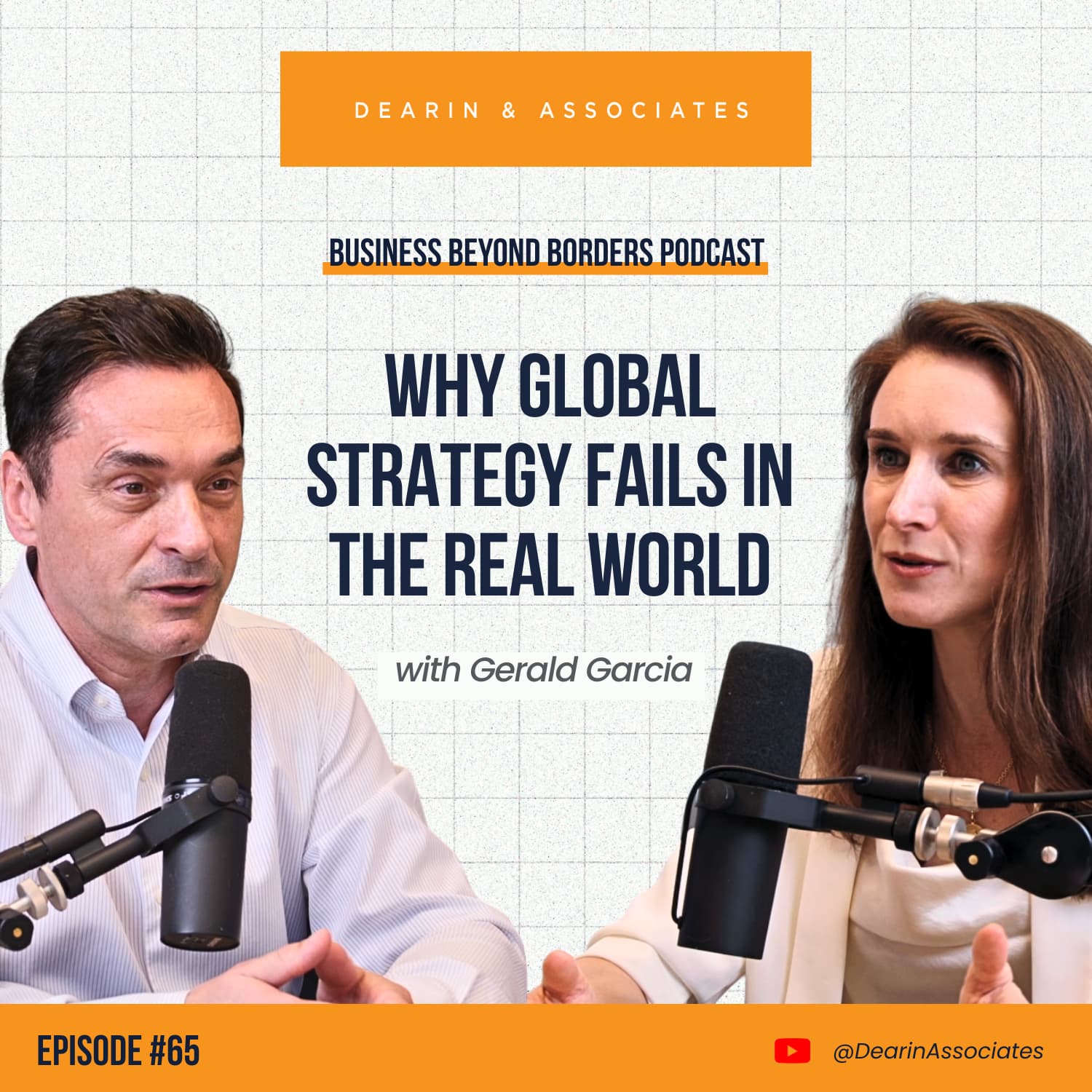
[00:00:00] Speaker A: Welcome to Business Beyond Borders. I'm Cynthia Deeran. You can have the right strategy and the right market and still fail internationally if the people side isn't thought through.
Today I'm joined by Gerald Garcia who leads workforce strategy at Deeren Associates and works with leadership teams to turn global ambition into human capability.
Gerald has spent his career building and leading cross border teams and he's seen that global growth is rarely limited by opportunity, but very often by talent, leadership and culture. Gerald, welcome to the show.
[00:00:33] Speaker B: Nice to be with you.
[00:00:34] Speaker A: Cynthia, you've got a fascinating background. You're from France, originally from the south.
You've been in Australia a very long time. I'm not sure if I'm allowed to say how long you've been here, but a very long time.
[00:00:46] Speaker B: Don't remind me.
[00:00:46] Speaker A: Yes, I'd just love to know a little bit about that journey. How did you get here and what led you into workforce development?
[00:00:55] Speaker B: It was just straight after my university and I got a degree in applied foreign languages and I always wanted to work overseas.
Why not Australia?
I managed to get a transfer from hotel chain. I was working for back the time and I arrived in Sydney. The rest is history.
However, I had some amazing mentors in my life. People who guided me, people who show me how to, to be a better manager on a day to day basis and show me how to fail. Because you know, we always say if you don't plan to fail, you don't, you fail to plan.
[00:01:43] Speaker A: Yeah.
And is that, do you think those mentors are part of the, I guess the inspiration? I mean you're passionate about workforce development and putting the right people in the right teams. Do you think those mentors had a lot to do with that?
[00:01:57] Speaker B: I learned on the ground too, yes, with their feedback and their input. But I learn on the ground working with people. I mean you cannot guide people or like to work with the workforce or within the workforce ecosystem if you don't like people, if you're not passionate about engaging day in, day out. You know, I read a lot of people who comment on thought leadership. Yes, about people. But did they really work with people or are they comments that they generated out of an AI tool, GPT?
So yes, being on the ground you learn greatly about, about people and you know what is, I believe most important is how to connect emotionally with people. If you don't and the same with businesses, if you don't know how to connect emotionally and you learn that as a skill.
If you don't know how to connect emotionally with people, it's very difficult to get your message across.
[00:03:04] Speaker A: I often think in business, people want to keep the emotion out of it. You know, we're trained not to. We're trained in the opposite way. We're trained. Emotion is for your personal life and you know, business. Everybody suppose, especially in an Australian culture which is very Anglo Saxon, we're taught to, you know, keep our emotions in check. But I, I really agree with you because I think if you can connect with people emotionally, you get to know who they really are. You know, you get to know them as people. And connecting with people as people is just so key to building a great team and, and to the people in your team having a great experience and so therefore being able to deliver great results.
[00:03:41] Speaker B: Correct. Things have evolved. It's no things taken out of a playbook. People want to see exactly what it is on the ground. And if they can relate to an experience of yours, if they are able to see what you went through and the steps you've undertaken to achieve certain outcomes, they'd be able to relate. So that is on a personal level, I mean personal level, personal connection with your direct employees, but also with businesses. Look at all the, in all the cultures, there's a sense of how can you relate, how can you be a part of a thinking process.
And the best way to understand people is to immerse yourself in their day to day.
[00:04:27] Speaker A: And I look, I've seen how carefully and how diligently you've done that with some of the younger people in our team, coaching them, bringing them along, spending time with them, just even doing something as simple as walking through how you would do something and the results that would come out.
[00:04:42] Speaker B: To be able to relate is you have to be able to.
And to be able to be relevant is you have to be able to walk the talk, basically. And that is one of the essential things I've learned very quickly. No point to use big words, big sentences, but walk the talk and show them how you would do it very genuinely and with authenticity. This is what helped me to move forward and manage effectively some teams in the past.
[00:05:15] Speaker A: Yeah. And now you're working with teams in the global space. And I have heard you say that most global strategies fail because the team wasn't designed to deliver them.
What do you mean by that?
[00:05:28] Speaker B: Often projects are rushed through.
It starts with a strategy from the headquarters with no people on the ground.
And they think they can replicate the successes that they had domestically.
But you would know that domestically and international markets, Domestic and international markets are very different and they need to be thought through differently from the strategy point of view to the delivery. So there need to be a certain level of alignment and they need to have people locally on the ground to participate into the, the development of this new market.
[00:06:13] Speaker A: And not just any people, because it has to be people who understand the local market, but who can also translate that back to the people at headquarters and get the feedback from headquarters and translate that back into the local context without getting offended or getting it muddled
[00:06:30] Speaker B: up or no doubt that you would need initially the headquarter representative to be on the ground and identify the skill sets that are missing or the skill set that we be able to, to get the project off the ground.
The only or one of the main reason why someone from the headquarters would be parachuted, I would say is to be able to maintain the level of, maintain the processes, maintain the systems and maintain the culture.
So the higher level, the framework basically to help the local person thrive, basically.
[00:07:20] Speaker A: So what was the first international expansion that you were involved in or saw where you realized that the talent was actually going to make or break that market entry?
[00:07:29] Speaker B: Yeah, it's actually about an Australian company that has set up their entity in Europe and started with France, opening their first shop there.
We had the relationship, we own the relationship here in Australia. But to open up an entity in Europe, in this instance in France, we needed people based locally to take them through the journey. So it was very important to have this local experience. So obviously being French, I managed to go there and be a part of a process on the day to day operations and the protecting what I was saying, the culture, the framework that was required, were required protecting the culture and the framework that were required to help the businesses, to help businesses scale up there. So I was on the ground and obviously we had to employ people who were, were knowledgeable about them, in this instance the labor market in France and being able to share with them some of stories, war stories with customers and how we dealing on the ground with. With the customer with different approach, different customer service than in Australia for instance, or Asia.
[00:08:57] Speaker A: Let me ask you about that. What do you, I mean, you know, having worked, being from France and having been here for a long time and working on projects like this between France and Australia. What are some of the key differences that have popped out for you in terms of how Australian and French business culture are different?
[00:09:13] Speaker B: Yeah, French, they don't like to be frightened, like physically or emotionally. So with people who come very hard on you, you know, thinking that they're the best people in the world, if it might be funny for a French to say that, but if they see, if they see someone coming towards them and thinking they're the best in the world, they will get in their shield, defensive, defensive, and they will actually shut down and they won't be very friendly or open to help. So what I've learned is that it's better to be humble, better to show you vulnerable, to show you can make mistakes.
And we are actually on the same boat. And at this moment, the European culture will open up and will open their arms and will help you, definitely. So I thought that was a nuance, but I didn't notice here in Australia.
[00:10:25] Speaker A: I was going to ask you, what's your impression of Australian business culture coming to it as a French person?
[00:10:30] Speaker B: I think there's often more other countries in Europe than France are like this, very by the book and this is the way it's meant to work and that's it. I think Australia and Asia are more flexible in the business setup and business growth than in Europe.
Still a little bit in by the book process following this episode is brought
[00:11:02] Speaker A: to you by ofx. One of the things we see all the time with companies expanding internationally is that the strategy might be sound, the market choice might be right, but the financial plumbing is just not keeping up.
Managing global finances can quickly turn into juggling currencies, unpredictable cash flow and far too much admin.
OFX helps take that friction out. They're trusted by more than 37,000 businesses worldwide and they make it easier to pay international suppliers and teams and local currencies while saving on FX fees and simplifying the admin through one platform. If your business is operating across borders, OFX gives you clearer visibility and more control over your cash flow.
You can find out
[email protected] and we'll put a link in the description.
So there's been a lot of cultural and societal change in the workplace over recent years, particularly because of COVID which obviously changed the way that pretty much everybody worked.
How do you think it shaped the way organizations think about workforce strategy?
[00:12:09] Speaker B: Well, people cannot firstly, in most of the countries there is a skill shortage. Right. And they need often to look for outside of their shores for workforce leading to different type of contracts and employment such as employer of record or offshore talent or outsourcing.
That going to contribute to the new mix and be a part of a workforce ecosystem. I think we cannot look within our boundaries anymore. And what Covid taught us is that people can deliver working from home.
[00:12:46] Speaker A: Yeah.
[00:12:46] Speaker B: And it's often this Mixed. This balance that businesses are faced with, and they have to find the right balance. Some businesses want their workforce to operate exclusively from the office. Others work totally remotely.
How do we engage with customers and what is the best way to do so?
So I think it.
The success and the global success is within people.
And people need to be taken in this journ.
And we need to have a right balance between working from home and working from the office.
[00:13:22] Speaker A: And it's been a very controversial topic today. You know, some people are up in arms because they say, well, no, it's our right to work from home now, except that it never was before. COVID and other people are saying, well, no, you have to be in the office all the time because you can't be productive if you're not. And I think both of those are wrong. I mean, for us at Deeren and Associates, we were working remotely and in a hybrid fashion way before the pandemic. So we started to have a remote workforce in 2016. So for us, it was. People asked me, oh, did Covid just upend everything for you? And I sort of went, well, no, it's pretty much just exactly the same as it was. You know, at that point I was working remotely. I had, you know, babies and small children. So remote work was great for me. But I know for a lot of people in the world, the last five years or so, five or six years have just been a huge shift and I think it's very uncomfortable for a lot of people. So people who've come out of this traditional model of you have to go to the office from nine to five, they can scarcely get their head around, okay, now I'm going to have a workforce sitting somewhere offshore in the Philippines or Vietnam or Pakistan or Jamaica or wherever it's going to be.
[00:14:29] Speaker B: Yeah. But when you look at around the world, the 9 to 5 scenario or schedules, the way it's been done in the past is totally different in these businesses and countries are beyond this 9 to 5 that we can see in Europe or sometimes in Australia also at the end of day, working from home or working from the office, don't we have to think about the customer first? What do they want?
[00:14:53] Speaker A: Yeah. And what results can we get? I mean, does it really matter where you work from as long as you get your work done?
[00:14:58] Speaker B: Yeah, but ultimately, if there are a lot of customers who prefer, you know, a handshake or face to face engagement, we have to be able to offer that and continue engaging that way. Others would like a more transactional way of thinking. You know, and it's very generational, too. You know, I'm talking in other video projects on the generational clash. But yes, businesses react differently based on the generations that have created the businesses.
[00:15:32] Speaker A: What I think is really interesting is, you know, despite how controversial that topic about remote work or not or hybrid work is, my personal experience is that you can actually do it really successfully, but you have to be very disciplined about it. You have to set up the systems and the communication patterns and the expectations around how people will show up, if you like, virtually even when they're not there. And if you do that and you keep it structured, it can work. But if you just let people sit in their office on the other side of the world and you only speak to them once a fortnight, it's probably not going to work very well.
[00:16:07] Speaker B: Which brings back to what I said in my previous example, how to connect emotionally with your staff. And they can be remote, but you need to find a way to connect with them. I mean, I experienced that when I used to manage a team offshore from the Philippines. And their culture is very different from the Australian way, even the French way or European way.
You need to connect emotionally with them regardless. So you need to talk about your private life, to talk about your kids, talk about your parents.
There is, you know, about 10, 10 minutes or 15 minutes in the conversation that has, you know, around this and maybe five minutes around what. What is the real topic of a conversation?
Other countries and other businesses are more straight to the point when you refer to. To German or to French or even
[00:17:03] Speaker A: to Australians, I mean, we lose it. I know I sometimes hear from my team, we want to get to know other people in the team better.
And I'm thinking, oh, we're gonna have to do, you know, heaps and heaps of social stuff, but that's what people need, to feel connected. Whereas, you know, in Australia, we might come and say, hi, how was your weekend? Okay, let's get straight to it. But you do have to take that into account. You know, how people want to relate to you in order to get the best out of them, because they have to feel cared for and seen 100%.
[00:17:30] Speaker B: And to be honest, initially, I'm coming from a background where it's not into small talks. You know, why are we here for? Yeah, are we in a relationship like or like not professional relationship, or are you here to do business together? But business is all about relationship and it's all about people. So this is what I learned through my journey about, you know, connecting emotionally and My greatest rewards. I know you haven't asked me the question, but we haven't talked about it. My greatest reward was when you, you realize you make a difference in people's life, you know, and how do I see that? You actually physically see it. You see in their eyes that you had an impact.
[00:18:18] Speaker A: Yeah.
[00:18:19] Speaker B: You know, you made a difference in their day.
[00:18:22] Speaker A: I'm totally with you.
[00:18:23] Speaker B: And from that moment I said, well, you know what, I'm actually, I've been working in sales all my life. But yeah, I'm actually, I learned that I'm not selling anything. What I'm trying to do every day is build trust.
[00:18:38] Speaker A: Yeah.
[00:18:38] Speaker B: Build trust with my staff, with the people I meet, trust with the businesses I meet every day. And from that moment it's been, you know, a game changer. I realized that, well, things seem much easier. Is it because I'm older or is it because I actually find the real reason why a business operates?
[00:19:07] Speaker A: Well, I guess that's what, you know, being purpose driven in your practice and what you do means. Right. It's not just about the transaction and how much revenue did you generate, but it is really about what difference did I make for somebody? And that's, I mean, that's very satisfying for you, but it's also wonderful for the people who are on the receiving end of that.
[00:19:28] Speaker B: Yeah. And I learned to be a good leader was to have a sense of purpose and introduce to your teams why. Why we are in business.
[00:19:43] Speaker A: Yeah.
[00:19:44] Speaker B: You know, and from that moment with the shiny eyes I was referring to, it was a different, different game. And I realized we could achieve a lot because we were actually unified around the purpose, around the why.
[00:20:01] Speaker A: Yeah.
I want to go in a slightly different direction and I want to ask you about the most common people related failure you see in international expansion projects. You know, as a company is saying, right, we're going to go into this new market and we're going to have a team over there or we're somehow going to sell our stuff over there. What's the biggest mistake that people make?
[00:20:26] Speaker B: There's actually quite a lot. Firstly, they're not knowledgeable about the pricing metrics or model that is applying to the country.
They don't know if their product or their value proposition is actually point of interest for the country that they decide to develop the market into.
And they don't have the right people in place. You know, they think they can just send someone with the domestic price modeling and they'd be able to tackle exactly the same market in health or in Retail and that they just need to replicate the success story they had in their own country. So there are three, those three big mistakes which is having the wrong people in place, making assumptions that it's going to work because they've been successful domestically and applying the wrong price model.
[00:21:29] Speaker A: And if you had to kind of dig into that people piece a bit further, if you thought about people related mistakes, what would your biggest people related mistake be? I mean is it just selecting the wrong person or are there layers within that?
[00:21:43] Speaker B: It's a day to day management style. So they're going to manage people or talk to someone from an Asian background the same way they talk someone from a European background or Australian. They're totally different ways to engage with people.
[00:22:02] Speaker A: Have you read that book the Waves of Culture? It is a book about cross cultural management and there are heaps of stories in it. But one that springs to mind is I think it's a French person working in a US company and the French person thinks they're doing a great job and they go in to have the interview with their boss, their performance review and the boss is not very happy with how they're doing. And so the boss gives, you know, feedback in the standard US style.
And the French person, because of the way it's presented thinks that they're actually being complimented on the work that they've done. And so it's a complete opposite, complete miscommunication just because culturally they're pulse apart.
[00:22:45] Speaker B: Yeah. When Europe would expect something a little bit more harsh, mentioned from the beginning and could lead to a better outcome or a more positive pathways performance.
[00:23:01] Speaker A: Whereas the American person is starting with what is colloquially known as the shit sandwich where you give the good news first, you know, all the good things you did, then the criticism in the middle and then wrapping up with something positive.
[00:23:15] Speaker B: Yeah. And then you don't know. It's like a yo yo, right?
[00:23:17] Speaker A: Yeah.
[00:23:17] Speaker B: You up and down throughout the conversation and you come out of it totally shattered.
[00:23:23] Speaker A: Yeah.
[00:23:24] Speaker B: You don't know it was either good or bad. Where do I need to improve on? Yeah. So I think that in Australia we clearer in that, in that respect people in people and people working in people and culture are more setting up the way or what needs to be done to turn the situation around.
[00:23:44] Speaker A: Sometimes I think people think we're too blunt though. So I remember having a conversation many years ago with somebody who was Moroccan by birth and had then lived in Canada, who I came into contact with overseas and he said to me, oh my goodness, you Australians are so blunt. And I said, what do you mean? We just say what we think. He's like, yeah, but it's like so tactless. And we don't think we're being tactless, we just think we're being clear. Yeah, Other people don't always feel about that.
[00:24:09] Speaker B: There are also some controversial, you know, topics. You know, for instance, I remember once I escorted a candidate we interview for a position, escorting them back to them to the lift.
[00:24:26] Speaker A: Yeah.
[00:24:28] Speaker B: To hersh them back, you know, and then you need to use some small talk. I mean, in my instance, it was totally genuine and authentic moment with this person. I say, thank you for being here with us.
And I mentioned, are you going to the Chinese New Year festivities?
[00:24:50] Speaker A: Seems like a normal question to me.
[00:24:52] Speaker B: Actually what happened is my colleague, when we went back to the office, to the desk say, why did you say that? I said, what do you mean? I said that I was, I was going to participate into the Chinese New Year festivities.
And they were totally shocked. They were nearly to discipline me because I mentioned we're going to the Chinese New Year festivities to an Asian background person and they say, why do you assume they're Chinese?
I said, I don't assume they're Chinese. I mean, I'm not Chinese, I'm going to the Chinese New Year's festivities. So it became like almost, you know, controversial to say Chinese New Year. Hence in Australia we talked about the Lunar New Year.
But it's very funny because I talk to Chinese people regularly as within the scope of my work and they say no, for us it's totally normal to say that. And even you talk to South Korean or you talk to Thai, we always say Chinese New. Anyway, it's on a personal note, but that shows the differences into leadership, talking to people, being emotional, connected, what is the right things to say or use.
In certain contexts it would have been wrong to say that. But overall I think people are beyond that now.
[00:26:21] Speaker A: Yeah, I want to go in a totally different direction now and I want to ask you about some of the models that you can use to grow your team internationally. And I'm thinking of ones that might be particularly relevant for mid sized businesses. You know, if you don't have the war chest that enables you to buy up 500 meters of office space in a downtown location in a capital city somewhere and then hire a bunch of people full time and set up a fully fledged office.
What are some of the ways that you can set up your global team as you expand internationally without breaking the bank?
[00:26:59] Speaker B: Yeah, yeah, there are several Ways to look at it, into it. So for instance, the first steps would be if you're not set up into a country but you still want to break into that country, is to refer to an employer of record model.
[00:27:15] Speaker A: What is that?
[00:27:16] Speaker B: Which is what Tiering and Associate is doing is to act as the legal employer of the organization we represent and then we would support the organization in the headquarters looking after the compliance aspect of a recruitment and the payroll and HR compliance on their behalf. So we act as an extension of a business in the other country.
The benefits of that, Cynthia, is that at any moment they can stop if they think it's not working in the country. This is actually the wrong market that they're targeting or the employee is not performing very well. They just close the deals and then terminate the position and change and go to a different country.
[00:28:06] Speaker A: And it saves a lot of fooling around just in terms of contracting and payroll and all the complexity of local market.
[00:28:14] Speaker B: Complexity of a local market, employment rules and so forth. Complexity of a local market. Definitely. And that's.
It's a follow up on what we discussed before is like the headquarters are non knowledgeable on. On what's happening on the ground and the legislation and the workforce. Yeah, law. So this is why the workplace law.
[00:28:36] Speaker A: Have you, have you seen, have you seen people blow up a lot of resources by saying oh no, we don't want to do EOR because it's a bit expensive, we'll just do it ourselves. And then coming unstuck on, I don't know. I mean, you know, I know that French law around holidays and so forth is quite different to Australian law. But if you're there, you have to abide by it and people don't always realize that.
[00:28:56] Speaker B: And you know, based on the flexibility we discussed before working from home, working remotely, the different models can be. Different models can be offered. I'm thinking about the offshore onshore outsourcing. So outsourcing is. Is. Is growing into businesses growth mindset and they explore and they contemplate different models often an hybrid way they can have some workforce as VAs other workforce being on the ground as BDMs with a mix of onshore for the headquarters and finally maybe generating some marketing and sales campaigns offshore for a period of time. So I think that's where when it brings back to flexibility and agility around the workforce ecosystem something that Deering and Associate can offer. Definitely. But there's a lot of businesses out there who offer outsourcing. What is important is to have a right mix and what is suited to a business at a specific moment. As I always say, it's having the right people at the right time for the right role.
[00:30:06] Speaker A: And as you know, where you run one of these globally distributed teams where you've got some people from headquarters, some VAs in another country, some local stuff, it comes with challenges. You've got different time zones. You know, you might have people sitting in eight time zones, you've got different languages. Everybody's trying to maybe operate in English, but not everybody has the same style or level of English. There are different communication styles, direct, indirect.
I mean, aside from our company where we know that this model works really well, which is why we're still doing it. Have you seen other examples where it's worked very well? Or have you seen other examples where people have tried to do it and it's just blown up?
[00:30:46] Speaker B: Not blowing up, but both. Yes, both example.
It brings it back to leadership and. Right. Leadership and having people who have the experience of global leadership, not just domestically. And when you talk about culture and people from different countries having obviously different culture despite the time zone, what is important is again how you connect emotionally with them. And when you have those virtual calls. Different time zones. When we talk about different time zone, you know, currently with Europe, it's 10 hours difference. So when you have Asia, Europe and Australia, people are a different mindset, they're in different mood.
You need to be able to cater for everyone. And I was lucky and fortunate to have. Be exposed, to have been exposed, exposed to this, this experience and understand where people are coming from and different angles to. To approach them.
[00:31:49] Speaker A: It always makes me laugh when people abroad are not always aware of time differences and they just keep scheduling calls at times that suit them, not realizing that the other people on the other side of the world are going to have to join the call at 2am over and over again.
[00:32:04] Speaker B: Yeah, yeah, yeah.
[00:32:04] Speaker A: I mean, I think that's something you have to be very careful with.
[00:32:07] Speaker B: Or you erode people's and mindful always.
[00:32:10] Speaker A: Yeah, but you know, you erode people's sort of sense of happiness and sense of being cared for if you make them get on a call at 2 o' clock in the morning every week. It's just not a kind thing to do if you can possibly avoid it.
[00:32:21] Speaker B: What also I've noticed is be mindful and that it's again about the culture and about connecting emotionally. People are different. Public holidays, obviously.
[00:32:31] Speaker A: Yeah.
[00:32:31] Speaker B: So to not schedule something during a public holiday that would follow a day that would fall on a public holiday for the countries where you have your staff working.
[00:32:40] Speaker A: So we're talking about mindfulness and being kind to people and just taking into consideration what people need. Apart from that, what are the other leadership qualities that you think matter most in global teams? And how do you prevent culture from fragmenting as you scale? Because obviously it can be tricky if you've got people all around the world, some of them who you may never have met. How do you keep that cohesion and keep that core culture that you've built consistent so that it doesn't break down and you don't end up with pockets of politics and fighting and behaviors that
[00:33:13] Speaker B: you don't want at the end of the day? I mean, for me, it boiled down to three components. Authenticity, integrity and impact.
I've noticed that when I was fair, when I am fair, the firm people are more respectful and that's how you build the trust. So I was exposed to this kind of misunderstanding or issues amongst teams. But if you remain true to your words, authentics.
So act with integrity and you make an impact, you actually talk concretely about something, not just big words.
So that's how, for me personally, it was a success story.
[00:33:57] Speaker A: And how would you handle it? If you're in a team with people who might come from another country and another culture and you discover along the way that they have a totally different set of values to the ones that you operate on and that that drives behaviors you don't like, what. What do you do about that?
[00:34:14] Speaker B: Well, it wouldn't happen because I would have caught that at the recruitment, at the recruitment process. You know, often we say, well, it's not actually the knowledge as such that is important, but it's more. Because the knowledge can be taught.
[00:34:33] Speaker A: Right? But it's more.
[00:34:35] Speaker B: It's more of a behavior, the attitude to work, you know, so if it's picked at the recruitment level or step you would obviously wouldn't contemplate to continue or to pursue down the employment path.
[00:34:58] Speaker A: Before we wrap up, I would love it if you could share with me one story of where fixing the people issues in the business made all the difference.
[00:35:09] Speaker B: There was a time what Australians find difficult is to performance manage.
And in leadership, if you cannot performance manage someone effectively, you're not a good leader.
And there was a time we probably have, all of us have similar examples, but a troublemaker within the team.
And ultimately it impacts on your management style, it impacts on the culture, it impacts on the way you have perceived and seen by the rest of the team. If you don't eradicate this issue right. With.
With a specific team member.
So I had to tackle, you know, this, this issue, obviously, out of the rest of the team, outside of the rest of the team, on a one on one. And suddenly when the, the problem disappeared, people understood, oh, something has been done.
They didn't need to know what, how and when, but they knew something was done. And it reinforced your leadership Persona and ability to protect the team and all move together towards the same directions.
[00:36:37] Speaker A: I have loved talking to you today. This has been such an interesting conversation and I just wanted to say thanks so much for being on the show.
[00:36:44] Speaker B: Thank you. And it was great to be with you today.