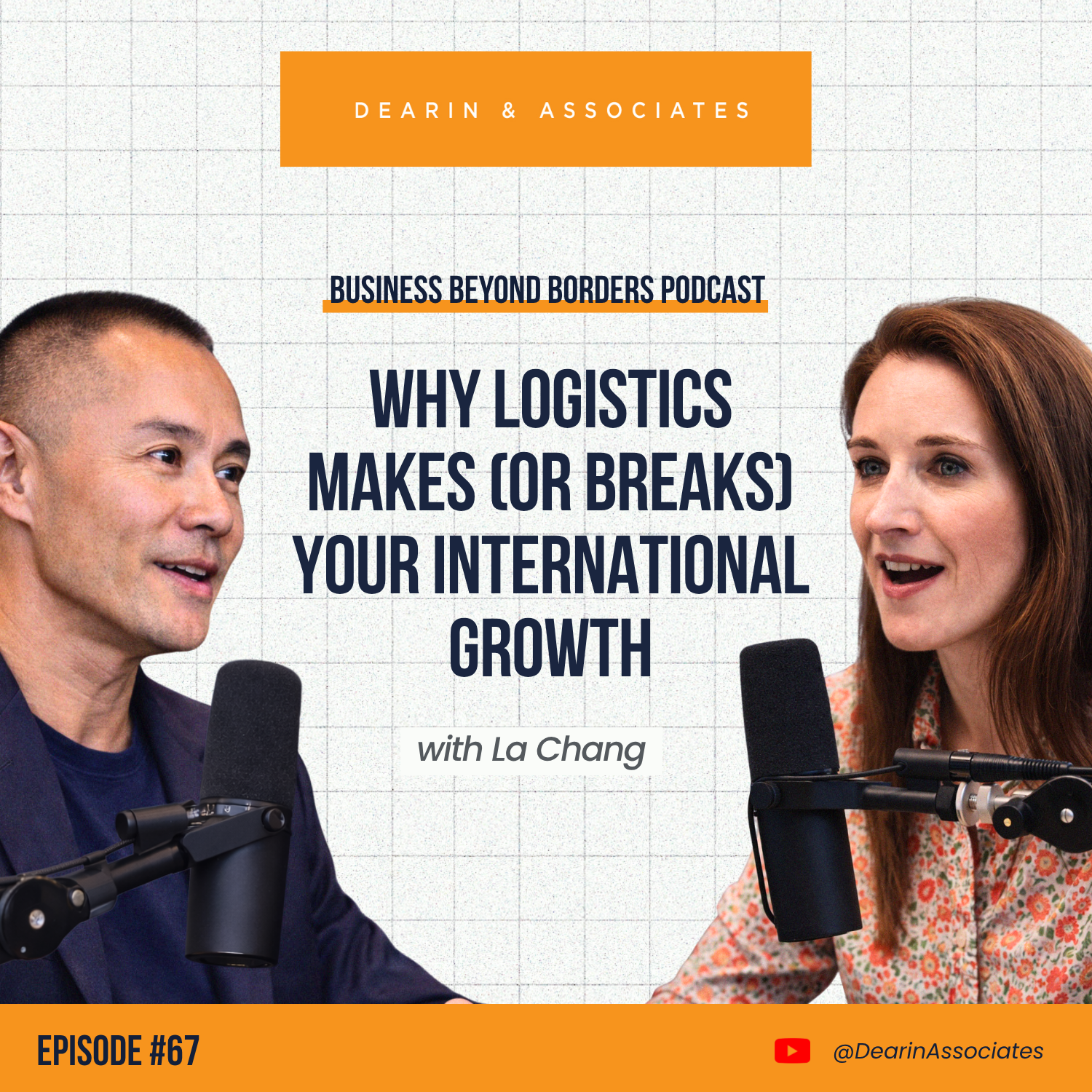
[00:00:00] Speaker A: When companies expand internationally, they often focus on markets and customers. But behind every global business is a complex logistics system that moves goods across oceans, borders, and supply chains. My guest today is Lai Chang, founder and CEO of Think Global Logistics, an international freight forwarding company headquartered in Sydney with operations across several countries in the Asia Pacific region.
Lah built the company with the intention of operating globally from day one. And over the years, he has navigated some of the most turbulent periods the logistics industry has experienced, from pandemic disruptions to shifting global trade routes. Lah, it's so good to have you with me today. What is the worst logistics disaster you've ever had to fix up for a client?
[00:00:47] Speaker B: The worst situation that I have ever seen.
I genuinely can't think of one particular example that what we went through was. Was disastrous outside of a customer's shipment that, you know, has to arrive by a certain time. And then the vessel for, you know, it's Murphy's Law, right? It's always the one that the customer don't want something to go wrong with that something goes wrong with.
And it happens all the time.
[00:01:19] Speaker A: What kind of product? I mean, so I'm just thinking of one that I dealt with. This must be about 13 years ago now. And it was a company from Australia that was trying to get.
They had beer bottling machinery and I think they were trying to ship from recollection, it's a little fuzzy because it's a long time ago, but they were trying to ship bottles of beer, bottles may be filled with water so they could test this bottling machine.
And because of the rules in China, it just didn't work. And the stupid thing just got stuck on the dock and they could not figure out, they had absolutely no clue how to get it unstuck. And the things were sitting there for, like, months and months and accruing all these fines and, you know, frustration. People just like tearing their hair out. And, you know, they ended up. I can't remember how they found us, but they ended up calling me and saying, can you help me to fix this?
And I couldn't directly help them to fix it because I'm not a logistics expert. And in the end, I ended up working with a logistics company that had extensive operations in China. And we went back and forth and back and forth and back and forth, and we got the thing on stock in the end, but it was really painful. So, I mean, I'm wondering if you can tell me a story like that, you know, like, what country was it in here?
[00:02:42] Speaker B: Yeah, well, you Just said, you know, that is purely on the onus of the original people or the original provider of logistics that moved it there in the first place.
[00:02:52] Speaker A: I think they didn't have one. I think they tried to just do the whole thing themselves. Right. With no expert help.
[00:02:58] Speaker B: They have to use someone.
[00:02:59] Speaker A: Yeah, I guess they must have.
[00:03:01] Speaker B: So unless they went to the shipping line directly for one container to move it, which again sounds very strange. I don't think so. They would have used someone.
[00:03:10] Speaker A: Yeah.
[00:03:10] Speaker B: And it's that particular party's fault for not triple checking whether this thing will get through. Yeah, right. The customer doesn't know. The customer just sells product. It's not in their purview to understand all the entry requirements. So it's that party that dropped the ball. Right. And then you have to go recover, which is a disaster.
Right.
There is actually one example as we're talking come to mind is one of our customers who has a US base that communicated they needed to transport some product in a temperature controlled container.
[00:03:46] Speaker A: So like a cold supply chain kind of thing. Like a food or a medicine or a drink or something like that.
[00:03:51] Speaker B: Exactly, exactly. So it was, it was ingredients, but it has to be kept, you know, within a certain temperature.
[00:04:00] Speaker A: Right.
[00:04:01] Speaker B: And we all know the Americans uses Imperial.
[00:04:07] Speaker A: Yeah. Fahrenheit.
Right.
[00:04:10] Speaker B: But the way they write it, it's degrees. What you know. Yeah, but it's just sort of a certain degrees.
[00:04:19] Speaker A: Yeah, yeah.
[00:04:20] Speaker B: And how we read it was degrees. So there was a breakdown in communication. And look, in hindsight we should have picked up that. Look, these are Americans.
[00:04:30] Speaker A: Yeah.
[00:04:30] Speaker B: They don't, they only communicate how they communicate.
[00:04:34] Speaker A: Yeah, yeah.
[00:04:34] Speaker B: They don't care what the rest of the world do.
[00:04:36] Speaker A: And they think 30 degrees Fahrenheit, Celsius and you're like 30 degrees. Oh, that's 30 degrees Celsius. No problem.
[00:04:43] Speaker B: And for us, because we deal with 60 countries at any given time and 99 of the time is Celsius.
[00:04:51] Speaker A: Yeah.
[00:04:51] Speaker B: You know, it doesn't take a lot for the operator here just to go 30 degrees. Okay, Celsius.
[00:04:57] Speaker A: Yeah. And you say like, hey, that's not even temperature controlled at that.
[00:05:00] Speaker B: Not blaming the customer. No, we should have picked that up. Look, we're dealing with Americans.
[00:05:04] Speaker A: Yep.
[00:05:05] Speaker B: It should be that.
So long story short, we said a degree should be Fahrenheit. It's minus.
[00:05:11] Speaker A: Yeah.
[00:05:12] Speaker B: The temperature was huge. A huge variable. The container was worth something like 300,000 USD.
[00:05:18] Speaker A: Oh no.
[00:05:19] Speaker B: And, and, and that was not usable. So we had to put that through insurance.
[00:05:24] Speaker A: Yeah.
[00:05:25] Speaker B: And you Know, and therefore, you know, the upper management of the customer came and came down, goes, oh well, you know what happened? And I was like, look, yes, we, our mistake was that we didn't verify.
[00:05:37] Speaker A: Yeah.
[00:05:38] Speaker B: But given the circumstance of the situation,
[00:05:41] Speaker A: you can see how, how it happens.
[00:05:43] Speaker B: It takes two to tangle.
[00:05:44] Speaker A: Yeah. And like most of the world uses Celsius. Right?
[00:05:47] Speaker B: Well, yeah, but also the way they was communicated. Right. It was just a short sentence, X amount of degrees.
[00:05:54] Speaker A: Yep.
[00:05:55] Speaker B: And it was like, well, you see that it can. This could have gone both ways very easily. Right. And the, and the management sort of understood. They like. Yeah, okay. So they didn't give us a hard time. We claimed through the insurance.
[00:06:07] Speaker A: Yeah.
[00:06:07] Speaker B: And you know, because it was quite dramatic. 300,000 USD worth of goods in there.
[00:06:13] Speaker A: Yeah. That must have been so stressful.
[00:06:16] Speaker B: Not really because that's the world of logistics.
[00:06:19] Speaker A: Yeah.
[00:06:20] Speaker B: Right. You've got to work through it.
[00:06:21] Speaker A: You got to have a certain temperament for it though.
[00:06:24] Speaker B: Yes. Well, and this is why I think we get a lot of, we have a lot of attrition in the industry where people simply gets fed up in dealing with problems because that's generally what a logistician main core job is.
People think, oh, you move stuff. No, no, we don't move stuff.
[00:06:46] Speaker A: You solve problems.
[00:06:47] Speaker B: We solve problems, receive problems and then communicate problems and then cop. Whatever that comes from that communication.
That is the real job.
[00:06:57] Speaker A: Yeah, right.
[00:06:59] Speaker B: You know, people, I often simplify what we do. When I talk to a lot of people on the street, Even today in 2026, when I explain to them, people ask me what I do, I say shipping. They go, oh, you know, they straight away go to oh, do you import drugs or something?
How do you go from that to that? And that just tells you the simplicity of the understanding by the wider public.
But more importantly, I always tell people when they really don't get it, I just, look, just think of us as travel agent.
Right. Instead of for people, for goods.
[00:07:31] Speaker A: That's. I like it. Travel agents for goods.
[00:07:33] Speaker B: But that's also a double edged sword because it oversimplifies the importance of what we do. Travel, aging books a ticket for you. It's like a concierge.
[00:07:41] Speaker A: Yeah.
[00:07:42] Speaker B: Then you have your own mouth and brain to navigate cargo. Doesn't we have to deal with other people that looks, that takes care of this piece of freight that is not sentient. Right. Yet.
And, and we have to make sure it stays on track.
[00:07:57] Speaker A: Yeah.
[00:07:58] Speaker B: And something always goes wrong. Yeah, well, rather not something goes wrong, but life happens, delays will happen. You know, because mostly are human driven. Human will make mistakes.
[00:08:08] Speaker A: Yeah.
[00:08:09] Speaker B: And it's up to us as the freight forwarder to be in the control tower and try to mitigate those risks.
[00:08:16] Speaker A: What's the riskiest thing you've ever transported? I'm thinking like you know, a million dollar power painting or I don't know,
[00:08:23] Speaker B: a human organ or high value stuff is, is high. High value. Are high value. Something goes wrong, it's not nice. But you are protected. You are, you, you know, you are, put it through your insurance and so forth. But if you, as long as you place enough of the standards that goes around high value like protection, thorough oversight and stuff like that, you are generally protected against that. Unless there is gross mismanagement. Right. Then yes, you're, you're up for a lot of pain. But usually when you're handling high value, you got enough sops around it that as long as you cross the T's dot the I, even if something goes wrong, you are generally protected.
[00:09:08] Speaker A: Yeah.
[00:09:09] Speaker B: I say the most riskiest stuff is probably when you're handling dealing with government contracts or defense stuff.
[00:09:15] Speaker A: Yeah, I can imagine that, that, you
[00:09:18] Speaker B: know, that obviously has its own regimented type of processes around it.
[00:09:23] Speaker A: An extra layers of security I'm imagining.
[00:09:25] Speaker B: But even then, right. As long as you follow the letter of the guidelines and the regs and, and the contract, whatever, you are still insulated to a great degree.
[00:09:37] Speaker A: Have you ever moved a tank or a Bushmaster?
[00:09:40] Speaker B: Not, I'm not a tank, but we've definitely moved in our time a lot of the defense equipment that may have gone into these things.
[00:09:48] Speaker A: Okay.
[00:09:48] Speaker B: Or other things.
[00:09:49] Speaker A: Yeah.
[00:09:51] Speaker B: Moved a lot of fun and weird things, I mean in my career.
But I'm sure that we, we moved a lot of those sort of stuff during the time I've been in, I mean in the industry and it's been
[00:10:00] Speaker A: a while, hasn't it? It's been since the late 90s that you've been in logistics.
[00:10:04] Speaker B: Yes, almost 30. Almost 30 years. Two years shy of 30 years.
[00:10:08] Speaker A: So how.
[00:10:08] Speaker B: No, sorry, one year shy of 30 years. Yes.
[00:10:10] Speaker A: How, what pulled you into that? Like how?
[00:10:13] Speaker B: I, I, I, I answered a very little add ons to the Sydney Morning Herald in the back pages of of job, you know, job section.
[00:10:21] Speaker A: Do you have a red pen? I used to do that with a red pen. You know, you'd go through and say what could I do?
[00:10:25] Speaker B: And don't think I could have afforded red pen. I think it was just a pencil.
It was just an ad that was promising international travel Right. Like those days to explain what international logistics is to a job hunter of my age. At 21, nobody knew what it was. People still don't know what it was. But back then, even more so. So what they did is they had to say, are you interested in international business? Yes. Are you. Are you interested in international travel? Yes. Call this number. And that was it.
[00:10:57] Speaker A: So what did they say when you called?
[00:10:59] Speaker B: Basically, you know, I'm interested. And they asked you what you did. It was a trainee position for sales.
And back then, employers didn't need to explain a lot to you. You see, I. I joined the workforce in a very different environment to what it is now, where employers don't need to justify themselves to you. You were lucky to get a job.
[00:11:21] Speaker A: Okay, I agree with that.
[00:11:22] Speaker B: Today is different environment now, and I must say, it's not for the better either.
[00:11:26] Speaker A: Yeah.
[00:11:26] Speaker B: Because it teaches. See, back then, because you. I. I didn't know anything. I was here to learn. Therefore, I didn't deserve any rights, quote, unquote, that the young seeks today because I'm there to pay my dues.
[00:11:41] Speaker A: Yeah.
[00:11:42] Speaker B: If I need to cop a few lashes on my back, that's what you needed to do. Right. And that's wholesome for me.
[00:11:48] Speaker A: Yeah.
[00:11:49] Speaker B: It didn't lead you up the garden path in delusions of grandeur. Right. You knew that you were nothing. You have to go pay your dues,
[00:11:57] Speaker A: Start from the bottom of the ladder.
[00:11:59] Speaker B: You got to learn. Right. You got to learn. And for me, that's actually healthy.
[00:12:03] Speaker A: Yeah.
[00:12:04] Speaker B: It teaches you how to be humble and respect authority and respect knowledge.
[00:12:08] Speaker A: Yeah.
[00:12:09] Speaker B: As opposed to. Because you have a brain doesn't automatically give you the right to think. You're right. Right. So.
Yeah, so it was one of those. That's how I joined. And eventually, to be honest, after maybe.
Well, I mean, look, shortcut, maybe. Ten years later.
[00:12:28] Speaker A: Yeah.
[00:12:29] Speaker B: I still really didn't understand 100% of what it. What it was that. How we did it.
[00:12:34] Speaker A: Yeah.
[00:12:35] Speaker B: I knew what we do, but I didn't really understand how we did it 10 years later.
[00:12:41] Speaker A: Was that when you started TGL or was it even later?
[00:12:44] Speaker B: TGL started another probably would have been six years.
Yeah. Six, seven years later.
[00:12:55] Speaker A: And was that just because you got frustrated with how the industry was working? I mean, what was the thing that made you go, oh, I'm gonna. I mean, you'd been employed, right. And you'd obviously gone along with that. Had gone pretty well. How. What was the thing that made you jump out and start your own show?
[00:13:08] Speaker B: So I was a reluctant business owner because again, coming from how I.
My upbringing, you know, I was kept in a very humble path in saying that you gotta be loyal.
As long as someone treats you well, you know, you continue on the path.
And through my career, I maneuvered myself into positions where I always had something to learn.
And the last posting I had was for a Fortune 500 company.
And I pitched to them the idea of Australia. Even though they were Fortune 500, they were, you know, $11 billion net worth at the time.
They didn't have any plans to planting their flag in Australia.
So I reached out to the regional head at the time who was sitting in Hong Kong, and I said, look, how about. Have you guys thought about Australia? He goes, no, no, no, I haven't thought about anything about Australia. He goes, I just got the posting to Hong Kong six months ago. I. I don't even understand what Asia is for me yet, so I'm not going to go try to, you know, take up a whole continent.
And I said, okay.
And I said, let's keep the conversation flowing and see what we can do, how we can collaborate. I've got, you know, I've got a lot of good ideas. And he was commercial enough and dynamic enough for him to sort of, you know, keep that conversation alive.
[00:14:32] Speaker A: And were you here at the time?
[00:14:33] Speaker B: Yes, I. I was in Australia.
And then after a period of consulting for them in Australia, I kept on pushing the cause. And then eventually, you know, he pretty much said, look, you write out the business plan, the budget, the whole, the whole box and dice, and then we will consider it. So I wrote out the plan as he put his, per his request, and then after maybe three weeks of submitting it, it was approved.
[00:15:00] Speaker A: Oh, wow.
[00:15:00] Speaker B: In hindsight, I think I asked. The money was just chump change, right? Because I was not experienced, never done anything like this before.
So it was chump change for him. They would look at the, I mean, saw the budget, they would have gone, this is our stationary budget in one of our branches. You know, like he. And this guy wants to start a whole continent for us. Let him have a go. We've got nothing to lose, right? It was literally chump change.
So that, you know, so when I started that and I really sort of was like, you know, did everything myself, I literally treated. I was my own, because I never done this before. I'd never had a mentor in the industry on that regard, right. So I really had to learn everything on the fly. And, you know, there were some long nights and because it was Such a huge responsibility. And I was like, wow. They gave it to me, what I do now.
So I did everything. I. I remember my first office was probably 25 square meters.
It was amazing. So it was a mizzening level within a warehouse at the back of Banks Meadow in here in Sydney.
[00:16:11] Speaker A: Oh, wow.
[00:16:12] Speaker B: It had no windows.
[00:16:13] Speaker A: Okay.
[00:16:14] Speaker B: It had an aircon, thank God. And a door. Right.
[00:16:17] Speaker A: Phone.
[00:16:18] Speaker B: 25 square meters. Well, had to get that connected and stuff.
[00:16:22] Speaker A: Desk and a chair.
[00:16:24] Speaker B: Yeah.
[00:16:24] Speaker A: And that's it.
[00:16:26] Speaker B: You know what? For the first month, I was working out of my car because I didn't want to spend money to get an office that was know, like it was just ridiculous. People, you know, they would have laughed their heads off if they thought, what are you doing?
You are like now the managing director for a Fortune 500 company in Australia. And here you are working out of your Camry at the back of a warehouse, who you just after one month getting a 25 square meter worth of office without windows like it. To think Brad was quite funny.
[00:16:57] Speaker A: It is funny, but like, you didn't know, right? You'd never done it.
[00:17:00] Speaker B: Had no mentor around, right? Nothing, Nobody.
So, you know, and I remember the first set of furniture we got. I was going online and buying furniture from companies that went bankrupt, right. So I got it for cheap and I hide my own rental truck and my best mate, which I pulled out, you know, and said, let's, let's go. Help me move the furniture. And we were doing this for Fortune 500 company, you know, hey, it teaches you a lot of things.
[00:17:25] Speaker A: Yeah.
[00:17:28] Speaker B: So we did that. And then my boss at the time was. He was quite dynamic, the guy who gave me the green light.
And he was very commercially astute and he was looked like, he goes, look, this is your game now.
You take care of it. I don't want to hear any problems and I don't want you to lose money. That's the only two criteria.
So I was giving a lot of free rein and that's when I really deployed a lot of the ideas to see whether it will work.
Right? And it was such a great experience because it was such unique position to be had. I was here dealing with a network of offices and companies that was part of this huge juggernaut of a business in logistics. But at the same time I was able to do whatever I wanted.
Right. However I wanted to develop the process, no one actually came and tell me what to do.
[00:18:29] Speaker A: That's pretty good. You had to do an experiment on somebody else's money. Even if it's not that much money.
[00:18:33] Speaker B: True. But at the same time, nobody else would have taken on the show because they're like, what the hell, what is this? Because nobody. You see, sometimes the bravery that comes from naivety is a powerful thing.
[00:18:47] Speaker A: Yeah. You wish you could get it back afterwards when you know everything and you're like, ah, this is really scary now.
[00:18:53] Speaker B: Well, exactly. Back then it wasn't. Because back then you didn't have time to be scared.
[00:18:58] Speaker A: Yeah.
[00:18:58] Speaker B: It was just like going about doing your thing.
And I think a lot of the grounding of like, you know, how when we're young, you go out there expecting to cop a few lashes.
[00:19:10] Speaker A: Yeah.
[00:19:11] Speaker B: Be humble, work your bum off. You know, be lucky you have a job type of mentality that would have powered, you know, myself in that position through that situation. Whereas I didn't have those lateral thinking goes, oh my God, I don't have the time to be scared, to be honest. Right. It wasn't even something in my mind.
[00:19:28] Speaker A: Let's keep pedaling.
[00:19:30] Speaker B: It was all about making sure you don't let your boss down.
[00:19:33] Speaker A: So how did you get from there to then? Tgl Hap. Like, how did you get well again?
[00:19:38] Speaker B: So because of that experience, I built the whole business with my own bare hands. Right.
[00:19:42] Speaker A: Yeah.
[00:19:43] Speaker B: So therefore I was very loyal to the company and to what I built.
And we were making some great progress. We're making good money acquiring good customers.
And.
And by all accounts, I was very satisfied with what was being achieved and where we were going. So I was happy to stay there, to be very frank with you, for the rest of my life.
[00:20:05] Speaker A: All right, all right.
[00:20:06] Speaker B: Working life.
But then, because, because, you know, with multinationals of this size and what have you, they have to maneuver and pivot for their own commercial interest because they're a public company.
[00:20:19] Speaker A: Yeah.
[00:20:20] Speaker B: So to keep the shareholders happy, they have to acquire other companies to be of a certain size or to be perceived as something.
And this is where the disconnect between your day to day job, what is actually being done to what the shareholders in the stock market see you as becomes detached.
So, and I understood, I respected, I knew what they had to do. They had to make sure to come across as they're acquiring all these of this size. Right.
They have to do it. It's just the nature of the beast. But at the same time, because what they had to do, they acquired another company which then had a local entity that was worth more on the revenue side.
Right.
And therefore the condition was like, well, we can't have this piece, if this piece is standing away.
So that was given us basically saying, well, unfortunately we have to wind the office down. This company will have to absorb the people.
And then I was given, the only person I would add, given the option of saying, well, you can come to our Chicago head office or you don't really have a job.
[00:21:31] Speaker A: Did you feel betrayed?
[00:21:33] Speaker B: Absolutely, but.
Absolutely I feel betrayed. But at the same time, more importantly, I feel bad for the people.
[00:21:40] Speaker A: Yeah.
[00:21:40] Speaker B: Because I hand selected all of these people that followed me.
[00:21:44] Speaker A: Yeah.
[00:21:44] Speaker B: That's creating great results.
All of them, by all account, individually were doing great things.
[00:21:51] Speaker A: Yeah.
[00:21:52] Speaker B: Like you. They would, they did nothing wrong. And then overnight I have to go and tell them and say, sorry, guys, either you joined this company that you didn't apply for or you don't have a job.
[00:22:05] Speaker A: That must have been really hard.
[00:22:07] Speaker B: It was, it was. And we had a wild final day, the office party where we had a lot of pizza, maybe a few beers. And then we, and we did a. This sort of like dance. You know, at the time they had this mob dances and, and I recall we shot it quick 30 second video mob dancing with pizza boxes and stuff like that. And then maybe somebody clicked sand to the entire email group email of the entire global offices.
And I think to this day that was a very infamous video.
So we went out with a bane. Yeah, yeah, yeah.
[00:22:47] Speaker A: And then what you just.
[00:22:48] Speaker B: So I had no choice. I, like, I wasn't prepared to move to a new city that I knew no one.
[00:22:54] Speaker A: Yeah.
[00:22:54] Speaker B: I didn't have any base. You know, all my contacts and connections were here, all my customers were here. What am I going to go over there for? That essentially would have alienated me from everything I've been building.
So I was pushed. So I was like, okay, well fine, you know, the, the second week or the third week I was out of the business. I started my own company.
[00:23:17] Speaker A: This episode is brought to you by ofx. One of the things we see all the time with companies expanding internationally is that the strategy might be sound, the market choice might be right, but the financial plumbing is just not keeping up.
Managing global finances can quickly turn into juggling currencies, unpredictable cash flow, and far too much admin.
OFX helps take that friction out. They're trusted by more than 37,000 businesses worldwide, and they make it easier to pay international suppliers and teams and local currencies, while saving on FX fees and simplifying the admin through through one platform. If your business is operating across borders, OFX gives you clearer visibility and more Control over your cash flow. You can find out
[email protected] and we'll put a link in the description. That is crazy. Wow. That is such. That is a wild story. I mean, did you think from the start that Think Global Logistics would be an international operation? I mean, logistics is, I mean, it can be international in its focus, but did you think at the start that it would be just mainly Australia, or did you already saying, oh, it's going to be global from day one?
[00:24:29] Speaker B: I started TGL with the idea that it has to be global.
[00:24:32] Speaker A: Okay.
[00:24:33] Speaker B: That's why it's called Think Global Logistics.
[00:24:34] Speaker A: Yeah, yeah, yeah.
[00:24:35] Speaker B: Not Think Logistics Australia.
[00:24:37] Speaker A: No, totally.
[00:24:38] Speaker B: No.
[00:24:39] Speaker A: I have your crate at my house. You know, you have the little crate, the pink crate with TGL sits up.
[00:24:44] Speaker B: I should have brought it in and
[00:24:45] Speaker A: stuck it here on the desk.
[00:24:47] Speaker B: It has to be international because it is a game.
It's the only game I know how to play.
[00:24:55] Speaker A: Yeah.
[00:24:55] Speaker B: And, and I was fortunate enough to be with companies through nearly 30 years in different sizes and shapes.
[00:25:05] Speaker A: Yeah.
[00:25:05] Speaker B: Ownership structures for me to see how all of these operated, what makes one tick and while the other didn't and so forth. And I quickly realized that, you know, when you're sitting in the position and it's a privileged position to know your industry that intimately and to know how all the players behaved and what they actually and what the actual customers wanted, it's very easy to spot the opportunities.
[00:25:31] Speaker A: Yeah.
[00:25:31] Speaker B: Right. And that opportunity is plenty to be had.
And probably the most prominent one is that there is not enough passionate people in our industry.
So therefore I rather shine in a sea of people where that lacks passion.
[00:25:48] Speaker A: Yeah. You want to be the best.
[00:25:49] Speaker B: I, I, I shine very brightly.
[00:25:52] Speaker A: Yeah.
[00:25:52] Speaker B: Whereas if I join a different industry where there's brilliant minds everywhere, it is very hard to shine.
[00:25:57] Speaker A: Yeah.
[00:25:57] Speaker B: Right. So this is why this is great. And I say this out loudly to any viewer who wants to join the industry or maybe have kids that don't know what they want to do. Join logistics, but make sure they join the right companies.
[00:26:13] Speaker A: Yeah.
[00:26:13] Speaker B: Because there are a lot of, in fact, if not majority of companies out there are so siloed in their operations, including the training of new people, that any new talent that they take, they ruin it by.
By not giving these people enough.
[00:26:33] Speaker A: Yeah.
[00:26:34] Speaker B: Whereas if they join the right company, we're able to give these minds, or young minds, the latter, the latitude to think for themselves and apply this. They can make this whole game that's called logistics, so so much more interesting and so much more powerful.
[00:26:51] Speaker A: Yeah.
[00:26:51] Speaker B: We don't need systems to move to advance and this is what people have to understand. A lot of our competitors, pushy systems is because they know they can't scale with people because they don't have enough structure in education or enough structure in leadership to manage it, because they know most of their workforce are unwilling and unmotivated. So that's why they push the digital thing, because they know they can't scale with people.
And I will argue counter is that if you can't have an environment where you can inspire people to do, to be at their best, no amount of system is going to fix it.
[00:27:30] Speaker A: I totally agree with that.
[00:27:32] Speaker B: Right. So that's the brilliant thing, is people who look and thinking about, understand that there are a lot of mediocre competition and if you just join the right company that give you the right education and right latitude to be brilliant, there's so much room, there's so much opportunities.
[00:27:52] Speaker A: So I'm really curious that now TGL operates in across Australia, New Zealand, China, Vietnam and beyond. What do you think was the hardest part of building the company out across those regions? Because they're hardly, you know, homogeneous, they're quite, they're quite different. Just tell me about some of the challenges that you came across when you're trying to, you know, get that network stood up.
[00:28:19] Speaker B: The challenge, of course, the first obvious one, is making sure when you go into a country that you actually have a just cause for going into that country, rather than just going to a country and spend a lot of money and then having no real income to support it.
And I know that's easier said than being said than done. Sometimes it's chicken or the egg, right?
[00:28:42] Speaker A: Yeah.
[00:28:42] Speaker B: It's like if you build it, they will come. You have to make those calls, but try to have that balanced.
So if you're going into the country, really ask yourself why? What is the reason you want to be in this country?
[00:28:56] Speaker A: So I can see why you'd go to the China market because it's huge and I'm assuming you speak Mandarin, right?
[00:29:02] Speaker B: Yes, I do. China market is probably the most reluctant market I want to go into.
And we are only there purely from a service standpoint, not from a client acquisition or trying to be the next dominant Chinese player.
[00:29:18] Speaker A: Do you find it hard, a hard market to operate?
[00:29:20] Speaker B: Absolutely. Because there's too many there.
[00:29:22] Speaker A: Yeah.
[00:29:22] Speaker B: And they've got the workforce to justify it. They've got companies on that's rising at the backs of, of the local manufacturing industry who have now all become, They've gone from the backwater, you know, factories churning out whatever they're churning out to now.
Global standard, quality, standard of manufacturings, a power base that no other country can replace.
[00:29:46] Speaker A: Yeah.
[00:29:46] Speaker B: And then you've got this logistics engine that's basically alongside of them, that's prospered with them.
So I would argue no foreign company today can compete with a Chinese well run Chinese forwarding company either by sure of talent, string, revenue, cash flow and its base that they can draw revenue from. No company outside of China can compete with them. And that's in fact probably the biggest threat to companies like us who are non Chinese and hasn't been on the ground since DOT one. Right. Back in the day. We always think competition is a very lateral thing. Okay, well because I am called ABC and he's called xyz, therefore XYZ is my competition. I will argue now the competition. We need to think more multidimensionally in saying that instead of thinking another company is your competition, you got to start thinking a group of companies in a, in a geopolitical, geodynamic relevance. So I would argue a lot of my Chinese forwarders now are my biggest threat as opposed to a non Chinese forwarder.
[00:30:57] Speaker A: Yeah.
[00:30:57] Speaker B: Because we are facing the same threats coming from that region because they've just got so much of everything that we need.
[00:31:05] Speaker A: And we started, we were talking just before we started to record about the fact that you're moving up to Malaysia in a few months time to stand up the business there. Tell me, how did you, how did you arrive at that decision?
[00:31:18] Speaker B: Well, Malaysia again. So all of our international expansions are not there to be, I guess not there to be go and develop that market. Right. Because let's face it, most of these markets that we are going into are already quite well established with local representation.
We go to these markets purely because it's on the backs of how do we deliver a better service structure for, for our existing customers.
[00:31:48] Speaker A: Yeah.
[00:31:48] Speaker B: And on the backs of that at least we know then we have a real wholesome purpose of being there without needing to take any risks or gamble.
But as we build that out and our customers enjoying us being there from a service standpoint versus us using an agent and they see this service improvement, we might get a lot more from these existing customers. And then again from developing that additional revenue streams from new business from existing customers, we then able to afford more front office like sales teams and so forth to then go and get local providers. Because that becomes a bit more interesting story, doesn't it? Now you can tell the customer saying. Instead of saying, well, we're here now, we're just going to be like the next guy that you've already been using.
[00:32:36] Speaker A: Yeah.
[00:32:37] Speaker B: Versus, well, we're here now. Look at our story. We came from here. We're here to service these customers. We have shown success stories in how we do it for these customers. And look at our backstory. It's far more interesting than saying, my name is xyz, I'm a newcomer to the market. Can we have your business?
So.
So again, it comes from the purpose of why you're there, because it just gives you a bit more fabric to your story. That's for more people to grab onto.
[00:33:08] Speaker A: Yeah.
[00:33:08] Speaker B: And to go. That sounds interesting and makes a lot of logical sense. And you're actually telling me real life experiences of how, why and what, you know, you answer those questions as opposed to what we now just another competitor in your market.
Can we have your business?
[00:33:24] Speaker A: Yeah. I mean, I think the story is so, always so important when you want to connect with if you don't have
[00:33:28] Speaker B: it, because the conversation will always go to the lowest denominator and that's price.
[00:33:32] Speaker A: Yeah. You have to have something and you cannot go there.
[00:33:35] Speaker B: You cannot go there. Right. Because you are a service industry.
[00:33:38] Speaker A: Yeah.
I think it'd be fair to say, I mean, we were talking at the start about how. How people see logistics as simple when in reality is actually extremely complex. I think it'd also be fair to say that the logistics industry seems to live in this constant state of disruption. Right. You know, pandemics, port strikes, tower of geopolitical tensions. If you had to pick out one, what do you think would be the most stressful moment you've had running tgl?
[00:34:09] Speaker B: Most stressful? Well, I think Covid. I think the first months of COVID was.
Was stressful because we simply didn't know what was going to happen and the like.
It was. And it wasn't, I suppose, because, you know, it was because we literally didn't know what was happening because we weren't assured by the parties that we had relied on to give us assurance.
[00:34:41] Speaker A: Yep. So you're waiting for other people and
[00:34:43] Speaker B: when that system collapsed, you're like, what now?
[00:34:46] Speaker A: Right.
[00:34:47] Speaker B: But it also was the very thing that made us uncertain, also gave us some respite because it was like, well, everyone's on the same boat.
[00:35:00] Speaker A: Yeah. You have to.
[00:35:00] Speaker B: You know what I mean? So it's like. So it was Ying and yang. So that was probably the most uncertain that we as a business went through yeah. But that was quickly remedied because we had the biggest boom in logistics within the six months of the pandemic happening, Right.
[00:35:23] Speaker A: Yeah. Because everybody had to stay home. So they started ordering more and more household stuff.
[00:35:26] Speaker B: Yeah. And. And it was a good time for all to be had.
[00:35:29] Speaker A: Yeah.
[00:35:29] Speaker B: For all that was in logistics, especially the shipping lines.
[00:35:32] Speaker A: So, I mean, if you look at what's happening now, we're seeing another massive global supply chain disruption with the strait hormone hormones closing.
When something like that happens, what does the next 24 hours actually look like inside a logistics company?
[00:35:48] Speaker B: Well, for us, this. You know, I. I'm not saying this in any flipping way. When things like this happen, a true logistics company actually really rise up and shine. Because to be a true logistics provider, you don't just do well when times are good.
[00:36:10] Speaker A: Yeah.
[00:36:10] Speaker B: When times are good, you really are a travel agent. You're just booking things and things runs. There's no disruptions, there's no chaos. It's very easy to do these type of jobs. But when things like this happens, because I always say it doesn't matter what happens in any location, any war, any famine, there's always things that needs to flow.
[00:36:29] Speaker A: Yeah.
[00:36:29] Speaker B: And behind that product flowing to that location, there's a logistics person behind.
[00:36:33] Speaker A: So what are you guys doing? Like, are you working all night? Are you making crisis calls? Are you having a war room? Like, what. What does it look like if I walk down to your office?
[00:36:41] Speaker B: Well, obviously, first thing you need to understand, you need to know what is, what is moving, what isn't moving.
[00:36:46] Speaker A: Yeah.
[00:36:46] Speaker B: And then you figure out different ways around it.
[00:36:48] Speaker A: Yeah.
[00:36:48] Speaker B: Of course, we're not this end or be all how things move. We rely on our partners to, To, To. To educate us on how things are being moved or what. What is reality for them.
[00:36:57] Speaker A: Yeah.
[00:36:57] Speaker B: And then we take the best out of those realities and then decide the best scenario for our customers.
[00:37:03] Speaker A: And how do you. I mean, how do you. When things are breaking down, you know, when the global supply chain is breaking down, suddenly you have to, I don't know, transship or change mode of transport. And the customers are panicking about delays, because I know that they do. How do you keep the customers and the team calm and focused? What do you say to them?
[00:37:22] Speaker B: Well, the first thing is what we say to ourselves.
[00:37:25] Speaker A: Yeah.
[00:37:26] Speaker B: We got to first determine what we can control and what we can't control. And we have to communicate that clearly to our customers.
[00:37:34] Speaker A: Yeah.
[00:37:34] Speaker B: So that they are left in no illusion of what is or the other.
It's Often when customers, when you let one thing slip and you do not communicate clearly, that's when customers expectations gets mismanaged. And when they that gets mismanaged, world of pain is coming. Because then they're just going to wrap everything in one board and it's all your fault.
[00:37:57] Speaker A: It's all your fault.
[00:37:58] Speaker B: So at the first sign of trouble, you must let the customer know, hey, this is happening, this is what we can control this we can't, we just got to, we want to make sure you understand that.
Now given those now we clear we're not going to tell you our course of action, what we will do in the face of this.
So again it comes down to communication.
You have to communicate extraordinarily clear to customers so that they're lifting no illusion of, you know, what is your, what is in your control, what is it. You don't want them to mix those two things up because before long when things really gets in a crunch and a lot of customers will go through a world of pain, I will argue what's happening now and they'll continue to go through a world of pain for years to come. Not weeks, not months, for years to come.
Is that when they're in pain, they're going to look for someone to blame.
And if you don't communicate that well from dot one, by the time you get to day ten, you are the only person they are that they are blaming. And you don't want to be in that position. Right. So communication, your people have to be taught, understand how to communicate clearly to the customers.
[00:39:07] Speaker A: If you zoom out, and this is my last question for you. What do you think is the truth about going global? That founders only discover the hard way,
[00:39:19] Speaker B: only discovery.
Again, if you, you will discover hard truths only because you've gone there unprepared. If you're going there, I mean prepared, sure, you might go to a place all of a sudden becomes a war zone, but you can't control that.
[00:39:35] Speaker A: Yeah.
[00:39:36] Speaker B: So you're not to blame.
So from that regard, you need to keep some distance. Understand things will go wrong, understand things will not happen because you imagine how it happens and remain nimble and flexible in your mentality.
And if you're that if so, if you're well prepared to enter a market and you're nimble and you're flexible and you're prepared, you've allowed yourself a bit of mental space to handle the variables. You know, I can't see you go wrong.
The only time you go wrong is you're not prepared. You don't know why you're there. Like we can argue, like, we can say, you know, ask America. Why are you at war in the Strait of Hormuz? They can't tell you.
[00:40:20] Speaker A: Yeah.
[00:40:21] Speaker B: So you don't want to expand like America has.
[00:40:24] Speaker A: I love it. That is a great note to end on.
I've so enjoyed having you on the show. Thanks for coming along today for a chat. It's been heaps of fun.
[00:40:32] Speaker B: Yeah, thank you. Thank you for having me.