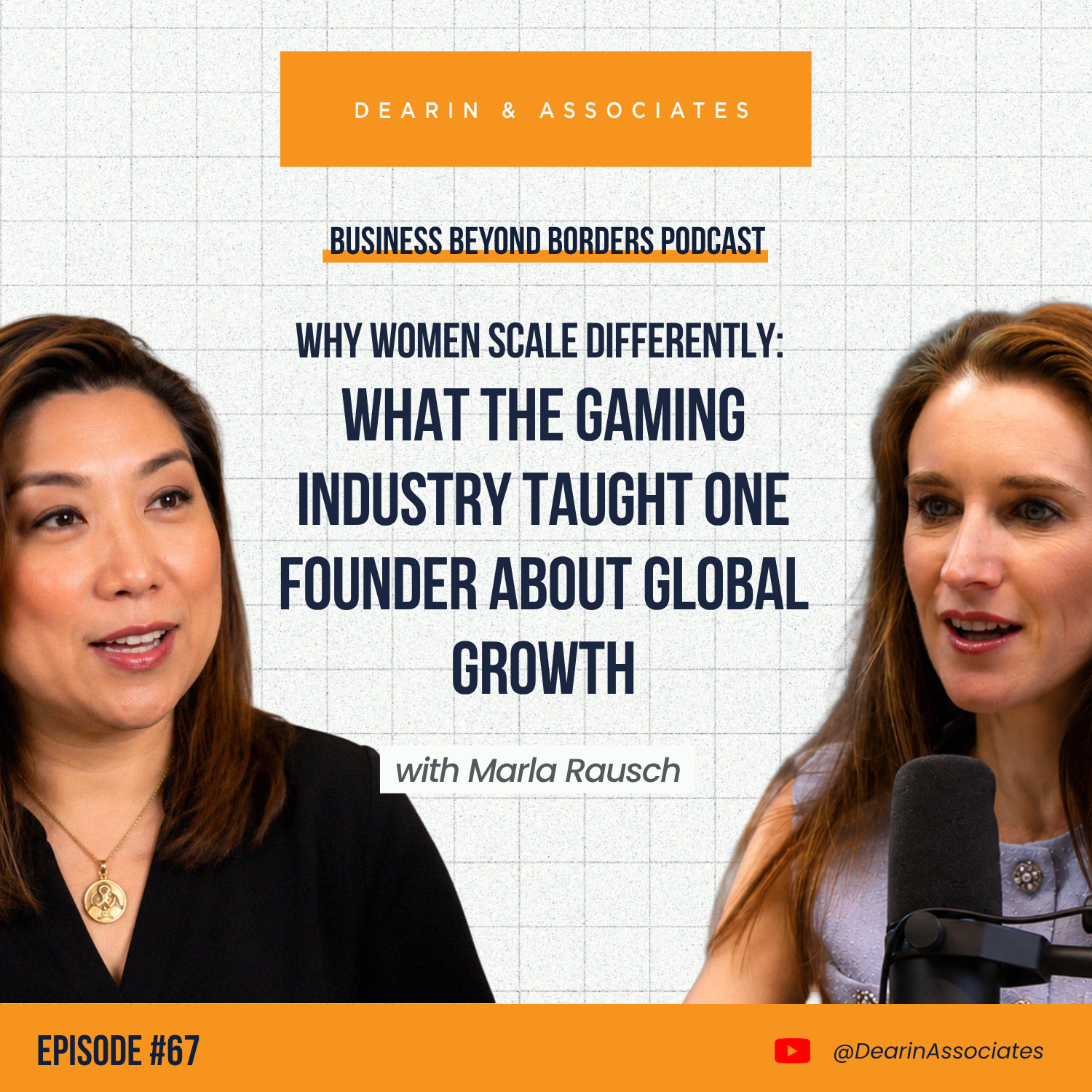
[00:00:00] Speaker A: The global animation and gaming industries are truly international.
Projects may be designed in one country, animated in another, and released to audiences around the world. My guest today is Marla Rauch, founder and CEO of Animation Vertigo, a motion capture animation company that works with major studios in film and gaming. Marla built a production pipeline connecting teams in the US and the Philippines, helping bring some of the world's most recognizable titles to life.
I met Marla through the APEC Women's Business Activator program, which I design and facilitate to help women founders expand internationally. During the program, I was struck by the scale of Marla's journey. And this is a truly remarkable conversation. Marla, great to have you on the show.
[00:00:43] Speaker B: Well, thank you, Sophia.
[00:00:44] Speaker C: I wanted to ask you.
I was thinking about what I wanted to chat to you about today. And one thing that was really
[00:00:53] Speaker B: sort
[00:00:53] Speaker C: of intriguing for me was, you know, many companies start with smaller clients and then they gradually build their reputation and work up to the big thing later on. But Animation Vertigo kind of went there straight out of the gate. And you started working with massive companies like Sony and Activision very, very early on.
What was it like building a company under that kind of pressure?
[00:01:19] Speaker B: It was insane because because of my limitations that I couldn't market, I couldn't do PR actively, which meant that everything had to be word of mouth and being and doing it word of mouth meant that you couldn't really truly make a mistake. Your reputation and the trust that you built from one company to another needs to be stellar for them to even talk about you to anybody else.
Activision was the third company. The first one was Sony. The second one was House Moves. The next one was Activision.
Activision.
I was proud to say that I met him. I met the person that I was going to meet with at E3 Electronic Entertainment Expo in Los Angeles.
And I remember when, you know, if our appointment was at that afternoon or something, I bumped into him just before our meeting and he said, I have met four or five people and I've overheard a couple of conversations and randomly they've been talking about animation, Vertigo, and oh, wow. Yeah. And these people were people I knew and I trusted.
So I think we're good. I think let's do the test and let's go from there.
[00:02:39] Speaker C: And what did you say to that?
[00:02:41] Speaker B: I said, who are they? Because how much do I owe them?
[00:02:47] Speaker C: Ah, that is wild.
[00:02:49] Speaker B: Yeah. Which broke the ice for us. And we get along well. I don't know that I'd ever be able to do that in a more serious Industry, but in game, in gaming you could.
In gaming I could in film and I wouldn't be able to.
[00:03:04] Speaker A: How did you get into it?
[00:03:06] Speaker C: I mean, what first pulled you into animation and motion capture? It's kind of wild.
[00:03:12] Speaker B: You're going to laugh.
I was pregnant and my husband was. My then husband was working for a motion capture company and I was waiting for him to get done.
And as I was waiting, he was, shall we say, taking a sweet time.
And again, I was pregnant and so I was wanting to leave. I was getting hungry.
[00:03:39] Speaker C: What was he doing? Something at work.
[00:03:41] Speaker B: He was doing motion capture, tracking and animation. So I was like, look. I looked over and it looked like a puzzle.
So I got curious about it and so I said, show me what that's like. And so I learned how to do it.
He then was hired by Sony and when he was hired at Sony, I. He would call me from my job, which was a stockbroker, and say, when the market closes, do you think you can come and help us? Because we're crunch time and we need more people.
And so I would, after the market closed, I would go to Sony and I work on motion capture. And then when my daughter was born, I was on leave.
I remember this. I was in his office at Sony because I was bored to tears and breastfeeding my daughter, leaning back and doing motion capture animation work. So it was kind of funny because that's how it started. And then it just became one of those things where, you know, since you keep hiring and firing people because the project ends, what if there was a company that exists that you didn't need to train up, that knew exactly your pipelines and then when you were all done, they won't disappear, but you don't need to pay for them anymore. And then when you need them again, they'll be there.
And that's how Animation Vertigo was born.
[00:05:11] Speaker C: Oh, wow, that is a crazy story. So you basically started with your first. You sort of built the company for your first client.
[00:05:19] Speaker B: Almost.
Yes, almost. It was like it was a pain point that he was having and he was complaining about because he. They would train people, people would stay there until the project was done and then they'd have to let them go because there was nothing left to do. But then when they needed them again, they were gone because obviously they would have tried to find out the work.
And so this was. This had happened a few times. And so having the background that I did, having been, having been born and raised in the Philippines, being very familiar with this, having the amazing Talent that I knew the Philippines had, it seemed to hit, you know, two few words in one stone. Because then I get to also see some of my family that I haven't seen who lives here. So I get a chance to visit and have it tax deductible because I was doing it for work.
[00:06:09] Speaker C: I like it. I like how you're thinking. So you're already in the United States and you'd been there for a while. So. So it wasn't really that you were in the Philippines, started the business and then went out. You're already in the United States and then you really went back into the Philippines to tap the talent pool. But selling to clients in the States, if I got that around the right
[00:06:30] Speaker B: way, that's about right. Yes. I was in the Philippines then by then about four years. Yeah, four years in the United States and then started Animation Vertigo.
[00:06:42] Speaker C: And so what was, I mean, what was that transition for you? Like just going back, even before Animation Vertigo, coming from the Philippines into the States. What was that transition like? I mean, what did it teach you about working across cultures?
Because the States and Philippines have quite different, you know, interaction and communication styles.
[00:07:01] Speaker B: Absolutely, absolutely.
I would say Philippines is far more relational and definitely have a more after hours social life compared to the United States. Like I always talked about the United States being a little bit more boring because after work most people just go home and you know, and you know, if you wanted to plan to have, see each other, have dinner, something that you plan, hey, which will be free next Thursday or something.
Whereas if you were in the Philippines or actually anywhere in Europe as well, you know, after work you'd probably go to a pub or you probably go to, you know, a coffee place and stuff before you went home or. Well, in the Philippines it would have been because of the traffic. But you know, you did hang out with people after work. You, you had a social life outside of the family, which was, yeah, I found very, very different and isolating in the, in the United States. I really needed to build a family outside my family there so that I would feel more connected. I think it's the best. Yeah. But beyond that.
Well, I was already, when I was still in the Philippines, a lot of people already saw, talked about the fact that I had a very western view.
I did voice my opinions very well. I didn't have an accent, which was very helpful when you go to the United States. Yes.
So it helps that I was very comfortable with the culture because I could speak my mind, I could be direct. I didn't have to do the, you know, beating around the bush, the circular thing to do here. Yeah, exactly. And here it's a little bit more. Although the United States does have what the, the shit show, the shit sandwich, isn't it?
[00:08:55] Speaker C: Oh, yeah. Where you give the good stuff first, then the, the bad stuff and then you finish. On a positive note
[00:09:04] Speaker B: here, I feel like it's not so much that it's really, truly like a. You're doing a great job. It's an amazing thing you're doing. We're very helpful. We're very happy that you're here and everything. There's this little thing that they need to pay you attention to. But, you know, beyond that, it's like, you know, it's, it's this really long winded way of trying to give feedback to someone so they don't get hurt or it doesn't become personal or anything like that. So it's strange because it was actually harder for me to be that way, be that relational, the Filipino way, than it was for me to be.
I'd call it Western.
[00:09:43] Speaker C: That's so interesting. I mean, I just know we have not quite half, but we have a fair chunk of our team in the Philippines.
And I have had to spend quite a bit of time over many years saying to people, I actually do want to know what you think.
If there's a problem, can you just tell me?
If there's something you don't like, it's okay just to say, this is not working, or I'm confused or can we not do it this way? Can we do it that way?
And when I ask you what you think, just please don't tell me that it's all really good all the time because then we can never make anything different. And I think eventually they've accepted that. But I know at the start they were like, oh, I don't think we can actually say, you know, directly what we think, because what if she doesn't like it?
[00:10:25] Speaker B: No, no, no. Absolutely not. And I think the, the, the, the other thing too is that sometimes when you're, when you're telling them and you, you know, and I think it's because I, you know, I understand, I see it, it's the nuances. I know they want to tell me no.
I know they want to tell me no. I know they want to argue with me, but because of the position and you know, the Philippines is very hierarchical, the fact that they called me Ms. Marla instead of just Marla, despite the fact that I've asked them not to it is there. And so when, when I see that, I said, what are you going to say? And they're like, no, no, no, no, no, no, no. You have to say it because I can read it. And I have to go through humor. I have to go through, you know, pretend, you know, I'm going, you're going to face the corner until you tell me what it is, you know, that sort of thing. Just so that they'll be comfortable enough and they laugh about it enough to where? Well, I don't think that that would work actually, because we actually are going to have a holiday on those days. And, you know, that's not going to work because that, you know. And they're like, that's a valid point to make. Why didn't you tell me it's a holiday? I don't want people to come to work.
[00:11:33] Speaker C: Well, people are like, I can't. And I'm like, I do have a holiday today. And they're like, well. And I'm like, if you have a holiday that I don't know about, just tell me you have a holiday and take the holiday. I don't expect you to work every single day if it's a holiday. And they're like, really? I'm like, yeah, absolutely.
Now, I want to ask you about, really, the vision for animation Vertigo. You started, I think, in 2004, when you started, you know, with the genesis of motion capture, the baby, all that stuff. Did you think it was going to be a global business?
[00:12:07] Speaker B: Global business?
Not really. I thought of it as, I guess, like I did with a lot of things. I thought of it as a challenge, right? There was a problem to be solved.
There was a need that I needed to fulfill. I guess it's very much how mothers are.
And how do you solve it and what are the ways to do it?
I, Before I became a business owner, I absolutely did not think I was going to be a business owner. I thought I was going to the corporate ladder thing. I thought I was going to do, you know, I'll be at the corner office. That's the stockbroker, that's the financial advisor. Because I really thought, you know, corner office, you know, job, job path and all these things, because I didn't think that I had the ability to be like a business owner who was visionary. I knew I was good at operations. I knew I was good at logistics. I knew I was good at fixing problems, but I didn't think that I had the ability to look forward enough and envision how I would want to have something be.
It took actually a few years in animation Vertigo, where I guess it. It happens when you're doing the same thing over and over again and you realize, you look forward and, okay, so what can I do different?
Because it's been two to three years and I've been doing the same thing, and I can't keep doing the same thing because, you know, and I hate saying this because it makes me sound a little bit more mystical, but I'm a Gemini, so boredom is bad for a Gemini. You can't just keep doing the routine. We'll go crazy.
[00:13:49] Speaker C: That's a June birthday, right?
[00:13:51] Speaker B: Yes.
[00:13:52] Speaker C: I have a kid like that. Definitely can't tolerate boredom.
[00:13:56] Speaker B: Oh, be very careful.
But it was. It was good because I then started to see what it was that I wanted to have to build in the Philippines beyond a service company. I wanted to showcase what the talents of the Philippines were. How do you to have this recognition available for Filipino artists so that their names would be on video games, so that their names might be on screen for credit?
What we've always been known for 2D animation, not so much on the. On the 3D or the technical animation. What would it be like to actually start pushing for a change in industry that we'd actually be more inclined to be technical artists that we do have, that we get to be known more than just drawing for Disney or drawing for other companies and working on their stuff?
So that happened. And so it became something where, okay, so how do we make sure that the people who are working with us are going to work so that they're fulfilled, and how do we make sure that they're going to be successful? I don't imagine anybody in my company to stay with me forever.
I. In fact, I would encourage them to try something else if they were unhappy.
But I always told them that my thing, my goal is people will know that you came from Animation Vertigo after working with you here because of what qualities and what skills and what work practices that you bring with you in their next one. And I'm really hoping that's the case as people are leaving, because I've had people that left. I've had people that also tried to come back or wanted to come back.
And so I think that's a good thing. But, yeah, I think vision is hard. And seeing what I could bring and grow it.
The fact that it became a global company just was a fortunate result of working on that vision.
[00:16:13] Speaker C: Wow, that's kind of amazing.
So you built out a pipeline, really, or a production Pipeline where you could connect these giant studios in the US with amazing talent in the Philippines.
And obviously you were very well equipped to do that, you know, because you knew the States and you knew the Philippines and you felt comfortable working between both. But what was the moment that you realized that building that out was going to be harder than it looked?
[00:16:40] Speaker B: Ah, that's a, that's a really good question.
I think it's when you suddenly now are working. So the idea of providing service is common. It's going to be across the board. That's. It's a product or a service that you're going to be giving to clients, and that's what you're going to understand. And it's going to be.
I wouldn't say, I wouldn't say common, but it's the expectation.
What is, what makes it special, what makes this, what makes it us, is how do you then transform that product or that service into something that's yours that you can bring into the various countries? Because we're not only United States or North America, we're also Europe, we're also Asia. So how would you then communicate that and make sure that it doesn't, you don't, you don't change in every aspect and culture?
And it boils down to a couple of things. It's trust, it's reliability, it's making sure that your communication is clear.
And that goes across the board in every culture. The difference for me was each culture has their own way of handling things. If the Philippines and the United States, for me, like what we were talking about, you know, having that way to be able to give feedback.
The other thing that I learned was sometimes in a, in a different country, giving feedback is not necessarily because they want to solve the problem, it's just because they want to vent. And it's not going to solve anything. In fact, the next prod, the next project, you're going to go through the exact same thing because nothing has changed from the last one.
But now you're a little bit more prepared because now you know, oh, yes, I remember they're going to be on holiday in the summer.
And despite the fact that there will be a milestone when they're on holiday, can't bother them.
[00:18:42] Speaker C: Fourth of July, don't call.
[00:18:46] Speaker B: Exactly. So what do I need to do in preparation for that July, now that I know it, but I don't necessarily need to leave it up to the client.
And on their end, they're very appreciative of the fact that I am very aware of, of how they practice and how they work.
And so they can trust that I will be flexible enough to be able to understand their own culture so that I can still fulfill what is expected of me without losing that.
Well, they are gone forever. The entire month of July.
[00:19:28] Speaker C: You've been doing it for ages now. Can you remember some of the early mistakes that you made?
[00:19:33] Speaker B: Yes.
Huh. Okay. So I think one of the early mistakes. So, because I, like you said, I lived in the United States and I was only in the Philippines for a certain amount of time, there were a few things that I was.
The mistakes that I did had mostly to do with two things. Fear and trust.
Because I was so far away and because I have sort of a control freak going, you need to understand, I need to make sure that everything's working the way that I would have done it.
And so trusting that people are going to understand that that's exactly how you're supposed to do it and how they do it would be very different.
That's a hard thing. And when you're, you know, in your 14 hours away in a different time zone, you can't exactly keep that in mind. So when I first started, I was working with a management team, a management company that actually took care of the employment, make sure that all the employees were paid for, government, government requirements were taken care of and all that because I didn't think that I would be able to handle the, the day to day bit.
So I needed some group to do it.
Well, that lasted a good three years and then it didn't work out because they wanted to also grow. Unfortunately, our contract was very specific. They can absolutely grow as a management company. They can do whatever they wanted. They just couldn't do motion capture animation, but they wanted to do motion capture animation.
And so I think that was the first time I've ever had to contest, I've ever had to impose the contract that we had signed and had to bring it to port.
So that was the first.
[00:21:30] Speaker C: That does not sound like fun.
[00:21:32] Speaker B: No, it was not, but it was. It made me realize two things. One, fear should not be how we make decisions on how to do things. It really should be on.
Well, okay, so if the fear was that I don't know how the government system works or how you pay, you know, for the, for the taxes and the health insurance and all of these things, then can I trust and hire people that would be able to do that and they would work directly with me instead of hiring another company that would do it for me?
So that was one and the second one was on trust. And so again, because you, you're starting out, you trust people that you know, you trust people that you're familiar with.
And so when it first started, the people that you knew and the people that you start with are your friends.
And so I hired my friends because I knew they're good people. They will have my, my, my, my, they would have my interests at heart.
They will never turn against me and stuff because we've been friends for a long time and they still are, they're great friends and they, they've been there for, for me for a lot of things.
But there is a difference between the loyalty of a friend and the fidelity and what you need to have in a professional role in a company.
And I think sometimes we try to protect each other's feelings by not being as clear, by not being as defined in our, in our scope when we talk about what we expect.
And because we are friends and because the Philippines is so relational, there is that gap that exists that can exist. Not saying that every friends, that no friends should ever work together, but there is a gap that does exist when you're trying not to be professional and you want to be friendly.
And that was also pretty early on in my, in my, in our, in the journey of animation Vertigo that I learned that good people are there and trust is there. But it's different when you talk about business because clarity, roles, definitions are very important.
[00:23:56] Speaker A: This episode is brought to you by ofx.
One of the things we see all the time with companies expanding internationally is that the strategy might be sound, the market choice might be right, but the financial plumbing is just not keeping up.
Managing global finances can quickly turn into juggling currencies, unpredictable cash flow and far too much admin.
OFX helps take that friction out. They're trusted by more than 37,000 businesses worldwide and they make it easier to pay international suppliers and teams and local currencies, while saving on F fees and simplifying the admin through one platform. If your business is operating across borders, OFX gives you clearer visibility and more control over your cash flow. You can find out
[email protected] and we'll put a link in the description.
[00:24:46] Speaker C: And I think, I don't think you'll mind if I ask this, but tell me if you can't say more. When we were chatting previously, you mentioned that one time you had to fire a friend.
What, what was that like and how did you deal with it?
[00:25:03] Speaker B: Well, it was not fun. It was not. I, I, neither of us Neither of us had a good time. It was. We knew each other for years.
We've been friends, and we both have. I still have their back, but it wasn't working out.
They had put my company at risk, and because of that, I could not in good conscience allow them to stay because then the example that I'm going to be giving the rest of the team would be far more detrimental.
So it was very hard. It required a longer amount of time that you communicate, of course, because you're not talking about to someone who. You're just going to tell them that, you know, I don't think this is working out. This is a conversation that requires, you know, understanding that this isn't about our friendship, that this is about what, you know, what roles we play. And unfortunately, my role is the CEO.
And just several years before we started talking again.
[00:26:17] Speaker C: Did their friendship recover, though?
[00:26:21] Speaker B: I. Yes, just not in the same way.
[00:26:24] Speaker C: Yeah, that must have been hard.
[00:26:26] Speaker B: Yeah, that's. That's unfortunate. But if I must. Would he. Would he still be.
Would he still be there for me if, you know, if. If I'm ever in trouble? I absolutely think so. I just don't think we're. We were as close. We're as close as we were then.
[00:26:43] Speaker C: Maybe just not made to work together better as friends than.
[00:26:46] Speaker B: Absolutely, absolutely. Yes. Yes. It. It's happened and, you know, I. That I learned my lesson, so. But it might work for some people and, you know, but yes, clarity, being sure that you're. When you define the roles and the expectations, especially when it's friends, sometimes you feel like, oh, we know each other so well. I don't need to tell you.
[00:27:12] Speaker C: Or. Or I can't tell you because it's like, oh, it will be uncomfortable.
[00:27:17] Speaker B: Yes, exactly. When you tell someone, you know, report to me about this, that doesn't sound. Well, when you're telling a friend that or something. So.
And sometimes even just criticizing, critiquing something that they've done, you know, you're a little bit more. Again, I'm a little bit more direct when it's, you know, when it's professional. But when it's a friend, you don't want them to think that.
You don't want them to think that you're trying to pull rank. Yeah.
Yeah.
[00:27:47] Speaker C: Oh, my gosh. So it's been, what, 22 years or so since you started Animation Vertigo? How do you think your leadership style has changed over that time? I mean, bearing in mind all those things that we've talked about, management companies that you had to take to court friends that you had to fire Giant studios, you had to navigate. What. How is it. How has it changed how you lead?
[00:28:14] Speaker B: I always thought that as you progress in, in, in business, you become harder and you become a little bit more steel. Like, you know, you, you think of Devil Wears Prada, right? You become Miranda or, you know, have two assistants who, you. Who's scared of you or whatever.
I find that it's quite the opposite that I was far more stringent, wanting to, I guess, prove also myself, insisting on my way and how to get that done.
Before I started learning that when you hire people, it's because you believe in what they can do and because you trust that they do know better than you about the things that you don't. I would never consider myself a good HR person. And so I would need to hire an HR person who knows so much more than I do. And I definitely would recommend to get some. Someone who knows far more than you and the specialties that you're not good at.
Totally agreeing.
And I should be open to say, okay, why tell me? And I'm happy to listen. And, and I think that that's, That's a really big one that I learned about how I kind of changed and even how I vision envision being the CEO. It's just from being very, very particular to seeing what, what people can contribute so that your company actually becomes much better.
[00:31:16] Speaker C: So you've just chilled out a bit with age.
[00:31:20] Speaker B: Yes, yes. I wouldn't say it that way, Cynthia, but okay.
[00:31:28] Speaker C: On a totally different note, you know, your role has a lot of travel. You have to fly around the world because you have clients and teams and offices in different places.
But you also have a bunch of family and caring responsibilities.
How have you juggled those?
[00:31:46] Speaker B: Early on, when I, you know, animation Vertigo was born, I like to say that it was born right after my two kids, so it's like my third child.
And, and, and by far, this is the child that is the, the, the most problematic.
My two children are perfect. This one's a.
At the start, it definitely required an understanding partner, a partner that was willing to share the, the responsibilities, that was not afraid of gender role roles and norms.
Something that I think I would have had a bigger problem with had I married somebody who was from the Philippines.
I don't, you know, I'm sure there are people that are that way here too, but it's just I've never met them.
So.
Yeah, from at the start, especially since there would be times when I would be in The Philippines, setting the company up for about a month, and I'd be gone.
There's a lot of help that your partner can do to be able to do that, but I think of it as also the same way that you would do it, that we would do it for our partners, that if they needed to focus on work, we would hold the fort down.
And that was just how it was for him. He needed to hold the fort down as we were doing something that was for the family.
Although we did have our rules. I mean, it's not as if I was free and gallivanting around. We did have the rules. My son had a rule for me. I can only. When he was much younger, I can only stay out of. I can only be away from him two weeks at a time.
[00:33:33] Speaker C: You're lucky. You get a whole two weeks. I didn't even get that.
[00:33:37] Speaker B: Well, lucky at first. And then there was a time when I had literally had to go from the Philippines to the US To Canada, then to the uk and each one I had to come back to you to. To. At that time, we were in California, I had to come back to California because they were two weeks at a time. And so I would have to. Philippines, California, California, Canada. Canada. California. California. Uk. I was like, holy cow, this is a lot of traffic.
[00:34:08] Speaker C: A lot of air miles.
[00:34:10] Speaker B: Yeah. But it was good because there. The thing that I learned there was that it's not the amount of time that you spend, it is the quality of the time that you actually get to spend with them.
[00:34:21] Speaker C: Yeah.
Not being there. Yeah. You have to be present.
[00:34:34] Speaker B: Right, Exactly. So it's a lot of give and take. It's a lot of back and forth.
The children got to learn about the business because every summer they became our unpaid interns.
[00:34:48] Speaker C: Starting from what age?
[00:34:51] Speaker B: I don't know if it's legal. No, no. But they were actor. They got into the motion capture suits when they were.
My son was 8, I think, and he wanted to make his own video game. And so one of the big things about video games is death seams. And so he was wearing his. He was wearing a motion capture suit. My daughter was wearing a motion capture suit. And their father had the immense joy of hitting them with, you know, pillows and stuff like that so that they'd fall and they'd pretend to die and stuff like that. And he said, there is something therapeutic about this, you know, just releasing this feeling that when they know every. All the times that they woke me up from the middle of the night, you know, for feedings, or whatever. This is therapeutic. And I was like, huh, that's interesting.
That's really funny. To going with me to the Philippines so that they could learn with animation Vertigo and they learned about the software to setting up a motion capture stage and all that and you know, fortunate because my daughter initially did not think that she was going to follow in their footsteps and it's now actually well established and had just. I just come from the Game Developers Conference in San Francisco last week and she was one of the speakers in a panel that spoke about outside of animation and gaming. Oh wow, that's.
[00:36:21] Speaker C: And is she in the company or she's just doing her own thing but in the space.
[00:36:25] Speaker B: Nope. She was in two different companies and now she's in, she's working for Nike but she was in two different gaming companies prior to that and those gaming companies actually gave her a lot of experience in stage. Her first real title with just her name on the game was Is Hogwarts Legacy, which is an amazing game. And so I'll tell you what though, if you've been in an industry for a long time and then you're in a conference and somebody comes up to you and you know, been in the conference for a long time and a man comes up to you and they're going to introduce themselves, the last thing that you ever expect them to say is are you Moira's mom?
Well, no, that changed.
[00:37:16] Speaker C: Not supposed to be like that.
[00:37:19] Speaker B: That was unexpected, you know, but it's, it's nice to see her getting into her own and, and, and being, you know, growing into the, the person that I saw as she was growing up and I'm very, very proud of what she's done. She's doing it by herself. I'm looking forward to seeing what my son does when he graduates from school.
[00:37:42] Speaker C: Oh, that is beautiful. I wanted, wanted to ask you, you know, you and I met in the context of women scaling businesses globally. Right.
And I didn't get to ask you this when we were down in Melbourne, but do you think in the experience you've had that women scaling a company internationally face different challenges to men or are the challenges all the same?
[00:38:03] Speaker B: I absolutely think there's a challenge. I think it's a challenge for both genders. I think I can only relate it to the way that women, the challenge that it does for women in a world where success, especially in the companies is measured by how strong, how aggressive, how fast a company grows, scalability becomes a mark that seems to.
Be more inclined for them. Male leaders not because women don't want to grow, but because relationships are important for women.
How we grow, what our company does, where, where the scale and how it should scale is important.
It's not just a matter of adding 300 more people and then let's have a thousand people company.
It is a matter of are am I supporting this? Is this going to be something where, if I grow it that big, will they continue to be with me or will I have to let people go at a certain point?
And I think that's. That. That's a big difference because we also talk about the relationships that we have with the people that we hire.
We find the importance in those relationships. Again, I'm not going to generalize and say that men don't do that. But what I do say, but I do notice, is that society tends to look at how women grow businesses less than because of how slowly we scale.
But if we do it on a comparative level and see whether or not the results and what we produce is equal to it, I think we do compete very, very well. In fact, I think that we are far better when it comes to making sure that the longevity and what we're producing is actually keeping in pace with what the world needs and what our people need. And I think that that's an important thing.
[00:40:24] Speaker C: That is a really great point. And I hadn't really thought of it like that, But I do 100% agree with you.
[00:40:31] Speaker B: Yeah, I like thinking about these things in my head. Right?
Yeah.
[00:40:37] Speaker C: Look, my last question for you is, what do you think most founders find out about going global the hard way?
[00:40:50] Speaker B: I think for a lot of founders, they feel that the goal is to be global.
I think the goal is to feel, fill the need, answer the problem, solve the problem, finding the commonalities across cultures and see where your solution can provide for them that answer.
Then each time that you solve that, you'll find that it actually opens up a new avenue, a new region, a new whole line of clients that's outside of where you were before.
And I think that going global is not the goal.
Going global is the fortunate result of doing what you want to do and doing what you love to do.
And if it's solving a problem and if it's being organized and if it's meeting really amazing people in the creative industries, then that's. That's a great way of doing that.
And also, I think especially in the creative industry, it's never. It's never to stay put.
One of the things I teach my. I teach my kids, we Teach our kids is when you get comfortable, then you're not growing.
So always put yourself in the uncomfortable.
So you mentioned animation Vertigo. I didn't realize it's 22. I always say 21, but it's on the 22nd year this year.
And like I said, if you were just in service for 22 years and doing the same thing, you'd be bored to take tiers. So halfway through, I changed what we were offering, expanded the services and stuff. And about 10 years ago, we started doing much more. We started doing original content which were meant that we were no longer just providing service for other people, but actually creating our own thing so that we could start telling our own stories. We wanted to have that. We wanted to be the hands that built the stories that are being told all over the world. The billion dollar stories that are expanded, played with, watched.
But we also wanted to have our own stories be expanded and talked about and bought. And so that's what we're doing now. And so it's a whole different ball game because now I'm learning new things.
And that's not a bad thing for someone who's the mom of some 25 year old.
[00:43:33] Speaker C: Marlo, I have had so much fun talking to you today. I feel like I could chat to you for a few more hours if I could, but.
Oh, look, it's been a blast. I hope I can have you back again on the podcast sometime to talk about the next chapter of adventures. And I hope I can meet up with you either in Manila or in San Francisco or maybe down here in Sydney if you're coming down this way anytime soon.
[00:43:58] Speaker B: Absolutely, I would love that. And thank you so much.
You made this so easy and made it such a comfortable thing. I'm usually far more nervous than I am, but this was just fun.
[00:44:08] Speaker C: Oh, no, it's my pleasure. I've been looking forward to it all week.
All right, well, we'll see you soon.
[00:44:18] Speaker B: See you soon. Thank you.