[00:00:00] Speaker A: When companies expand internationally, we often focus on the entrepreneurs and businesses making those decisions.
But behind every growing economy are the systems that make expansion possible.
Infrastructure, capital investment, and the way cities evolve.
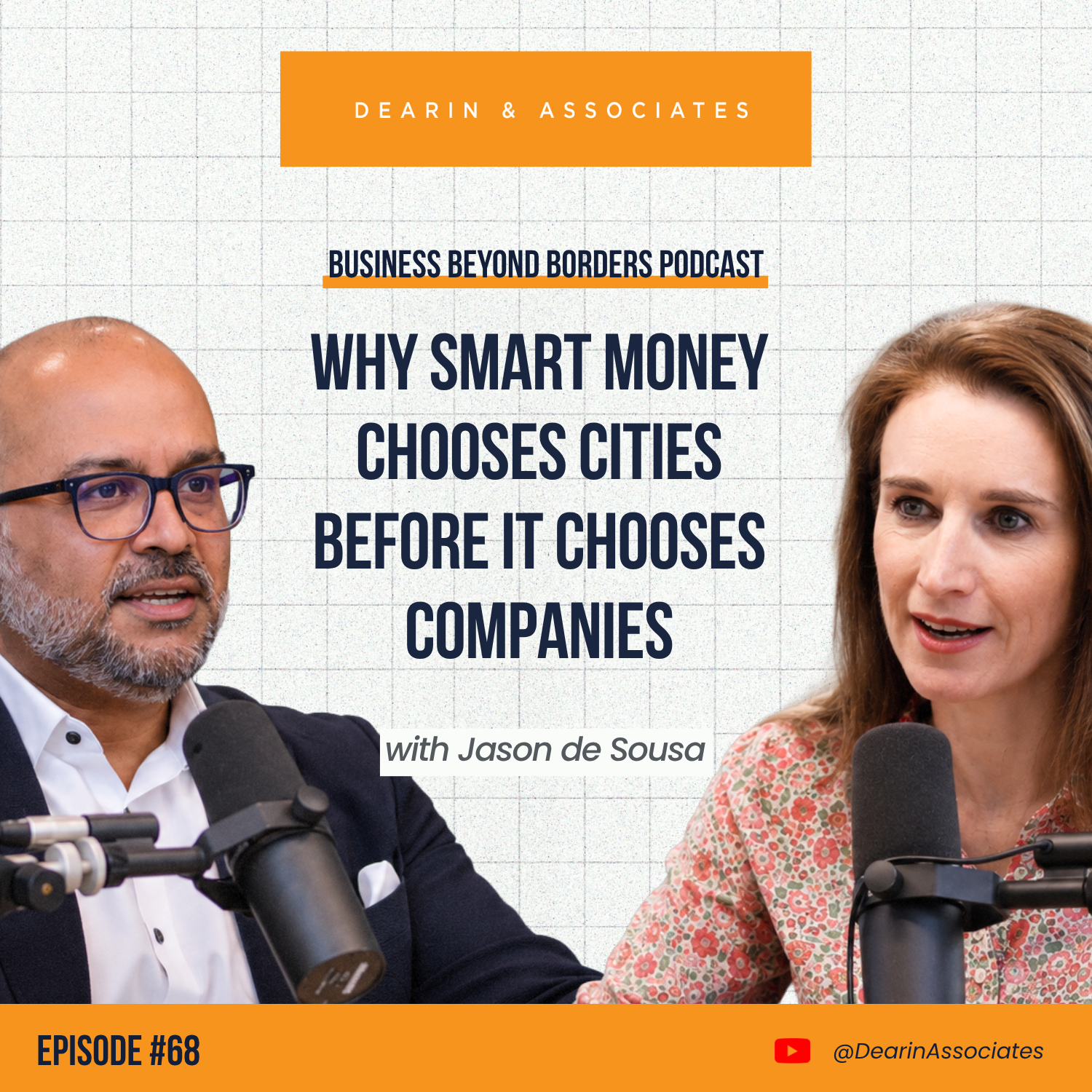
My guest today is Jason d', Sousa, founder of Idea Partners, whose work focuses on infrastructure investment and urban development across Australia and Asia. Jason and I have known each other for a long time. Today we're stepping back from the typical founder story to talk about the systems that enable economies to grow. Jason, welcome to the podcast.
So I think probably, I probably want to start just with a bit of that broader context. And of course, a lot of companies think about global expansion in terms of markets and customers, but you have spent a lot of your career working on, on the infrastructure that actually makes global growth possible. Would that be. Would that be a fair thing to say?
[00:00:57] Speaker B: Global growth sounds impressive.
[00:01:00] Speaker A: So if that's the case, why are infrastructure and connectivity so important for economic development?
[00:01:08] Speaker B: So I think if we look in Australian context, it's pretty interesting. So during the Howard era, there was a lot of focus on a belief that infrastructure was sort of a state issue and federal government wasn't really an investor or a supporter of infrastructure.
And I think that has proven to not be correct. And so now you found that the overall, there's a real understanding now that if you and I extend that a bit further, you had state governments that sort of said, well, you know, we had a premier that once remarked that Sydney was full in 1996, and by not building infrastructure thereby, the city would no longer grow and therefore there wouldn't be any need for additional investment in infrastructural housing, all that sort of thing. And that has proven not to be the case. And so what we now have realized is that cities that operate with strong connectivity from public transport, with strong connectivity in terms of freight, whether it's road freight or rail freight, in particular rail freight, which is, you know, we can talk about.
And strong connectivity of people are the ones that are economically successful. And you look at the large cities, that is very much the case. And I always remark on a experience I had a couple of years ago where the Tokyo municipal government, which is a, you know, a very large municipal government, came to Sydney. And the comment the general manager made was, we have completed Tokyo's infrastructure, and so now we are doing narrow casting back and narrow casting forward. And what he meant by that was a back casting and narrow casting is what he said to understand what infrastructure we need to renew, not build, renew, to continue Tokyo's growth and productivity growth. Right. So That's a very long winded way of saying planning and infrastructure preparation. Infrastructure delivery is what allows a city to grow efficiently. And that efficiency is what prevents sort of price spikes that we're sort of seeing across different markets. So in our market now, what are we seeing? We're seeing price spikes on housing, we're seeing price spikes on infrastructure costs generally. You know, those are all capacity questions that have come into play.
[00:03:19] Speaker A: So does that mean that if we got our housing right and we connected it with the right transport, we might potentially bring the cost of housing down?
[00:03:28] Speaker B: I think that's right. I mean, I think if you look at Sydney's case, we went through a period of expansion into the green belt, right? So people migrating out into the suburbs, suburbs like Kellyville at the beginning, you know, of, of the 2000s were, was farmland, you know, now it's, you know, housing as far as you can see. Right. Connected by road. Until the creation of the northwest rail link, the northwest of Sydney had no infrastructure. And the northwest rail link at that time was assumed to be this expansion of the legacy double deck rail network, which is quite slow and, and instead the city decided to invest in single capacity automatic trains to the northwest. That has really transformed the way the city has worked. And the expansion of that into the CBD has now connected suburbs that were never connected before. So now you can go from sort of Marrickville and these sorts of places, Sydenham, all the way out to the northwest through, you know, through the Harbour Bridge, like that.
[00:04:28] Speaker A: Half an hour or so.
[00:04:29] Speaker B: Half an hour.
It's changed the way Sydneyside is. Think about public transport, which of course, you know, I'm from Hong Kong, coming from Asia, this is quite common. Like it's not, you don't need a car in Hong Kong. In fact, it's more expensive to own a car than anything else, you know, in Hong Kong because you can, you know, catch high capacity rail anywhere you want.
I think that's the answer to the question on the, on the housing front.
That's where we're going as a city now. So you're now seeing across all of those metro nodes, housing build up around it, right. So areas like the hills, like, you know, the recent west metro that's coming up now, White Bay, the government just announced, will be a new housing precinct, you know, with a high capacity metro in the middle of it. That is the future for cities like, like that in Australia and certainly we're seeing that in other countries as well. Asia is already there. I think some of the western Countries are now starting to follow that and
[00:05:25] Speaker A: you need that densification to pay for public transport, obviously.
Do you think that more densification means that quality of life in cities goes down?
[00:05:38] Speaker B: Well, it depends, right? I mean it depends on what we as Australians feel is appropriate living. So if you asked me this, in Hong Kong, all of us lived in apartments. It's quite common. If you ask, ask me this in Tokyo, I'd say, well, many people live in apartments in Tokyo and have a, have a wonderful life doing so.
Same in Singapore, not so here. Right. In, in Sydney. You know, we have a lot of beautiful single dwelling suburbs. People are used to the, the backyard cricket analogy, you know. You know, the quarter acre block was a western dream of home, of home ownership. Not just in Australia, in the uk, in the United States.
Is apartment living where we're going? Well, as our, as our demography has changed, I think tastes for apartments have changed as well.
And so I think we're seeing a lot more apartment dwelling now around nodes. A lot of younger people start in apartments and then might, you know, have, have children and then move out into the suburbs later on. This is a sort of well worn path.
If you look back, you know, I arrived in this country in 1997, apartment dwelling wasn't really a thing.
Right. It started sort of in the early 2000s. You know, apartments started being built and you know, they didn't trade very well for a period of time.
Starting to see a lot more densification of apartments, higher apartment buildings, lots of luxury apartment buildings coming into play to support the downsizing community, you know.
So I think we are by necessity moving towards that. And we're also starting to see different types of ownership structures, you know, so build to rent is not really a thing in Australia. Hasn't been 10 years ago it wasn't a thing in the UK. You know, now it has become a thing in the uk, it was always a thing in the us it's certainly a thing in Japan, it's certainly a thing in France and parts of Europe. Not really a thing in Australia. Becoming one now. So five years ago we might have been at 100 build to rent units. We've probably got two and a half thousand in the pipeline now. I think that will increase. And what's interesting about that from a business point of view is that is an institutional grade asset. So up till now residential housing in this country has largely been a mum and dad investor based thing. And that's why we have this debate about capital gains tax and you know, negative Gearing and all of that sort of thing.
And quality of rental apartments has been dictated by whether the mom or dad wants to invest in the property or not. Right. Hasn't been any sort of standard around that. It might have impacted the price, but maybe they don't want to do that.
Institutional grade product changes that. And so I think we're moving the whole market is starting to change the way things. And as we've grown in the last 20, 30 years, with pension funds becoming more aggressive in terms of where they want to invest to get returns to pay for an aging population, the creation of these new asset classes has been fascinating. So we advise on a bunch of these sorts of things.
[00:08:32] Speaker A: And you've worked on infrastructure and development projects across multiple countries. How, how on earth did you get drawn into that was sort of.
[00:08:41] Speaker B: I've always been interested in big things, you know, I mean I grew up in a, in a family that, where my father was a. What he would self describe, not a particularly good engineer, but particularly good business person. And he built a business in a construct business in Hong Kong which is still going. And he sort of chairs at 84 years of age young.
And it did infrastructure, you know, it built, you know, pits and it built bridges and you know, it worked on. At that time when I was growing up, the Hong Kong's Chet Black Kok airport was being built which was one of the biggest infrastructure projects of all time. It's a beautiful airport. And our company was there and I would spend summers there, you know, working in the, in container offices which, you know, which our company was doing. I would chase invoices, I would, you know, half of which I was speaking to people who were, who were sometimes were fathers of my friends chasing invoices. You know, it was, it's a strange time.
[00:09:37] Speaker A: That must have been awkward.
[00:09:38] Speaker B: It was, you know, it was, you know, when you were young, you don't really realize the nuances in some of these things, right? So I'm like, oh, you know, hello Mr. Smith. You know, I just like that, you know, check for whatever it is.
And they were very understanding because they knew it was a summer job and they would yell at my father later and about, you know, about the actual realities of things. So that really got me really interested in this sort of thing. I didn't follow the engineering path of my father. I followed more a sort of finance and development path.
And so that's the side of projects I play on. I tend to work on bringing things together, right. And in infrastructure and in real estate and in real assets, generally, the pathway to success on any deal is bringing different components together. So whether it be capital, whether it be development expertise, whether it be site acquisition, whether it be community and stakeholder approval for something which is becoming more and more important.
And I've always enjoyed that, I guess, amalgamation agglomeration role. And so in my career, whatever it might have been, whether it might have been in government or in the private sector, that's really been my focus, is that sort of bringing things together and making something happen.
The downside of that is once you make something happen and it goes into delivery, the guys that build the stuff and manage it afterwards get all the.
[00:10:58] Speaker A: Get all the credit.
[00:10:59] Speaker B: They're the ones cutting the ribbons. And we're long gone by that.
[00:11:02] Speaker A: Standing in the back there somewhere.
[00:11:04] Speaker B: I remember this deal, it was five years ago.
[00:11:07] Speaker A: So, I mean, when you look at global business today and thinking about cities, what role do cities play in shaping economic opportunity for business owners?
[00:11:18] Speaker B: For business owners?
[00:11:19] Speaker A: Yeah. I mean, how does that. How does the city play into that overall environment of, you know, creating an opportunity for a business to grow and then go elsewhere? How does it work?
[00:11:30] Speaker B: It's a great question because I think cities are the agglomeration example of economic productivity, economic development. And so if you look at every country, we always talk about a global city, right? And so I use the analogy of our Melburnian friends, because we're sitting in Sydney, you know, they always talk about Sydney. We'll compare ourselves to Sydney. You know, we're doing this in Melbourne, you're doing this in Sydney. And I keep saying to them, guys, I don't know why you're obsessed by this, because when we're in Sydney, we talk about Tokyo and we talk about New York, London, we talk about Dubai. Like, we're talking about financial centers that we're competing against.
And I use that as an example of saying, well, that's the benefit of a city. The city is where the largest agglomeration effects for economic productivity happen. It's where the global talent comes to. To do things.
And that talent comes together to create new things.
[00:12:24] Speaker A: So is it about creating an environment that is somewhere that's exciting and inspirational and fun to be and easy to live in, and that draws the people. And then from the interaction of those people, you get the great business ideas and the innovation, and on it goes.
[00:12:39] Speaker B: And so if you look at Silicon Valley, is the argument between behind Silicon Valley is why did they go there? Well, there was land available there. They all decided to coalesce there and they built basically these businesses that now have agglomeration effects that keep innovating, that keep growing and keep growing. And many places have tried to replicate Silicon Valley, but they don't have the density of, of the talent that wants to live there, wants to live in Silicon Valley. They don't, they don't want to go and live in, you know, in another country's attempt at Silicon Valley.
[00:13:11] Speaker A: So controversial question, who's doing the best at this in Australia at the moment? If you had to pick a city that's creating that environment, who is anybody winning or.
[00:13:20] Speaker B: Well, I mean, I think the reality is Sydney is the, is the global city for Australia. Right.
Every city plays a role, right. So, you know, Perth is our resources center. You go to Perth now. It's gleaming, right? Yeah, it's gleaming. You know, these resources companies are doing very well.
You know, every city plays a role, right. And Sydney is our global financial center. So for, for the sort of capital element of this capital comes here. And most of my clients, they will come here and they'll say, I want to invest in these sectors, I want to invest in these areas, and I want to start in Sydney and Melbourne because they're the safest places to invest.
[00:13:56] Speaker A: Yeah.
[00:13:57] Speaker B: Ones with the biggest population, they're the, they're the ones with the biggest sort of diversity of, of capital investment opportunities. The ones with the biggest companies, the ones with the biggest headquarters.
That's, you know, that's what drives sort of economic growth generally. Look at our city here. It runs. Is it 7 or 8% of GDP? GSP?
[00:14:16] Speaker A: Is it as much as that?
[00:14:17] Speaker B: It's pretty high. There might be gsp, but yeah, it's pretty high.
[00:14:20] Speaker A: And I mean, you won't hear it on the show, but the building we're recording in today has got a lot of construction going on. I guess that's all part of it. Right. City is growing.
[00:14:29] Speaker B: It is.
[00:14:29] Speaker A: Buildings are getting built or remodeling.
[00:14:32] Speaker B: Building. Right. So this is 60 Margaret Street. This was purchased by a group of Japanese investors all involved in the rail industry.
[00:14:40] Speaker A: Is that right?
[00:14:40] Speaker B: Yeah, coordinated by that. And why did they buy into this asset? Because they find Australia a very safe place to invest. We act for a few Japanese clients.
Japanese clients tend to invest all over the world because they, they've. So they've got so much invested in Japan that they need to expand overseas
[00:14:59] Speaker A: to put money elsewhere. Yeah, Right.
[00:15:01] Speaker B: And so they've saturated the Japanese market in a sense with their own capital. So they've got to find other stuff and they are trying to use their expertise in overstation rail related projects to, you know, export that to the world. So 60 Margaret street was an interesting deal because it's, it's right over Wynyard Station, right. And they've all come together to sort of work on this, on this project. So it's a fascinating building in that sense.
[00:15:28] Speaker A: This episode is brought to you by ofx. One of the things we see all the time with companies expanding internationally is that the strategy might be sound, the market choice might be right, but the financial plumbing is just not keeping up.
Managing global finances can quickly turn into juggling currencies, unpredictable cash flow and far too much admin.
OFX helps take that friction out. They're trusted by more than 37,000 businesses worldwide and they make it easier to pay international suppliers and teams and local currencies while saving on FX fees and simplifying the admin through one platform. If your business is operating across borders, OFX gives you clearer visibility and more control over your cash flow.
You can find out
[email protected], and we'll put a link in the description.
Wanted to ask you also about public private partnerships because this is a space you know a lot about.
These infrastructure projects usually require government and private investors to work together because that's what a PPP is. What have you learned about making those partnerships work in practice?
Like, what does it take?
[00:16:39] Speaker B: It takes.
It's a great question, sin, because it takes. It takes a lot of understanding on the government side to be a good counterparty.
So the private sector can also be a good counterparty to government.
And I think PPP is very attractive for a couple of reasons. Right. Complicated projects get wrapped in a structure. The private sector says, I'm willing to take on the risk of delivering this project, whatever it might be, and you pay me rent for it for a period of time and then the asset comes back at the end and you can rebid it.
The history of PPPs is interesting. The social infrastructure projects, the convention centers which I was part of under a new government, very successful hospitals generally, some not so, but some pure hospitals where you're just building a building and renting it to the government.
Quite successful transport projects, some difficult ones. So we had a light rail here in Sydney. It really, it is a ppp.
It struggled because the private sector bid a certain price and then claimed that price wasn't sufficient and then basically argued that they should be compensated more. So in that sense, the transport PPP didn't quite work the way it was meant to. Having said that, the asset delivered is fantastic and people love light rail in Sydney now. Right?
[00:18:03] Speaker A: Yeah.
[00:18:04] Speaker B: So it, it's the, where I'm trying to get to on that is for projects to work they need to be, they need to have very strong counterparties on both sides that have deep understanding of infrastructure projects. And for a period of time in New South Wales, that was absolutely the case. We had very, very high quality level of civil service who was able to, to deal with the private sector on the other side.
That's not the case in all states, it's not the case in all countries.
And getting people into, into that kind of role in government is difficult, which is why they have, they continually appoint advisors to be fair, like us, who help with this process.
[00:18:43] Speaker A: Have you ever been in one of these deals, these complex deals where a project nearly fell apart?
[00:18:48] Speaker B: Absolutely.
[00:18:49] Speaker A: Can you say more without, you know, getting us all into a lot of trouble?
[00:18:54] Speaker B: That's true.
Look, I think there have been several cases where projects have got into trouble and you've had to unwind them. Reliance Rail is a good example. That was a PPP to deliver rail rolling stock. It was struck at a period of time when debt was pretty cheap and insurance was run by. There was a reinsurance scheme. The market changed completely and the deal had to be reorganized.
[00:19:21] Speaker A: This was back in 2011 or 12. Right.
[00:19:23] Speaker B: Long time ago.
[00:19:24] Speaker A: Vague recollection of this.
[00:19:25] Speaker B: And the thing I love about that story is the IM for that deal had the word complex in it like 150 times or something.
Don't quote me on the number. If anyone finds a document and reads it. But my point in raising it is you shouldn't have a document that says the word complex 150 times because if it's too complex, that means it's probably problematic.
[00:19:47] Speaker A: They're going to go wrong.
[00:19:48] Speaker B: I always say to our clients you're too clever by half is not clever at all.
You actually just want to focus on the fundamentals of a deal and that's what gets you to a successful place. And if both parties understand exactly where they're going and what the trajectory is and what the upside is and what the downside risks are and how they're managed, you will have a successful deal.
[00:20:07] Speaker A: I want to zoom out a bit now because I want to talk to you about the geopolitical context. We are, you know, we're recording this.
Nothing we're recording in March 2026. Okay.
I think it would be fair to say that it's a time of Considerable geopolitical uncertainty. I mean things are changing on, evolving on a daily basis. I open the news every day and I'm like, wow, what happened today?
How do geopolitical shocks affect infrastructure investment and economic development? I mean we've got short term supply chain shocks, but on a longer term basis, how do you see what's happening at the moment? For example, strikes on Iran or it's now the war in Iran kind of contagion spreading across the Middle east, the Strait of Hormuz closing. What's going to be the knock on effect for, for infrastructure and economic development over the medium term or the longer term?
[00:21:03] Speaker B: I think, I think the shock, the Iran economic shock, let's call it that is a continuation of where we've been going for a while, which is Covid, which is a thing that happened that nobody wants to remember and I understand why, actually taught us a bunch of home truths that the, the 1980s just in time supply chain, which you know, we all learned it about at school and this is the way we're going to operate from now on. And in this car manufacturer, this thing arrives five minutes before it's meant to be bolted onto the vehicle that doesn't work anymore. And all of a sudden things that we took for granted are all of a sudden not accessible. So during COVID there was this thing called AdBlue. Ever heard of AdBlue?
[00:21:52] Speaker A: Yeah, that rings a bell.
[00:21:53] Speaker B: What is it? Right, it's an additive in diesel. It's an additive that was put in because we had emission standards that we wanted to meet. So because we had these emission standards, they produce trucks that rely on this AdBlue stuff. Do we make any AdBlue?
No, we had to ask a company in Australia to start producing it because we imported it from China. Covid stopped it. So that's just one example. Australia during COVID found that it doesn't produce any ball bearings. Don't produce any ball bearings. Wheat ball bearings are in everything.
[00:22:21] Speaker A: Yeah.
[00:22:22] Speaker B: And so now we're talking about oil and we've got, you know, 20, 20 days supply or whatever it is, not
[00:22:29] Speaker A: the 90 we're supposed to have.
[00:22:30] Speaker B: 90 we're meant to have. And this is an issue we've been talking about for years. We had six or seven refiners, we've only got two. Both of them are about to be subsidized to stay open and stay open till 28 or something. Right. So what happens after that? We don't harvest any of our own oil at the moment because apparently it's A lower grade oil. So we're importing oil.
All of these questions are now going to be asked around, well, what does this mean for our own sustainance as a company, as a country? Say the word company too much, what does that mean? And what do we actually need to do to be sustainable as a country? And that means investing in our own, our own supply chain base.
[00:23:09] Speaker A: Do you see a resurgence of manufacturing?
[00:23:13] Speaker B: I see, I think that's difficult. I, I do, but I do see, and I've been saying this on, on our show for a while, is that I do see the friends and family package with nation states coming more into it. So the quad is a good example of that. You know, India, the United States, Japan and Australia.
You know, India brings a workforce, Australia brings capital and intellectual property. The United States is the United States, you know, and Japan brings, you know, technology, intellectual property as well. Right.
You add that together and, you know, the United States, I suppose brings a security blanket as well. Right.
All of a sudden you can see why that, what, what was a foreign minister's dialogue has now become a leader's dialogue and is working on economics. Right. And economic issues.
Similarly with orcas. Orcas is primarily a defense relationship between Australia, the United States and the UK that is allegedly only about submarines. But it isn't because Pillar two is about technology, everything else, and it's about technology sharing. And we've got 3,000 people coming to Australia to work on this and there'll be a whole industrial base that's built around that. So I think, I think you're starting to see these groupings come together from an Australian context that are being repeated by other countries. So, you know, you find, you know, India in its own region starting to build relationships with countries around it, trying to contain its Pakistani problem as from their perspective is a problem. You see China doing, you know, it's thinking about what its regional development model is post Belt and Road, which has not quite worked the way it wanted. And they've tried to create their own security apparatus and all this sort of stuff. So I think the Iran conflict is creating a continuation of problems that I think we've been seeing before that's leading to this, you know, instead of what we used to call a just in case supply chain, it is now it's just because we need it. Supply chain, Yeah. I think that's the new kind of way we're looking at it.
[00:25:17] Speaker A: And if we have to change how we think about supply chains, you know, we've seen that the just in time model is Too fragile to withstand what's happening in the world today. Does that or should that change how countries and cities think about infrastructure and connectivity?
[00:25:32] Speaker B: Well, I think so. I mean, I look at, somebody was remarking yesterday on the news and I don't remember who it was, that, you know, it's great that if you can get in your Tesla and drive to the shops to get your groceries, except there won't be any groceries there.
I'm like, ah, okay. So I do think, I do think it will change the way we think about, about infrastructure, about supply chains, and it will get us to value things differently. So I feel, for example, you know, we don't value our agriculture sector enough.
Right. Like, agriculture is one of our great exports from this country. We produce excellent quality meat, we do excellent quality wine, we do excellent quality everything, right? Food, wheat, you name it.
We don't really respect that as a primary resource yet. It's becoming more and more essential.
[00:26:21] Speaker A: Yeah. And we export 60% of it. Right.
[00:26:23] Speaker B: We export 60% of it. Same for our mining resources. You know, it's going to be controversial to say that, you know, coal is a valuable resource or, you know, iron ore certainly is. Copper is becoming an increasingly valuable resource. We export a lot of that. Uranium is becoming a valuable resource. These are our, these are things for us that as a country will sustain us, where other countries that don't have resources like this are starting to suffer because they don't have a security blanket of something that is valuable to somebody else.
[00:26:53] Speaker A: And so, I mean, on that note, in times of political instability or geopolitical instability of the kind we're seeing at the moment, do you think some cities become more attractive for investment and others lose ground? I mean, there are the obvious example. Probably nobody's rushing to invest in Tehran this month, but, you know, might be
[00:27:12] Speaker B: good value buying in Tehran, Right?
[00:27:13] Speaker A: Yeah, down, down, down on the prices. But I mean, do you think more broadly that, you know, leaving aside the immediate conflict scenario, do you think some cities lose ground and others gain it?
[00:27:25] Speaker B: Absolutely.
[00:27:25] Speaker A: And why?
[00:27:26] Speaker B: It goes back to your earlier question. You know, where do people want to live? Like, why is Dubai at the moment a place where lots of people from Britain are choosing to relocate to?
[00:27:34] Speaker A: Thought it was weather.
[00:27:35] Speaker B: Well, weather could be once boiling in Dubai. But the other reason is the, the sort of punitive tax regime that's being applied to sort of people who are wealthy in the U.K. yeah. And the, the, the United Kingdom government is raising taxes because it's got a ballooning welfare bill that it can't afford. And it's choosing to meet that by raising taxes, particularly on non doms. These are the people who have capital, often are running companies or own companies and they're leaving the country to move to Dubai where there's no capital gains tax and, you know, and so on and so forth.
[00:28:05] Speaker A: Yeah, no income tax.
[00:28:06] Speaker B: Now they're choosing to leave the UK to live in Dubai because that is a better scenario for them financially and probably, you know, probably standard of living would probably be better for them.
[00:28:16] Speaker A: Yeah, well, you cannot, you know, everybody has help in Dubai. Nobody has help in the uk.
[00:28:20] Speaker B: I mean, my own hometown, Hong Kong.
When the Chinese National Security Law was applied, it was, it was a media sensation, right, because of the umbrella movement and all this sort of thing that led to this, this law being put into place.
It scared a lot of people and a lot of expatriates left Hong Kong because of it, because they were worried that they would be captured by this law, which I would say not to defend this law, which I don't particularly like, but, but it isn't dissimilar to other countries that have similar laws right.
Around. Around criticism of, you know, national security. I'm not defending it, but so many people moved to Singapore or other places like that and they found that, well, actually the job market isn't as strong as they'd hoped, that things are very expensive. You know, it's not great for them. Some moved to the UK and found that, you know, things aren't great in the UK right now or Europe.
And so a lot of, a lot of people are now starting to go back to Hong Kong to work in Hong Kong businesses that are exposed to the Chinese economy that will bounce back, it will come back. The Chinese economy is no doubt.
Why? Because it's a 60% tax regime. There's help there. There's all that sort of thing. People agglomerate in Singapore and Hong Kong, places like that. People should agglomerate in Sydney. The standard of living here is wonderful.
[00:29:43] Speaker A: I agree.
[00:29:43] Speaker B: We all live here, right? We love it. Right. I mean, I, I married an Australian, which is why I ended up living here permanently.
Had I not married an Australian, who knows?
[00:29:51] Speaker A: But, you know, maybe Melbourne.
[00:29:53] Speaker B: Maybe Melbourne.
I love Melbourne, by the way. I don't want to attack Melbourne. Melbourne's a good.
[00:29:58] Speaker A: You have to put a Melbourne joke in there. It would be rude not to. Right.
[00:30:01] Speaker B: Well, you know, Melbourne is probably joke about Tasmania, I don't know.
[00:30:05] Speaker A: And maybe Sydney and you know, we
[00:30:07] Speaker B: haven't brought up Queensland yet.
[00:30:08] Speaker A: No, well, we could go there in another episode.
Our producer is from Queensland too, so we can't annoy him. Queensland's a great place.
[00:30:16] Speaker B: I love it.
[00:30:18] Speaker A: So for founders and companies expanding internationally, what signals should they watch in the geopolitical environment where they're thinking about where to invest or where to expand to?
[00:30:29] Speaker B: I take a more sort of nuts and bolts approach to this. Right. So obviously geopolitics has a play and it creates uncertainty. So your immediate focus is flight to locations that have regulatory certainty, strong government, you know, democratic government that, you know is exudes stability regardless of the political noise around it, that doesn't change taxes every 15 seconds, that, you know, that sort of thing. And that's why Australia has always been attractive because we have a very, a very stable government here, very stable economy. It has good growth trajectory, you know, strong population growth. All of these sort of fundamentals are there.
I would say then once you address those bigger questions, you know, where is it stable for me to invest? If we group it under that, it then comes down to, can I make money there?
[00:31:21] Speaker A: Yeah.
[00:31:21] Speaker B: Is the tax regime acceptable for foreign capital?
Right. We have a constant debate here about withholding tax. It's horrible. You know, it's not conducive.
Is there an impact upon a government choosing to increase taxes? So when the Queensland government increased coal royalties by 40% without any negotiation, any, any sign that they were going to do that, not great for foreign capital. Who's invested in our, in our resources sector and you know, that they may not leave the assets they're in now, but it's changed the return profile that they had booked when they invested, that's not going to allow them to do more things. If we increase regulation constantly to the point where it's impossible to do things that's not conducive to investment. So when our clients come here, they look at those sorts of things. Right. We're an Australian focused firm. They say, you know, what is the risk? And there have been cases where, where it has gone horribly wrong. I worked on a deal in, in a state which I won't mention, where the officials from the state came and isn't it wonderful investor, Great to have you here. It's wonderful. Thank you. For your first investment in my state. And the next day they increased taxes?
[00:32:31] Speaker A: Oh, no.
[00:32:31] Speaker B: The very next day.
And the investor was like, well, hang on, you told me that this was stable and, you know, regulation.
Government was stable and they just increased taxes. The next day the guy shook my hand, so we can't have that Sort of thing in Australia. Right. And I think, to answer your question, for a small business expanding, you've got to watch those things. Is the government stable? And I, I find, you know, some of the Japanese clients we work with, they'll often say, oh, yeah, you know, we were asked to invest in Myanmar. The return profile was well over 25%.
[00:33:03] Speaker A: You're like, there's a reason for that.
[00:33:05] Speaker B: I said, did you earn the money? Oh, no, we didn't earn the money. I said, well, there you go.
[00:33:09] Speaker A: Yeah. And so if you had to give one piece of advice, say, for example, to one of your Japanese clients thinking about global expansion today, what, I mean, what would you tell them to understand about the cities that they're entering? What's the most important thing that they need to consider about the cities they're going into?
[00:33:25] Speaker B: It's what. What is the baseline opportunity that you're actually investing in and what is the value proposition you bring to it? And so sometimes money isn't enough.
[00:33:34] Speaker A: Right.
[00:33:35] Speaker B: So I find with some clients, you know, they'll say, they'll come here and they'll have a check for a certain amount of money, and they'll say, I've got this money and I'd like to invest it. And it might be 20 or 30 million dollars. And you might go, okay, that's great. It's great that you've got 20 or 30 million dollars, but for the counterparty, why is that money valuable to them? Right. So for the counterparty, it's like, well, I'm inviting you into my project. I want $500 million. I want one party that I can deal with for $500 million.
[00:34:04] Speaker A: 10 parties for 20.
Correct?
[00:34:06] Speaker B: Right. And so for a lot of Japanese companies and Asian companies generally, they want. They want a toehold. They want to test the water, understandably.
So you then have to say, well, if your check is only $30 million, only $30 million, what else are you bringing? Is it IP? Is it technology? Is it, you know, is it people? Is it, like, how do you sweeten the deal? And so for a lot of our clients, that's what we advise them to do, which is, okay, your board has approved this strategy. They want you to invest in these sectors. You know, we might help guide their strategy. You should invest in these sectors. These are the potential deals you could work on. Here's the sort of return profile you're going, and what. How much do you have available in your budget? And they'll say, it's X. Okay, good. Well, how do we sweeten this deal for the counterparty overseas. And remember, the overseas party often doesn't have the same cultural understanding of you as an investor in their country than you might have of them. So as a Western country, people understand us a lot better than we understand them. Right.
Foreign capital often speaks English. We don't speak their language.
Right. And yet we go there and we expect them to speak English.
[00:35:17] Speaker A: Yeah.
[00:35:18] Speaker B: Right.
Why. Why is that the case? Right.
We. We expect them to. We expect them to adhere to sort of Western norms as opposed to their own norms. Like, I'm from Asia. I can see the difference. Why? Right. And I'll give you a case in point. Right. So we, we had a situation where investor, counterparty investor was buying a asset and they said, we would like a report to be produced for us on the. I'm going to make this up the second Tuesday of every month.
And the counterparty said, we can't do that now. We. We only produce reports on the fourth Tuesday of every month. I said, but we need the report on the second Tuesday of every month. Well, I'm sorry, our accounts department doesn't do that. You know, like Debbie and accounts will be FL furious if I asked them for a. To. To give them that workload. And I sort of said to them, guys, they're buying this asset from you. You want them to buy this asset for you. Have you asked yourself why they need the report on the second Tuesday of every month? Because their board meeting is the third week of every month and they need to give this to this person so they can give it to that person to tell them that their investment is fantastic. So by you not giving them that report, you're making them look bad. And they're the ones who've told the. Their, you know, headquarters and wherever it is that this is a fantastic deal. I think Debbie might want to do a bit of extra work. Oh, wow. Why didn't they just say so? Right.
[00:36:45] Speaker A: Yeah, I love it.
[00:36:46] Speaker B: So that Cultural Understanding piece, I think, comes into it.
[00:36:48] Speaker A: And look, that is a great. That is a great note to wind up on. Thank you for coming on the show. It's been so much fun chatting to you and, yeah, I look forward to seeing, you know, where you take Idea Partners and the world of infrastructure investment next.
[00:37:04] Speaker B: Always fun. Thanks for having me on.
[00:37:06] Speaker A: It's my pleasure.