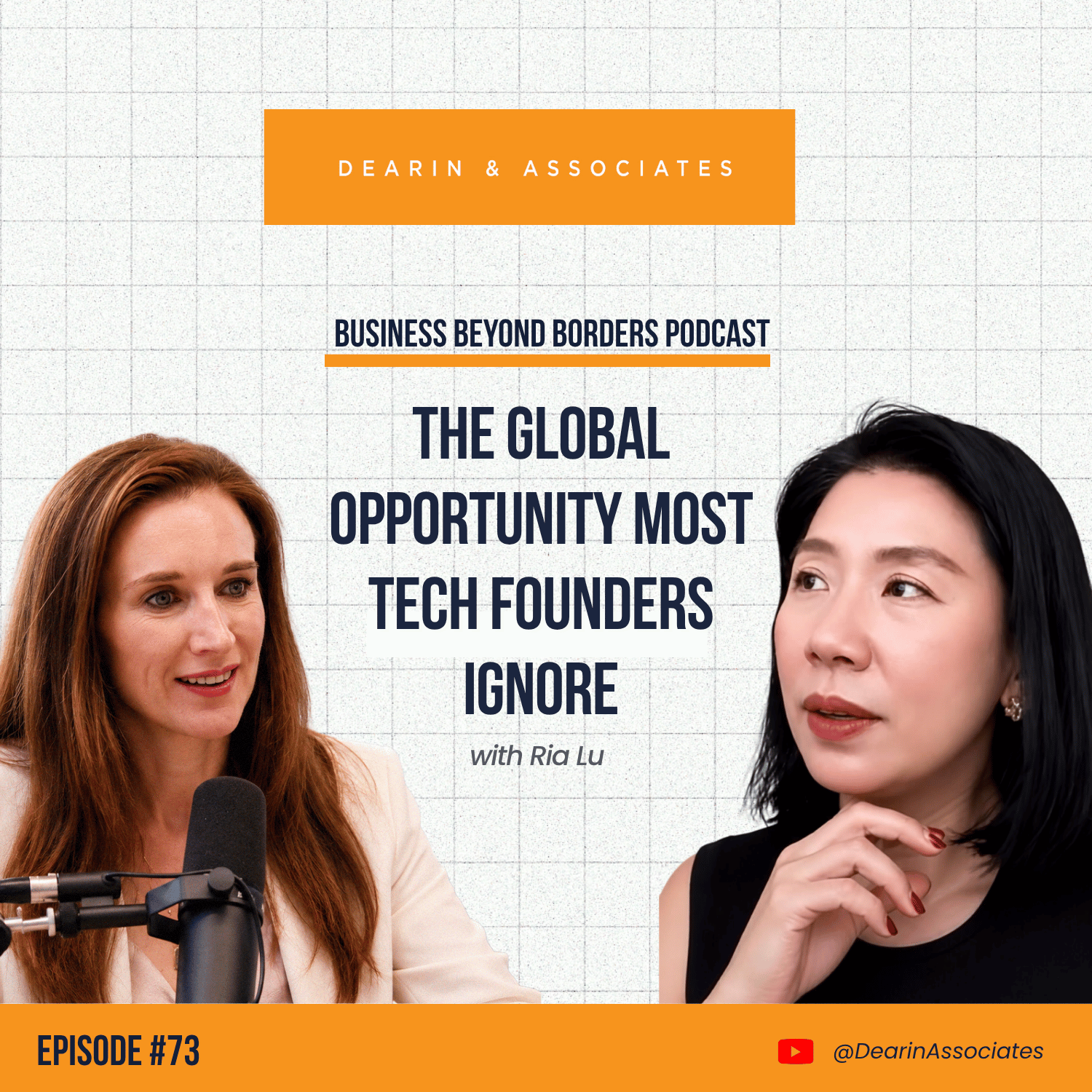
[00:00:00] Speaker A: The global games industry is one of the largest creative industries in the world. But behind the blockbuster titles and billion dollar revenues is a much harsher reality for many development studios. My guest today is Rhea Liu, CEO of the Leverett Group, a game development company working with international partners across several markets. But Ria's journey didn't start with Leverett. She previously ran another studio for seven years before it ultimately closed due to cash flow challenges, a turning point that fundamentally shaped how she built her next company. I met Ria through the APEC Women's Business Activator program, where I had the opportunity to work with founders from across the region who are building businesses internationally. Rhea, great to have you on the show. I think where I want to start is just to think about the industry as a whole. Gaming is one of the most exciting creative industries in the world in the 21st century. At least that's how I see it. But from what I know, it's also very difficult for studios to survive.
From your perspective as an insider, what makes running a game development company such a big challenge?
[00:01:06] Speaker B: Well, you could think, if you think about games versus, let's say an app. Apps are utilities. They have a use so you can more or less project how it'll do based on the needs that you see in the world. Right. Games are not like that. It's, it's entertainment. It's luxury if you think about it. So you're not quite sure.
And the thing about games is that if you want to, if you want to sort of ensure or like increase your chances of it being palatable to the market is that you try to follow formulas.
The problem is the more you follow those formulas, you know, you also tend to lose fans because, you know, it gets boring. It's like, same thing again, you know, it's like Star wars number, I don't know, 30. You know, it gets boring. So you, it's, it's, it's a world of story. So you really need to play around with it, experiment with. The problem with experimentation is that half of the time they don't work.
[00:02:05] Speaker A: Yeah, I see what you mean. And you think, is that one of the things that makes it hard? You know, you just.
Half the time you're just playing and, and many of those tests just don't hold up in the market.
[00:02:17] Speaker B: Yes, that is, but we, we, that's, that's a big part of the reason. Yeah, that's true. Although the, the companies now, we, we've learned like over the years to actually release like a small version of the Game test it out before like proceeding with, with the rest of production so that you know, we kind of, we can kill it if, if we see that the market doesn't like this, we can kill it, you know, but that is, that is one of the, one of the reasons why it's difficult for the, in the game industry.
Gaming is outsource and a lot of the companies in the Philippines are game outsource companies. Basically we make games for other people and the challenge on that part because that has challenges too.
Again it goes, but it actually goes back to the same problem because if the market isn't, doesn't like the game or thinks that, you know what, I've had it with this franchise, then there's no work that's going to come to us. Yeah.
And because of that even the outsource industry is a little bit more volatile compared to let's say voice support or software.
[00:03:25] Speaker A: Now maybe I'm just sort of thinking of stereotypes, but from what I know of the gaming industry, it's very male dominated and you're a nice girl from the Philippines and it seems to be that most nice girls from the Philippines are not usually expected to go into gaming. So how on earth did a nice girl from the Philippines get pulled into the gaming world? How did that happen?
[00:03:50] Speaker B: I like playing, you know, when I was growing up, high school, even younger, I like that, that space, you know, that's the comics and the animation and the gaming and those kinds of things. And so I really wanted to get into one of the creative industries. And at that time I thought you know what gaming, gaming it is, you know, so, and that's why I went into it. I didn't fall into the industry. I actually went after it because during the time also there was no game game industry in the Philippines. It didn't exist back, back then.
So, so yeah, that's, we basically like when I started in the game industry there were probably only about 10 companies in the Philippines. These are small studios doing.
Some of them were doing their own thing, some of them were, were basically doing outsource for, for companies abroad.
Uh, but yeah, my company was like one of those ten at that time and we were really just like figuring things out. But yeah, how I went into it, it's, it's just something that I liked, you know, and so I went after it.
[00:04:58] Speaker A: Do you remember the first game you built?
[00:05:01] Speaker B: Yes, yes. Actually it was an advert game. So when we say advert games, these are games that we make for brands. So that's what that was our first client. The first game that they did was a game for Oreo.
So yeah, so they had this whole twist, lick and dunk idea, right. So we had to make a game. It was like a Rue Goldberg machine dunk idea. So yeah, that was my first game.
[00:05:28] Speaker A: Well, that's crazy. I always think of that book. You must have read the book Tomorrow and Tomorrow and Tomorrow.
[00:05:34] Speaker B: No, I haven't.
[00:05:35] Speaker A: Okay, you have to check out that book. It's about this girl and this guy who become best friends and start this game company. And it's sort of an epic saga novel which it gets quite dark in places, but highly recommend that one. But that is all. That's one of the things that's made me so interested in gaming. Actually reading that.
[00:05:54] Speaker B: I will check it out.
[00:05:56] Speaker A: But before you ran lever, before you set lever it up, you ran another game company, which I think was the first one, and you ran it for a number of years.
What, what happened with that business?
[00:06:09] Speaker B: All right, so that was when I was starting out. So this was.
So after college I went to Japan to study games because there was no game courses in the Philippines.
So I studied computer science in the Philippines, went to Japan, studied game art, came back, set up my studio, which was called Komikasi at that time.
And my idea was, hey, you know what? We'll create games for, for the local market. And our clients will be primarily the local game companies. Maybe they'd like us to make a game for them. Most likely a lot of them are going to be brands.
So that was my concept when I set up Comic Casting, my first company.
And my friends were all like, are you targeting the local market? I said, yeah, why? No, you shouldn't, because the margins are too small. They don't understand the industry.
They basically treat you like a poster in terms of like costs. They expect you to really drop your price and they pay so late.
So that's what they told me. And I was like, I could, you know, let me, let me have at it.
[00:07:16] Speaker A: You know, I've got this.
[00:07:20] Speaker B: And so I did. And I ran Komikaze for about seven years.
And we, you know, we, we did a lot of games. Some were very interesting. We did like, like I said the Oreo game. We did that. Jollibee, if you've got heard of that.
[00:07:32] Speaker A: Yeah, totally.
[00:07:33] Speaker B: Yeah, we've done games for them. Nestle was one of our biggest clients, so. So, you know, it had its own success. Komikasi. But.
But at a certain point they were correct.
Cash flow was the problem.
Because, because we were dealing with ad advertising agencies, not really directly with the companies because usually games were used as part of a bigger campaign. So we didn't work directly with company, we would work with an advertising agency and we would be part of brands campaign.
The problem with that is that brands don't. Sorry, the agencies don't pay us until the brands pay them. And sometimes even after they've paid them, maybe they have their cash flow things as well. We don't get paid immediately, so. And we're a small company, you know, we're less than 20 people.
So. So it gets, it gets hard, you know, when, when they pay late. So basically that was it. It was, it was basically a cash flow issue that forced us to close after seven years.
[00:08:38] Speaker A: That must have been hard. I mean, how do you remember the day where you had to decide, okay, it's not going to. This is.
Tell me about the day.
[00:08:47] Speaker B: Yeah, I mean, I was holding on for like the longest time because you're kind of hoping, right? It's like, yeah, no, you know, we have collectibles. We can do it. No, next month we can find another project, you know, so we were trying to like hold, hold on for like the longest time. And I think I held on for like a year before I had to close it. And this year, that year was like I was borrowing money, I was, I was borrowing against my credit card just to make payroll, you know that, that kind of thing.
[00:09:13] Speaker A: Yeah.
[00:09:14] Speaker B: But at a certain point after like a year, I was like, no, this isn't working. And we're just gaining more and more debts, but we're not getting enough projects to actually cover them.
So yeah, after that seven years, I had to close it. I had to talk to my people and say, you know, we tried, it's not working. Had to close it. And it was so, like, difficult because. Well, number one, it was my first company. Yeah, it was difficult. But second, you have to understand this was at the time when, like I said there was. It was at the beginning of the game industry in the Philippines.
If you were, let's say an artist or a programmer who wanted to be in the game industry in the Philippines, you basically had to defy your parents.
[00:10:00] Speaker A: Okay. Is that what you did?
[00:10:03] Speaker B: Well, my parents are a bit more supportive, so I'm okay. But like, I've had, I have people. I had people then in my first company where their parents, you know, they're, they're not happy with, with what they're doing because again, this is Asia, right? Yeah. So like my One of my, my project manager, his dad would like introduce him and his siblings this way. It's like, oh yeah, this is my eldest son, he's a lawyer. This is my, my, my daughter, she's a doctor. And this, well, I don't know, my youngest son, he, he draws stuff, you know, so it's kind of like that, you know, so it, it's hard on these kids but, but they want to be in it. You know, they wanted to be in games and so they, they would defy their parents just to be in this industry.
So in essence, their, their, their hopes and dreams are like, on you, you know, and you dashed these dreams, you know, so it was, it was so hard. It was heartbreaking and it was like I felt like I had failed them in, in that, you know, way. It's not even just that, oh, you know, they won't have a job anymore. It's not simply a job. It was like your hopes and dreams were pre pinned on me and I failed you, you know, so, yeah, that was, that was hard.
[00:11:15] Speaker A: This episode is brought to you by ofx.
One of the things we see all the time with companies expanding internationally is that the strategy might be sound, the market choice might be right, but the financial plumbing is just not keeping up.
Managing global finances can quickly turn into juggling currencies, unpredictable cash flow, and far too much admin.
OFX helps take that friction out. They're trusted by more than 37,000 businesses worldwide, and they make it easier to pay international suppliers and teams and local currencies while saving on OFX fees and simplifying the admin through one platform. If your business is operating across borders, OFX gives you clearer visibility and more control over your cash flow. You can find out
[email protected] and we'll put a link in the description.
What did you, I mean, just take me on the journey? What did you do the day you shut the door? Did you, I mean, this is, you know, in the past, but did you think on that day, hey, I'm going to do all this again, or did you like, go and eat a lot of ice cream or did you cry or.
[00:12:20] Speaker B: No, I, I, I sulked and I, I hid away for like an entire year. You know, I, I just like, I, I allowed myself to be miserable. You know, Good thing is my, my, my parents were kind of like, okay with it. It's like, because I ran that company in Manila, but my hometown is actually south of the Philippines in Davao. And my mom was like, okay, I know I Know, it feels bad. Why don't you go back to Davao in the. In our hometown? You know, things are quieter. You can. Can think a little bit more. So actually, you know, I'm. I was lucky because my parents allowed me that space. But, you know, I sulked for the entire year for. For the year after that. I was like, oh, you know, no, I don't know what to do. Nobody's gonna, like, so. So some people were saying, like, why don't you just work for somebody for a while? And I was like, nobody's gonna hire me. The first thing I did after college was set up this company, and I failed. Why are you gonna hire me? You know, so all of these things.
So that was. That was me, like, for an entire year.
And then at the end of the year, you basically really just get tired of yourself. It's like, I'm so tired of feeling like this, you know, let's do something about it.
Yeah. So after that, I. I work for somebody, so. And that I. I remember it was, like, around Christmas time, and I was like, I'm tired. Let's. Let's. How do I get out of this?
I had debts, right?
And then. And I needed an income, so I said, yeah, okay, who's gonna hire me? You know what I told myself if I took, like, a hundred gold calls to get my first client, which was Oreo, then maybe if I send out 100 resumes, somebody's bound to hire me. I said, basically, that's what I did. So I ended up working in operations for a Japanese company simply because at time, they were looking for an operations person who could speak Japanese, But I studied games in Japan, so I spoke a little bit of Japanese. I wasn't that great at it, but I was like, you know what? Just go for it.
And so I stayed for that. I stayed with the company for, like, three years, I think.
[00:14:28] Speaker A: So.
[00:14:28] Speaker B: Yeah.
[00:14:29] Speaker A: What made you decide to start again?
[00:14:32] Speaker B: The pandemic, actually.
So I worked for that company. It was a Japanese company. Was also an interesting experience because now you. For me, it was. I was working for a company that was not a Filipino company.
So, you know, it's very insightful in terms of, like, international business. Okay, so this is how the Japanese work. Ah, okay. So this is, you know, so it was. It was interesting. After that, I worked for a US Software company. Basically, they hired me to set up the Philippine branch.
And then the pandemic happened. And then during the pandemic, I was also sulking again because I was so tired of Being cooped up at home because it was a pandemic, right, that when the borders finally opened, I flew to Singapore. Me and, like, two friends, we agreed to meet in Singapore. So I had a friend who's. I have a friend who's from Sydney, then another friend, also from Manila. So three of us just, like, flew into Singapore just to, like, can we just, like, decompress and, like, you know, just get out of this hole, you know, just. Just so that I'm not in, like, my condo in. In Manila, you know? And so we did. We met up, and then my. My Sydney friend who was like, hey, didn't you say that you wanted to, like, set. Get. Get back into business and set up your own thing again and everything? And, you know, the pandemic also makes you, like, think differently. And that time I was, like, sulking again.
I was like, yeah, but, you know, I don't even know what to set up. You know, if I get back into the game industry, it might be the same thing again, you know?
And then he's like, so what's really.
What's really stopping you from, like, setting up a company?
You said you wanted to set it up in Singapore this time because, you know, it's. It's easier. I mean, the business, like, way of doing business there is a little easier. The taxes are better and things like those.
So she said, what's stopping you from. From setting up in Singapore? And I was like, nothing.
He's like, they just set it up as what? And he's like, set it up as, like, a. A tech company and then just figure out what you want to do from there. It's like, okay. So I did. I set it up in Singapore, and then I just. But this time around, I said, okay, if I'm going to set up the studio again, I need to make sure that I have enough Runway. So in this case, I said, I want, like, a year's worth of Runway. I don't want, like, a few months. Because if you go to business school here in the Philippines, oftentimes they would tell you that you need to have a Runway of about three months.
[00:17:08] Speaker A: Yeah.
[00:17:09] Speaker B: I was like, nope. Like, the longest time I had to wait for a check for from one of my clients was nine months. It's going to be one year.
[00:17:17] Speaker A: So that's pretty smart, actually.
[00:17:21] Speaker B: So I did that because, you know, a lot of business people here would tell you that if you have money for, like, 12 months, that's your money basically sleeping. They're not doing anything. You know, it could have been put better use, you know, but for me it was like, I don't care, you know, I need to feel secure, I need, I need to feel that I'm okay so that I make good decisions. So if that's the cost, then that's the cost.
[00:17:45] Speaker A: So, yeah, I think, I mean, it's unconventional, but I think it's worth it because, you know, if you're in a volatile industry or in one where people pay slowly, I mean, that resonates with some of the experiences I've had. If you don't have a cushion of cash, then you're losing every second night sleep wondering if you're going to get paid and what you'll do, you know, in six weeks time if you don't.
[00:18:08] Speaker B: Right, yeah, yeah.
[00:18:10] Speaker A: With Leverett, you decided from the outset that you would, you'd focus on international clients. Why was it so important?
[00:18:18] Speaker B: So this time I, I decided to accept my friend's advice, you know, because that was the advice they gave me back in my comic acid days, my, the first company. And this time I said, you know what, I will hear a method, I will try it. And so that's what I did. So, yeah, from the start we, we focused on finding clients abroad. So we focused on like going to events outside of the country and yeah, that's basically how we did it, how we approached it. Although most of our clients didn't come out of like directly being at the conference. It was like more of like us being at the conference, meeting some friends, probably even in Manila. And those friends recommended like clients to us.
[00:19:01] Speaker A: So.
[00:19:02] Speaker B: But yeah, Leverett basically focused on international clients and it was, it's better, it's definitely a lot better. You have, you have higher margins and they pay fairly faster, you know, within two weeks. Normally, yeah, clients pay their invoices.
So yeah, it's, it's a, it's definitely a better experience than the first one.
[00:19:27] Speaker A: Am I right in thinking that your first major client with Leverett was an Australian Web3 company that was working on a Metaverse project? Is that right? I got that right.
[00:19:38] Speaker B: They're probably, they're certainly one of the first. Let me, I'm trying to remember if they were the first. First, but yes, definitely they were one of the first.
[00:19:44] Speaker A: What did it mean for the company when you got that kind of top tier project?
[00:19:49] Speaker B: At that time, the company wasn't actually very large yet, so.
So it was, so it was interesting and it felt, felt like a.
Okay, on the one hand it felt like a big win because it was A large project. But also on the other hand, it was, it was a difficult project as actually for that particular project, the Australian project, we didn't come in from scratch. We were basically brought in to fix a mess up and we realized it's like, okay, you know what, let's just accept that this is our role every now and then because we've had projects like that in the past wherein we really just come in to fix things.
Okay.
But basically that was the situation. They had hired, they had hired a different company, but apparently the ones they hired weren't from the game industry. The, the ones who owned the project weren't from the game industry.
This was basically web3. So they were more web3 people than game people.
And then. So. Well, sometimes it's understandable. You don't know anybody in the game industry. You hire somebody else in a different industry thinking that, you know, they could do it.
And, and the game wasn't working, you know, it didn't run well.
So we had to come in, look at it, ask questions, fix it basically.
So yeah, it was an interesting experience and I think it was, yeah, it, it was financially very good for the company.
[00:21:16] Speaker A: And was that sort of a springboard then to more work with big brands because you'd already got that credibility with a, a top tier company.
[00:21:24] Speaker B: Yes, yes. And also I think it helped also the experiences that I had prior to Leverett. Like before working for Leverett, I also ran a company called Laguna Games which was a US web 3 company.
So when we started working with that Australian group, they already knew that we worked with. Like I personally worked with laguna Games and Web3. So they were a little bit more comfortable working with me because I have been in that industry.
[00:21:53] Speaker A: Yeah.
So tell me about Leverett today. What does it look like? You've got offices in a few place, team in a few places. Tell me about that.
[00:22:03] Speaker B: Yeah, so we have offices both in Singapore and Manila and team members like all over because we're a fully remote company. So we have a team member in Australia.
We're working with groups around the country right now we have a project. We're probably going to be working with a Japanese company as a supplier to us.
I really like that setup because it takes off the limit that you just need to hire where you are.
So if there are no correct talent, because for example, for art there's a lot of great artists in the Philippines. But for example, if you need a certain look and it's not here, you can now work with anybody in the world.
So our Setup of being remote is great for us also.
Yeah. So the game industry at the moment is this.
Have a lot of changes, is undergoing a lot of changes.
This is because of. People think it's AI, but actually AI hasn't quite caught up to the game industry yet.
But the problem is actually that the player behavior, playing behavior of people has changed after the pandemic.
People are busier these days.
There's a lot more distractions, there's a lot more things to do on your screen other than games.
So things are changing.
People are moving into mobile a lot.
The older gamers who want more interesting games have come back to PC.
So things are moving.
So for lever at this time, aside from our outsourcing work, so we're still continuing to do that, we've also really focused on creating our own games as well. So we have a game that's coming out. We have a game that's on demo now because of course we have to practice a little bit.
So if you are interested in word games, we have a game called Word Cross on Steam. It's free right now for demo if you're interested.
[00:24:04] Speaker A: Can we put a link in the show notes? Okay, so any gamers watching this show?
[00:24:11] Speaker B: Yeah, it's interesting, it's. It's crossword but competitive. So yeah.
And then we have a game that's launching in May, which is a puzzle game with a narrative. And for that we're very excited about that because the monetization is a little different. We're going back to our roots wherein we're working with brands, but it's a little different from how we used to do things. So yeah, we're very excited about that one. It's called sort of Sweet.
[00:24:41] Speaker A: That sounds really cool.
I want to just take you back to this thing around remote working for a second because you have a fully remote company.
I have a company that's half remote and half in person. So about at least half of our team is split up around the world and then some of our team is in Sydney. But even within Sydney, we work in a variety of formats, so it's never static. What's your experience been about maintaining company culture and great communication, you know, and having everybody work well together when you're all split up, tell me, you know, what's your secret sauce for doing that?
[00:25:19] Speaker B: Well, I have to admit that, you know, remote work isn't for all people. There are people who work better, you know, in person. Like I've had. I've had. I've encountered people who just have A hard time being alone, like in a home office. They, they can't work that way, so they need people with them.
So we like, if, if it's, if that's the profile, then they're, they're not like a good fit for, for our company. And you know, we've had to let go of people who didn't kind of jive.
We do do our best to maintain relationships though, because, you know, it's a small industry.
But yes, there have been, there have been instances wherein the work style just doesn't work.
What works with remote work is really finding people who has autonomy, they can work on their own and they basically thrive on just deadlines and leave me alone, I'll do your stuff and I'll send it to you at this time. It helps getting them fresh out of college because there's no prior experience.
[00:26:32] Speaker A: Yeah.
[00:26:33] Speaker B: So, you know, they, it's easy for them to adapt to this type of work style.
So there, that's, that's one. Another thing is we encourage actually our people to not be tied to their desk. Like what we tell them is that, hey, you know, if you need to go have lunch with your friends, go and then just come back. Just know when the deadline is and just make sure that you submit on the deadline so that people who are waiting, you know, won't, won't be kept waiting. Because the game industry, for a game, it's really, it's. You are waiting for things. You know, if somebody in that pipeline like doesn't submit at a certain time, everything's delayed. Right. Yeah, so yeah, just keep to the deadline. If you need to like work tonight and you know, go out today, that's fine. Yeah, just keep to the deadline. So, you know, my guys know that and they're okay and they like that, you know, so you don't feel too like tied to work. Yeah, but what we do as much as we can, depending on the, depending on the budget for the year, but normally what we do is every year we have a, we have a team building activity wherein we basically bring everybody together in one place, usually like a beach resort, and spend maybe two or three days being together, you know, and just having fun.
[00:27:56] Speaker A: So what's, what is next for Leverett Games? I mean, where do you see the business in the next five years?
[00:28:03] Speaker B: So for us it's really more. We want to increase the, the, the side of the business wherein we're releasing our own games, but we're trying to like the, the, the game that I mentioned that's releasing in May sort of suite that's going to be a live game, which means it's going to run for like years.
So that would be like one of the, one of the big things that's happening for Leverett. We're also going to be doing a few experiments within the game industry. Like I said, there's a lot of changes in the industry right now, so experimentation really is necessary. So we are doing that. And of course, we're not going to let go of the work for hire side of the business as well. But I'd like to lessen that to maybe half of the company if possible.
[00:28:45] Speaker A: So, yeah, I love it.
Looking back, what advice would you give founders who are building companies in creative industries like gaming?
[00:28:56] Speaker B: Yeah, creative industry is like the game in the creative industry is really survival.
That's how I see it. Because like I said, the creative industry is not necessarily a necessity.
They're not.
You don't see the need immediately.
So it really is important to have that backup, that Runway.
And I think for people who wanting to be in the creative space or wanting to have companies in the creative space or are in the creative space, I would advise that go look at your numbers really, and as much as possible, make sure that you have a long enough Runway. Be prudent with their spending. Some of the, some of the game companies that some of the younger teams that have encountered, usually what happens would be they would get, they would have a successful game. Money would be there. You know, there's a lot of money. They would spend it, you know, like on maybe a vacation or, or a new house or something. And I'm not saying don't enjoy your. Your earnings go on, but just make sure that you have something, you know, that you leave for the company so that you survive. Because again, the name of the game in Creatives is survival.
[00:30:17] Speaker A: You know, that 12 month Runway. Very important.
[00:30:20] Speaker B: Yeah. Yeah.
[00:30:22] Speaker A: Rhea, thank you so much for being on the show today. It was really great to reconnect and chat and I hope I get to see you when I'm either up through Singapore for business or when I'm in the Philippines seeing my team. I'll come by and we can grab lunch.
[00:30:38] Speaker B: Sure. Let me know. Let me know if you're in the area.
[00:30:40] Speaker A: I would love to do that. All right, I'll see you soon.
[00:30:44] Speaker B: Thank you.