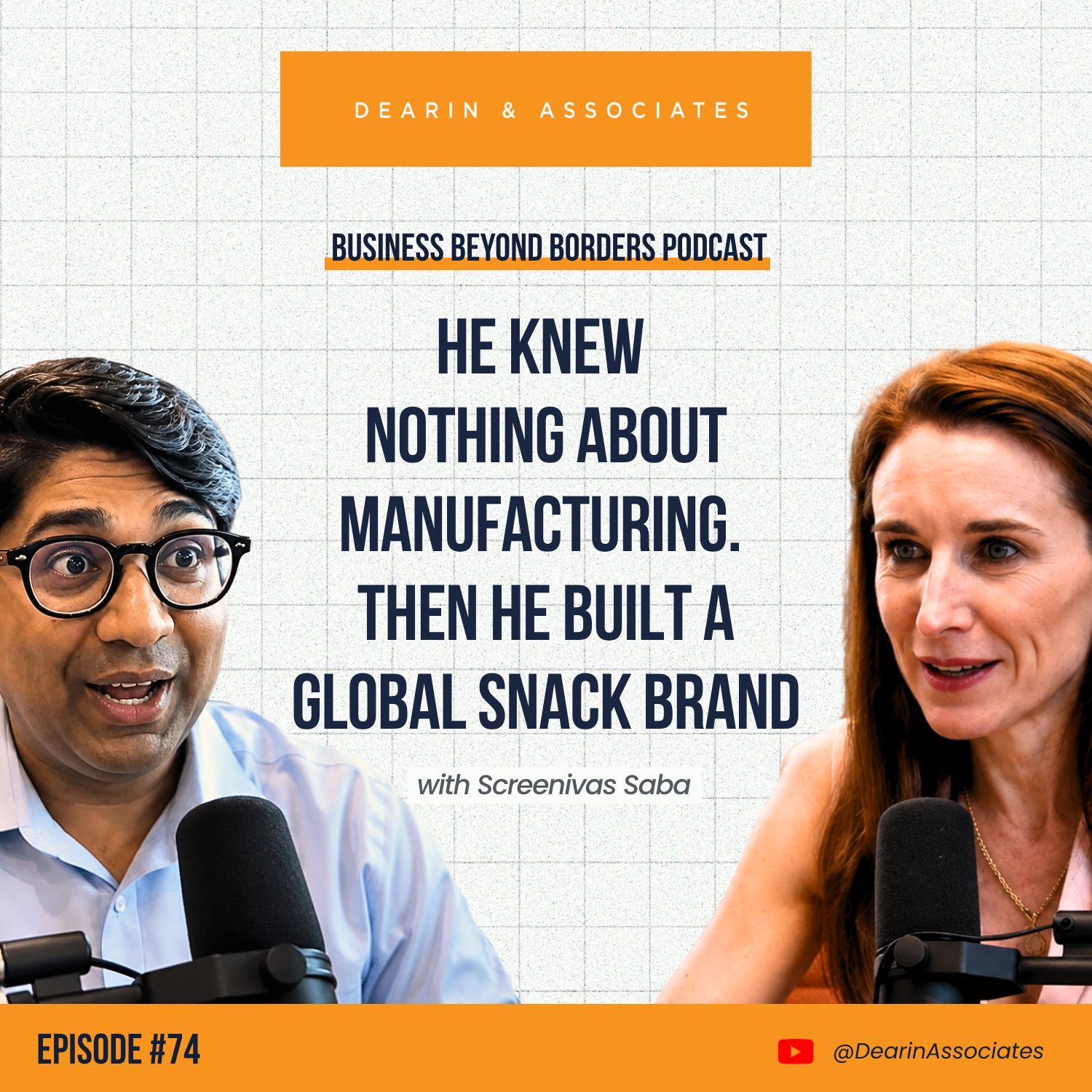
[00:00:00] Speaker A: So during COVID when the world was shut down, I think every week I would send a new sample box to our customer in the us and over time, I think I must have sent like at least 30 or 40 different samples of one every week. And because they would say, okay, this is too salty, this is not crispy enough. This is this and that. Whatever feedback they had, I would incorporate it in this, keep shipping. I think that approach, I think they appreciated it and that's how we were selected for this one private label customer.
[00:00:26] Speaker B: Building a global consumer brand is one of the hardest challenges in business.
Getting a product onto supermarket shelves in another country requires distribution networks, retailer trust, and often a fair amount of persistence. My guest today is Srinivas Saba, managing director of Uncle Saba's Papadoms, a snack brand that has expanded from Southeast Asia into international markets including the United States and Australia.
I met Srinivas when my firm, Deeran and Associates, worked with Uncle Sabas to organise distributor meetings in Australia as as well as part of their international expansion strategy. His story offers a fascinating look at what it takes to turn a traditional food product into a global snack brand. Srini, welcome to the show. I was curious. You mentioned when we were chatting before that the whole Uncle Saba's thing started with something quite unexpected. And what I remember from your story was that you were about 15 and you ate a papadom when you were in the uk.
What, what happened in that moment?
[00:01:31] Speaker A: This, I think, when I think about Uncle Sabas, I can trace the lineage, as it were, all the way to the time I was in boarding school in the uk.
You know, we used to have a little tuck shop and we used to get all kinds of knickknacks over there. And for the first time in my life back then, I saw walkers had, I don't know what the flavor was, but they had a poppadom chip. And, you know, I just come from India to the UK and everything was, you know, still a bit new to me. But when I saw this, it was, you know, I was kind of pleasantly shocked, but also surprised. So I thought I had to try it. And lo and behold, it tasted great. And it was something I'd never tried before. A poppadom in, I guess, sour cream flavor or whatever it was back in the day. So I thought, hang on, there must be something in this, because even up until that point, my dad had a.
A food distribution company, which we still have, and poppadoms were one of our mainstays. So I thought, okay, you know, somebody's done it somewhere in the world. So this is worth keeping an eye on.
[00:02:32] Speaker B: Do you feel like you got the inspiration for the whole brand in that moment and then maybe kind of realized it later? But do you think that was really the genesis of it?
[00:02:42] Speaker A: I don't think. I don't know if it's the inspiration per se. It was somewhere tucked away in the back of my mind. But I thought that here is somebody who has taken an idea and who has commercialized it and people love it and, you know, they've made a go of it. So I thought it's been done successfully before, but it was only 10 years after that incident that I really, you know, thought about starting the Uncle Sabah's line. So. Yeah, so it was a long time between the two.
[00:03:09] Speaker B: So your dad started the business in the 1970s?
[00:03:12] Speaker A: That's right. No, my dad has had a very kind of storied career.
He's done all kinds of things primarily related to food. So he used to be a commodities trader, food importer, distributor, etc. So I think this, he started, I guess in the late 60s where he essentially took over a small provision store that my grandfather had and he built it and expanded to various kinds of food product lines.
And in the 70s, I think it really started, you know, to get going. And he, he's tried everything from rice, mangoes, cashew nuts, you know, you name it. So I guess food has always kind of been very near and dear.
[00:03:55] Speaker B: So how did that business play a role in the creation of Uncle Sabas? What, what, what happened there?
[00:04:02] Speaker A: You know, I think that business, I think mainly kind of vicariously because I would always hear stories from my dad about all the things that he had done, all the things that he was planning, et cetera. So I would, in, you know, over the years, I just had heard so many great adventures of his about how he, you know, imported new product, how he went to Africa to buy some cashew nuts on essentially on a whim, all kinds of things that I don't think I would. I, I don't for sure, I don't have the kind of the, the chutzpah to do.
But I, I think what it really kind of reinforced in me is that, you know, my dad took a lot of risks, calculated risks, etc, and sometimes I felt that you need to, you know, give it a shot, whatever it is. So I think that was the main takeaway, that even if I didn't necessarily have a background in something, it was worth trying.
[00:04:58] Speaker B: And so did Uncle Saba grow out of the family business or did you and he really create it for you or how did that work?
[00:05:06] Speaker A: I think it's more of the latter. So my this, my dad was always talking about, you know, we used to have, we still have a poppadom ready to cook, brand called Taj Mahal, which does, I think very well in Malaysia and Singapore. And every time he would invite his friends over, etc who are not necessarily Indian but literally anybody else, you know, they would have like a kind of a bucket of papadoms and by the end of the evening it would all be gone. So I think that the realization for him was that, you know, people really like it but nobody who's, you know, not of a South Asian background, nobody would even bother trying to cook it on their own. So he's. So he would always tell me, like, why don't we try to, you know, reposition this as, you know, as a snack so that, you know, friction of needing to make it wouldn't be there.
And in 2014 I got involved and, you know, we decided jointly that we would try to make this into a product. So that's how it got started.
[00:06:02] Speaker B: Do you remember the day or where you were when you decided or the conversation that you had not.
[00:06:08] Speaker A: I mean it's, it, it had happened kind of over the years in bits and bobs, but actually in 20, I remember the series of the incidents which led up to it because back then my dad had a rather terrible fire accident when he was at the temple and he fell and he, you know, I think he had a lot of second and even some third degree burns and he was the one really spearheading the project. So. But when he was, you know, in hospital for I guess close to three months in the hospital and then three or six months at home, that's when I decided to step in and I thought, you know, look, it's worth giving it a shot now. So when he was getting better, I used to make frequent trips to Malaysia and to Singapore etc to try to get it going. So I think it took nearly a year and a half to set everything up. So I remember the set of circumstances leading to it really well.
[00:07:04] Speaker B: So, you know, pardon the pun, but a bit of a baptism of fire for you?
[00:07:08] Speaker A: Yeah, absolutely. In more ways than one. That's right.
[00:07:11] Speaker B: Wow.
When we were chatting before, you said to me that one of the most uncertain moments in the business was when you started manufacturing in Malaysia. Can you tell me a bit about that?
[00:07:22] Speaker A: Yeah, sure.
You know, I had no background in food manufacturing at all.
So after Uni. I was working in a kind of supply chain logistics startup for a while and I was kind of thrown into this. So I knew nothing about food manufacturing systems involved, etc. So I had no idea how to do it. But the One thing, the two things that really helped me were YouTube and Alibaba.
The reason being every time I wanted to know how a machine worked, for example, I would go search on YouTube and you'd have so many vendors, still the case today, who would put a video of how their machines worked. And once I'd find those, I'd find the names of the vendors and contact them on Alibaba. And usually they would. So many of these vendors are, you know, were very supportive. They would explain how it worked, what the costs are, what I should be aware of, etc. Etc. And then sometimes I would even like meet with these vendors in person, either Singapore, Malaysia, elsewhere, etc, So I knew nothing about it. But the, the, what I did to learn was extensively use YouTube and Alibaba, you know, at least in the initial years, just to get a sense of what the process entailed because I had no background.
[00:08:36] Speaker B: That is crazy. So you just taught yourself how to build a manufacturing plant in Malaysia?
[00:08:42] Speaker A: Essentially, yes. And the good thing is that any vendor, they're always so happy to like and back then I was, I mean, much younger. So people are always happy to give the new guy a go. So they're, they'd be very generous in their time explaining contacts, etc. Etc. So I just meet these people, you know, many, many times. Some of them ended up becoming friends as well. So I think that's how I learned, you know, everything that needed to be done in the initial days.
[00:09:09] Speaker B: And so what was the year that you decided to move beyond just the domestic market and look at international and what, what was the trigger for that?
[00:09:17] Speaker A: Yeah, so, you know, I think pretty much from the get go we were looking at the international markets because initially when we started it was just Malaysia and Singapore and that business took a little bit of time to get going. So the first full year of operations was 2016.
But you know, things were slightly slow then, so I wasn't really sure how things are going. But then what we did do, even before we started, even in 2015, is that I used to attend a lot of trade shows and expos and I met so many people from all over the world, many of whom the idea of the product connected with because it's very easy to explain to somebody a ready to eat poppadom chip or Pop it on in a can like a potato chip. And so like intuitively people would understand what the concept is. And so they would ask me for quotes and saying that, ah, it could work out in Australia, in wherever, in Japan and in Europe, etc.
So you know, I tried for all of these avenues and lo and behold, some of them worked out. But the other thing that really helped us, so in Singapore there's, there's a really like iconic store called Mustafa. It's a 247 department store of sorts. And especially before COVID a lot, I mean it's still a lot of tourists go there, but I think slightly more before COVID And so many people would find our product either in Mustafa or at the airport and they would take a picture and get in touch with, with us. So exports kind of happened organically. So from this, from Mustafa or at the airport. And I was kind of really surprised how customers found us. So that was something that I never anticipated.
[00:10:58] Speaker B: That's sort of like the dream scenario, isn't it?
[00:11:01] Speaker A: Well, I don't know about that, but it's just one of these happy coincidences, I guess.
[00:11:05] Speaker B: This episode is brought to you by ofx. One of the things we see all the time with companies expanding internationally is that the strategy might be sound, the market choice might be right, but the financial plumbing is just not keeping up.
Managing global finances can quickly turn into juggling currencies, unpredictable cash flow and far too much admin.
OFX helps take that friction out. They're trusted by more than 37,000 businesses worldwide and they make it easier to pay international suppliers and teams and local currencies while saving on FX fees and simplifying the admin through one platform. If your business is operating across borders, OFX gives you clearer visibility and more control over your cash flow.
You can find out
[email protected] and we'll put a link in the description.
And then of course, you managed to get the brand into the US which is a giant milestone for any business.
And you got it in front of some really enormous players.
Can you say more about that and how you actually made those partnerships happen?
[00:12:12] Speaker A: Sure.
The U.S. has been, is and will be, you know, a significant focus for me personally, because, you know, what I realized was in certain markets you get a high margin but not enough volume. In other markets you get excellent volume but not enough margin. The one country where you can get both a decent a great margin and great volume is the US and you know, all trade is, is kind of, at least for us, it's it's in the US dollar and manufacturing Malaysia, where the Ringgit had been weak and selling to the US was always an attractive kind of proposition.
But so, okay, I decided we have to get into to the US but then one of these things, I had no idea how. And also it's, you know, this intense competition in the US as well, which I either ignored or didn't anticipate as much.
So what really happened was we.
So we do a lot of private label in the US and we also sell in our own label in Costco over there. But the private label contracts, we were in discussions with them with our, one of our major customers since 2017. And how it happened is I just sent them a cold email and somehow the person on the other side replied to my email, which seldom happens, but, you know, it's one of these lucky moments in life. And then I was discussing with them, I think, for nearly two or three years about recipes, pricing, this and that, and they came and saw the factory and everything, but nothing happened. But I think the kind of flip was during COVID because all factories, at least in the initial part, most factories in the world were shut down. Ours also was for a brief moment, but certain parts of it were still active. So for example, where we had to make the formulations, we had a small frying plant then as well. So during COVID when the world was shut down, I think every week I would send new, like a new sample box to our customer in the US and over time, I think I must have sent like at least 30 or 40 different samples, so one every week. And because they would say, okay, this is too salty. This is not crispy enough. This is this and that. Whatever feedback they had, I would incorporate it in this, keep shipping. And I think that approach, I think they appreciated it. And that's how we were selected, you know, for this one private label customer.
[00:14:44] Speaker B: You must have so much patience, Srini.
[00:14:47] Speaker A: You know, this is one thing that I've kind of been forced to learn the hard way, and I'm still learning it, which is the value of patience. But hopefully it's a lesson that'll stick.
[00:14:57] Speaker B: Did you ever feel there's no other
[00:14:58] Speaker A: way to do it? You know, I don't know how else to have done it.
[00:15:01] Speaker B: Did you ever feel discouraged?
You know, while you were waiting to get, you know, to know whether you'd be successful at getting into Costco? Did you ever think, I can't keep doing this.
[00:15:11] Speaker A: I'm just fed up, you know, for sure it happens. And you know, I think in this business it's so many ups and downs, etc. But sometimes you have no choice just to keep trying, and if it works out, great. If not, you kind of have to pivot and do something else. But I guess no matter what happens, I think I shouldn't try to take things personally, because the most important thing is, did I try my best? And in many occasions I think I did well.
[00:15:40] Speaker B: Clearly you did something right, because getting into Costco is really, really difficult. I mean, these guys have got such high standards.
From your experience, what does it take for a small brand to earn the trust of a giant like Costco?
[00:15:54] Speaker A: I think to have a good product, good price. Of course, that goes without saying. But then anybody who wants to get into somebody like Costco, the good thing is they're very clear in what they want.
What I mean by that is, you know, they have a certain set of standards which they want you to meet. They have a Costco audit, they have saidx, which is a certification for the ethical treatment of people. So they know exactly what it is that they want. And everywhere in the world these resources are available.
So consultants who can help you get those certifications, change your systems, etc. So being willing to do what it takes, even without there being some assured reward on the other side, I think that's the most important thing because the ecosystem is so well developed all over the world. Wherever there's any kind of food manufacturing taking place, that, that, you know, you just have to listen to them and get your systems up and, and do. And keep doing what it takes. I think that's the most important thing.
Of course, I'm assuming that somebody already has a product that they believe in at the right price, quality, etc, over and about that just, you know, they make it quite easy. Well, they make it very straightforward for suppliers in terms of their expectations. So that itself is a good thing.
[00:17:12] Speaker B: Yeah, I think they're pretty great to work with, aren't they, once you get in there and get on board. You were saying to me also that obviously you got into Costco during this pandemic period, or that was sort of the genesis of it, where you were testing every week and sending them and then incorporating the feedback. And I think when we were chatting before we started to record that, you'd said to me that the pandemic was sort of like a turning point or an inflection point for the business.
Can you tell me a little bit more about that? I mean, I know there's a Costco piece to it. But were there other things that happened that really generated that inflection during the pandemic?
[00:17:49] Speaker A: Sure. So Costco is slightly later during the pandemic. It was a different customer. Costco is, I think, last year, and we started year before, and it was last year. But during the pandemic, you know, like, people were used. I mean, as is the case now, people are okay with having meetings online, much as we're doing right now. It was not so much the case before, and I think that it was easy to jump on a call with anybody on relatively short notice, and people are willing to try things because people are stuck indoors, etc. And food consumption is going up.
So I think being able to meet with people online and for them to kind of, you know, they had no other choice. So we're able to, like, you know, get. Get through a lot of customer. Get through to a lot of customers during that time because, you know, it was possible to do so. And also, I think the fact that we kept the factory going, we changed so much of the layout to make sure we're in compliance. You know, we were abiding by the laws, et cetera. But the fact that our factory was operating, that was a real bonus because so much, you know, so many people weren't, and the fact that we could. It really helped.
[00:19:01] Speaker B: It sounds like a classic case of crisis being an opportunity. You know, the world shut down because of COVID and here you are continuing to operate the factory and powering on and actually seeing for your product go up and then use that as a gateway into an international market, in a sense.
[00:19:16] Speaker A: Yeah, I think. Absolutely right. But the thing is, what I didn't anticipate is that every year had its own version of crisis, hopefully, which will turn into opportunity. So, you know, I. I think, you know, this is not something that I anticipated before, but you have to get into that crisis opportunity mindset on a continuous basis in a job like this, in a role like this, because there's so much like, um. So much. It's such a dynamic situation all the time. There's never a dull moment.
[00:19:46] Speaker B: Rightly or wrongly, it makes you more crisis proof. I mean, people always saying to me, oh, I don't know if now's really the right time to go international.
And I say, and I'm allowed to say this on account of being a woman, but, you know, it's like having a baby. It's always a good time. It's never a good time. There are always opportunities, and there are always things that can be very Inconvenient or go wrong. And so you have to look at it and just say, is this something that I want to do? Do I want to turn the brand into a global brand? And if you do, then you just, you know, price in the rears, work around the obstacles, keep. Keep your head down and keep going 100%.
[00:20:18] Speaker A: You know, as a maxim, I always tell myself, you never try, you never know.
And that's essentially it. You know, sometimes it works out and sometimes it doesn't. But. But importantly, it's important to, like, keep trying. Is. Is.
[00:20:30] Speaker B: Yeah, I totally agree with you about that. Well, if you look back now. So it's been, what, 12 years?
[00:20:38] Speaker A: Yeah, I guess thereabouts. So 20, 14, 15. So yeah, 10, 11, 12 years thereabouts.
[00:20:44] Speaker B: What do you think are the most important turning points in turning the company and the brand into an international one?
[00:20:51] Speaker A: I think there's been so many, like, ups and downs over the years, but the fact that we persisted and you know, from without necessarily the right background, et cetera, the fact that we could scale and enter the US etc. Etc. And all these other international markets, I feel that was a very, like, that's. That was a good thing. And, you know, and the thing is that.
How do I put it?
Poppadoms are essentially a cottage industry, or at least they were. So it's done in a very small way in, in most of the world. But at least we tried to play our part in trying to industrialize this industry so making, you know, the supply
[00:21:33] Speaker B: chain
[00:21:36] Speaker A: kind of weatherproof, as it were, you know, despite, you know, how shall I say this? So poppadoms are still made in a very traditional way in many parts of the world, but we've industrialized the process and we've made it much more consistent. So even from the supply side, making sure that we are able to kind of modernize this industry and from the demand side as well, that we've taken a product which of course, has South Asian roots and. But repositioned it to a global audience. So I think that entire process was, you know, I think that's something, right, that we've done.
[00:22:10] Speaker B: And was there ever a moment where you doubted and you thought, I don't think this is going to work every single day.
[00:22:16] Speaker A: You know, there'll be something small which, which keeps coming up. And, you know, like I said, in this kind of business, there's so many, so many ups and downs. But even I think what I realized is that it may not work out in the way that you're thinking, but some manifest of it always will.
So in that sense, you know, it's important just to like, keep adjusting course pivoting and, and keep going because the original idea, I guess, wouldn't manifest exactly how you envisioned it, but some version of it will. And you have to keep an open mind, you know, not just be too stuck to whatever initial conception you had of it.
[00:22:57] Speaker B: I love that philosophy.
[00:22:59] Speaker A: Yeah.
[00:22:59] Speaker B: Here's the hard way question.
[00:23:01] Speaker A: As somebody who always wanted it things a certain way, but life has taught
[00:23:05] Speaker B: me otherwise, very important question. What is the best flavor of Uncle Saba's Papadoms?
[00:23:10] Speaker A: Oh, I think, well, everybody has their own. I personally like the sweet chili because the chip that I actually used to like when I was in school was the Walker's Thai Sweet chili, which is why I did our sweet chili as well. So that's probably my favorite.
[00:23:24] Speaker B: Can we put a link to it in the show notes?
[00:23:26] Speaker A: For sure, we'll do that.
[00:23:28] Speaker B: Excellent.
So my last question for you is this. If somebody wanted to build a global food brand and they were starting out where you were starting out back in 2014, what would you tell them to expect that they probably haven't thought of yet?
[00:23:41] Speaker A: Expect higher highs and lower lows than what you thought. I think this is this thing because when you get into it and when things work out, you have so much momentum, etc. And you feel things are working out, but then suddenly things change and then it's, you know, very hard to, you know, accept when things aren't going your way, etc. So I think you just have to be consistent and like I said, accept, accept the things will work out, but maybe not in the way you wanted, but it's important just to keep going, keep trying, and no matter what happens. And this is something that I think now, everything that you've experienced in the journey, the contacts, the relationships, the knowledge, expertise, supply chain, scaling up, Costco this, that, none of that will ever leave. So even if it doesn't work out for the brand that you're thinking of, you can always apply those skill sets to something else. So even if the brand doesn't meet your own expectations, I don't think it's all lost because there'll be so many points in the journey that you've learned things which others most certainly won't have that you can apply to something else. So I think looking at it from that perspective also helps a lot.
[00:24:59] Speaker B: Srini, it has been so great to have you on the show. Thanks for carving out some time to hang out and have a chat. I am absolutely looking forward to seeing you next time I come up to Singapore and or Malaysia or you're traveling down this way to Sydney.
[00:25:13] Speaker A: My pleasure. And thank you so much. Cynthia and I really enjoyed the conversation as well. And look, even when we were working on the project a few months ago ago, I actually really appreciated your insights about the Australian market, international market, etc. And yeah, you know, for anybody who wants to kind of, you know, learn to internationalize, I think they know who in this conversation they should turn to.
[00:25:38] Speaker B: That's too nice of you. Well, great to chat to you today. And we will we'll connect again really soon, I'm sure.
[00:25:44] Speaker A: Will do. Thank you so much. Have a great day. Bye.