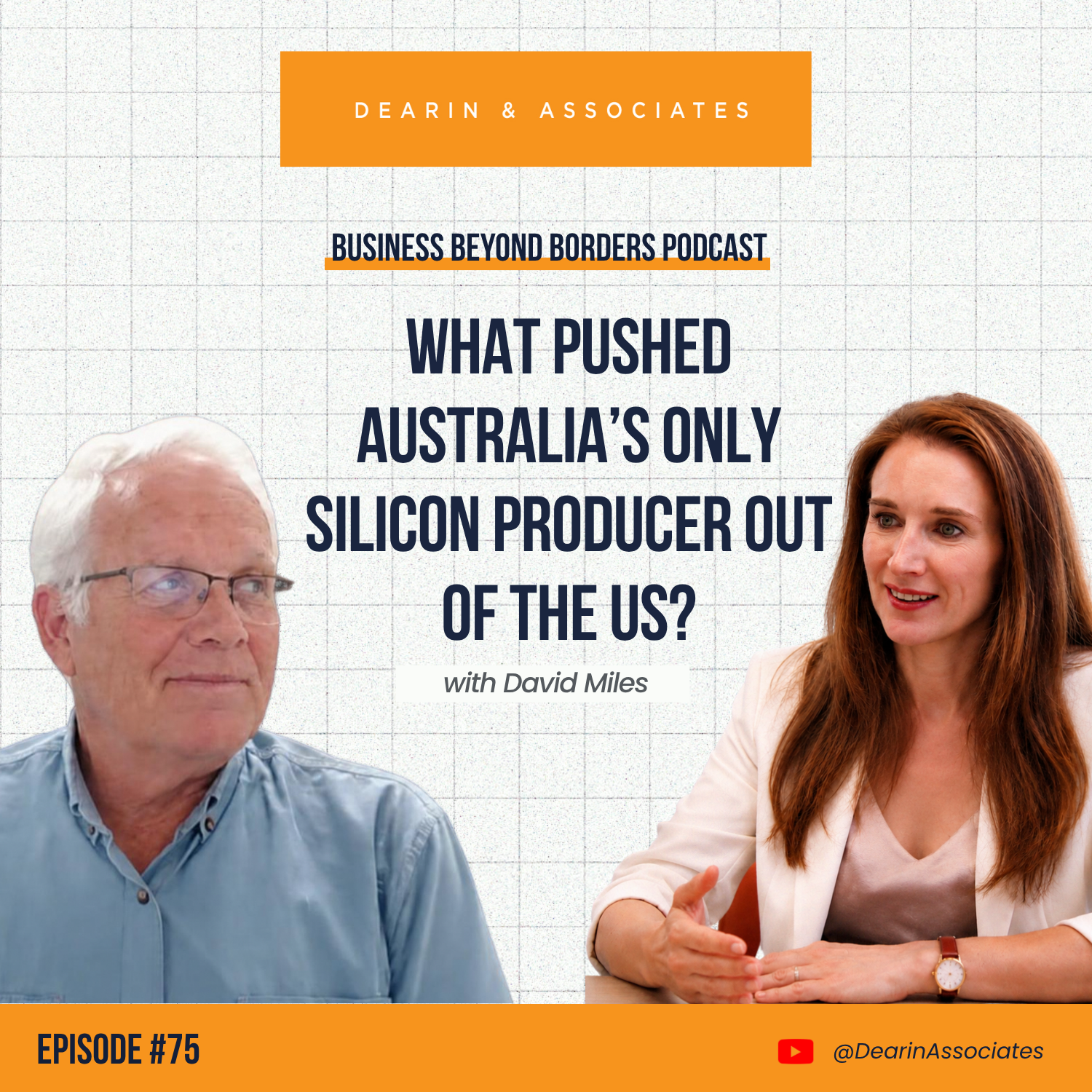
[00:00:00] Speaker A: A few weeks ago, I made a video about a Western Australian company called Simcoa. Simcoa is Australia's only producer of silicon metal and until recently it sold around 10,000 tonnes of that production to the United States every single year. Then a US trade investigation resulted in additional duties of around 40% and Simcoa made a very significant decision. It left the American market. Now, that video generated an extraordinary response. More than 100,000 people watched it and the comments were full of speculation about what happens next. So rather than keep speculating, I wanted to speak to the person actually involved in making those decisions. David Miles is the Vice President of Sales at Simcoa and he's been the company's public voice throughout the dispute. David, welcome to business beyond borders.
[00:00:47] Speaker B: Thank you. Nice to be here.
[00:00:49] Speaker A: When did you realise that Simcoa was actually going to have to leave the United States?
[00:00:55] Speaker B: Once we received the final decision as a result of the ITC hearings and the Department of Commerce ruling.
Once we, once that became official, that was it. I think the date was became active as of the 1st of August or something like that, 10th of August. Once that date was in, we were hit by the additional duties.
[00:01:16] Speaker A: And do you remember whether there was a particular moment or a particular meeting when the decision just suddenly became inevitable?
[00:01:24] Speaker B: I think to be fair, we'd work very closely with our legal team in the United States.
They had warned us that the chances of us winning was not great.
At best, it was a 50, 50 decision.
Unfortunately, the U.S. commerce Department, invigorated by MAGA, we knew that we had an uphill fight.
[00:01:46] Speaker A: So it wasn't exactly a surprise.
[00:01:48] Speaker B: Not a surprise, but I was hopeful that good guys win.
[00:01:52] Speaker A: That must have been very disappointing, certainly
[00:01:55] Speaker B: when you spend two years working towards a final outcome of business. And you know, I think we were on the ver landing quite a significant supply contract into the US polysilicon solar industry.
And quite frankly, you know, after two years you suddenly think, well, two years, that's a waste.
[00:02:14] Speaker A: Yeah. Gosh, how important had the US been to Simcoe commercially?
[00:02:19] Speaker B: I think it's important from the point of view. It's in silicon's a very global market and it's very competitive. And the explosion in demand of silicon versus polysilicon, which goes into making solar panels, was a growth area.
And you know, we were very keen to attach ourselves to a growth market.
The easiest one to gain access to and certainly the one that had the most money behind it was the United States.
[00:02:44] Speaker A: And I mean, you said you knew from early on that There was an uphill battle. But did you think at any point there was a realistic chance that you might resolve the issue and be able to stay on in the market?
[00:02:54] Speaker B: Absolutely. As I said to you, I firmly had some faith that good guys win and that, you know, the, that, you know, there would be some reality check here. The United States needs to import. That is a fact.
And it's just a question who they want to import from. And of course, sitting here, I'm thinking, hang on, where are Australia? Where are your allies?
[00:03:18] Speaker A: Yeah, how many. I mean, we know that China controls most of the global supply of silicon metal, but aside from Australia, how many other friendly, if you like, countries are there that actually produce and export silicon metal to the States?
[00:03:34] Speaker B: The two major ones is Brazil and Norway.
So Norway was also targeted, by the way, in this trade dispute.
And Norway are a very accomplished producer as well.
[00:03:50] Speaker A: So it doesn't really leave a lot left in the market, does it? If, then, if Australia and Norway both shut out.
[00:03:56] Speaker B: Well, particularly both of us were very concentrated on this solar, emerging solar business and, you know, we're both very good at that business.
And so I think we were absolutely targeted by the US domestic producers because of the position that we were going, we occupied in the US Market.
[00:04:16] Speaker A: And once those final duties were known, what did they actually do to the economics of selling your silicon metal into the States? You know, how did those numbers break out?
[00:04:26] Speaker B: Well, effectively, when, like we're just the same as a domestic producer, we have to, we have to meet the domestic price.
We don't get the advantage of adding 32 and a half percent onto the price and the customer paying for it.
[00:04:40] Speaker A: So you couldn't have passed that through to the customers at all?
[00:04:44] Speaker B: Not, not a chance. No chance whatsoever.
[00:04:48] Speaker A: And could you have absorbed any of that or was that. It was again, just way too much?
[00:04:52] Speaker B: No, remember, we already had 12.5% against it, so.
[00:04:56] Speaker A: Yeah, yeah.
[00:04:58] Speaker B: And of course, you know, the domestics have got none of that. And, and of course, please remember that exporting into the United States is not a cheap exercise.
[00:05:07] Speaker A: And what was the reaction from your U.S. customer base? I mean, what did they say to you?
[00:05:16] Speaker B: That was it? I mean, we wanted them to join with us to fight the decision.
But, you know, I think there's a, maybe there's a reality check from them as well. Is it worth the fight?
Yeah, and, and, and I suppose, you know, is there an opportunity? Can they source material from elsewhere?
Yeah, probably they can. It's a, it's probably a backward step, but they can do it.
[00:05:39] Speaker A: And so not everybody will have the context on this story. So for people who haven't followed the investigation closely, can you just tell us about what the US authorities actually found against Simcoa and what was it specifically that you disagreed with?
[00:05:57] Speaker B: Well the big issue is what we call the CVD countervailing duties.
The allegation is actually made against the Australian silicon industry.
In other words, the allegation was made against the Australian government of which there is only one producer in Australia and that's Simcoa. So clearly we're targeted.
The allegation was that we received unfair subsidies from the federal and state governments which enabled us to sell our silicon into the United States at unfair prices, which discriminated against or unfairly treated the US domestic industries.
The big issue, if I may just touch, was where that subsidy was, was basically cheap power.
Cheap power. So the mere fact that we're an energy intensive industry and we were receiving a special rate of power under what we call dsm they judge, the US Commerce Department judged that to be a subsidy which it's not by the way. It's DSM for your.
It's called demand side management is actually accepted globally under the WTO rules and so does it.
[00:07:15] Speaker A: Does that, can you just explain for people who don't know what is demand side management? Just give us a bit of a picture of that.
[00:07:21] Speaker B: Very simple, very simple power, Power demand. Of course the across a 24 hour period is not flat. So there are periods of peak demand typically between 4 and 7pm in the afternoon. So rather than build massive power stations to cope with that peak that occurs between 4 and 7, big energy users are encouraged or by government, by people who control the power networks are encouraged to shut off their power demand during those peaks.
And you know, we receive some compensation for that. But it's a very smart way of doing things and it saves you from having to build billion dollar power stations to take care of peaks.
It's practiced all over the world.
[00:08:07] Speaker A: And so what you're saying is you're using a fairly commonly accepted means of cooperation with government where you give some energy back to the grid.
Does that mean then that your domestic competitors in the United States would be doing the same thing?
[00:08:23] Speaker B: Absolutely, absolutely.
[00:08:27] Speaker A: But they wouldn't have classified what they did as an unfair government subsidy.
[00:08:31] Speaker B: No.
Remember the accusations against. The accusation against is against us, the importers. It's got nothing to do with the domestics.
[00:08:42] Speaker A: I know, it just seems a bit sort of uneven to apply one set of rules to an importing business.
[00:08:52] Speaker B: You, I 100% agree with you. It feels terribly, terribly unfair and it doesn't agree with WTO rules.
[00:09:01] Speaker A: Okay, now look, you've said publicly and this was really where the story came to my attention in the first place, we're not going to be going back to the United States a couple of months in. Is that your position, do you think it will be a forever position?
[00:09:18] Speaker B: In the last week we've actually made a, we've made a decision that we are going to try and appeal the decision.
It hasn't got a high rate of success on don't think. But the point is, you know, we believe we're right and also the Norwegians, Norway's also decided to appeal.
So we think we're going to give it a go to appeal and let's just see what happens.
[00:09:48] Speaker A: Okay.
When you just to go back to the dsm, the demand side management piece and the application of that in Australia and the, I guess different interpretation or application of that in the United States. When you saw that US interpretation, did you think about what it might mean for other Australian manufacturers who are participating in similar arrangements?
[00:10:15] Speaker B: Absolutely. It puts a target on the back of every Australian industry that is an energy that is taking a decent size amount of power. So energy in any energy intensive industry in Australia has now got a target on its back.
[00:10:33] Speaker A: So what does that cover? I mean, people who don't know, you know, you're doing silicon, if you're an
[00:10:39] Speaker B: aluminum smelter, if you're a copper smelter, a zinc smelter, anybody that's using a large amount of power and you're getting a cheap rate out of the national grid.
[00:10:52] Speaker A: Okay.
[00:10:53] Speaker B: I mean it puts a big target on Australian industry.
[00:10:57] Speaker A: And have other Australian companies spoken to you about it? You know, have you been fielding phone calls or comms from people wanting to know?
[00:11:05] Speaker B: No, not at this stage, no.
[00:11:09] Speaker A: But is it something that you think other exporters or maybe even the Australian government should be paying attention to at this point?
[00:11:16] Speaker B: Certainly. But I think all that does though it's a warning to Australian industry that if you're going to export into the United States, you need to understand the geopolitical risk.
If you, if you're, if you're intending to export to Europe or Asia or something, then then the risk doesn't exist in, well, maybe a little bit, but nowhere near the United States.
[00:11:42] Speaker A: There is another aspect of the timing that I think is quite difficult to ignore, which I mentioned in that initial video that I made that got us in contact and got us speaking and that is that less than a year ago, before Simcoa left the US market, Australia and the United States signed a major critical minerals framework which was designed to develop more secure and diversified supply chains.
At the time, what did you think that agreement meant for a company like Simcoa when it was announced?
[00:12:20] Speaker B: Well, to me it's, you know, cooperation and friendship. You know, there's no trade barriers.
Unfortunately, the result goes to show you that a critical minerals agreement does not give you any protection from trade action, from commerce departments who wish to take out trade action. It gives you no protection at all.
[00:12:44] Speaker A: And did you. So I assume you thought at the time, hey, this is good news, it'll improve our position, right?
[00:12:51] Speaker B: Certainly.
[00:12:52] Speaker A: This episode is brought to you by ofx. One of the things we see all the time with companies expanding internationally is that the strategy might be sound, the market choice might be right, but the financial plumbing is just not keeping up.
Managing global finances can quickly turn into juggling currencies, unpredictable cash flow and far too much admin.
OFX helps take that friction out. They're trusted by more than 37,000 businesses worldwide and they make it easier to pay international suppliers and teams and local currencies while saving on FX fees and simplifying the admin through. Through one platform. If your business is operating across borders, OFX gives you clearer visibility and more control over your cash flow. You can find out
[email protected] and we'll put a link in the description. And did you, I mean, when, when this decision came out, I'm assuming from what you've said that you engage with both the US Department of Commerce and also the Australian government. What, what response have you had from, you know, the government's on both sides through the process. How has that gone?
[00:14:00] Speaker B: Well, I think dealing with the U.S. commerce Department, I think is extremely difficult. I mean, clearly they've not, clearly they've not listened to any of our arguments whatsoever to get to the current position. I mean, clearly, you know, I mean, we, we would have put substantial arguments to them about the benefit of our imports into the United States and we would have had customers supporting that to our position. So talking to U.S. commerce Department is not easy and quite frankly, I'm not sure that they really want to listen.
As for the Australian government, remember the action was initially taken against the Australian government. They've, to be fair, they fought very hard to assist us, but the decision has not gone in their favour at this stage. I'm not aware that the Australian government is prepared to lodge an application to reassess the situation.
Maybe it's just too hard.
[00:15:06] Speaker A: Yeah.
I mean, thinking about the difficulties, how do you reconcile the US wanting secure, diversified, critical mineral supply chains on one hand, and the fact that Simcoe, as the only Australian producer, has simultaneously had to step out of the market because it just can no longer afford to sell there? How does that work?
[00:15:32] Speaker B: There's a disconnect. There's a complete disconnect between what is on one policy coming out of, let's say, the White House versus what's coming out of the U.S. commerce Department. The two are not in sync.
It's one doesn't support the other and they're in conflict.
[00:15:54] Speaker A: Yeah.
So that's all in the past, apart from the fact that you're going to appeal. But, I mean, let's think about what happens next. Leaving the appeal to one side for a minute. You've now got about 10,000 tons of silicon that used more than that. Well, you know, 10,000 plus tons of silicon that used to have U.S. customers.
Tell me a bit about how you actually go about replacing that business.
[00:16:21] Speaker B: The global silicon industry is not that big.
We kind of. We certainly know all the producers outside of China. But in terms of the emerging solar, polysilicon business, which polysilicon is where they refine the silicon into solar grade, the amount of those plants in the Western world is very small.
And we know just through local news sources, et cetera, which countries are planning to invest, which companies are expanding, et cetera. So we use the commercial telegraph line, if you like to know where emerging markets are happening.
And of course, once we know that, we just got to get on our bike and put our best, best foot forward and hope that we can be the supplier of choice.
[00:17:13] Speaker A: And so when you're assessing one of these new markets, how do you go about working out whether it's genuinely attractive to Simcoe? I mean, is it about demand and growth? Is it about the price? Is it about the competition? What. What are you really looking at?
[00:17:26] Speaker B: All of that? All of that, Cynthia, you know, at the end of the day, you know, which companies, you know, where is the growth opportunity?
How much do they want? When what the chemical composition or specification that they want? So in other words, what is the exact. Does that and does that match what we do?
And then, of course, most importantly, do. Is it a relationship we can establish? Is it, you know, we. These. Once you build these relationships, they tend to last, you know, for 10 years, you know, longer than that.
So you need to, you know, you need to have someone, you can trust.
[00:18:06] Speaker A: Absolutely.
[00:18:07] Speaker B: Because you can't afford to just, you know, lose 10, 20, 30% of your business every year and start again. You need continuity.
[00:18:17] Speaker A: Yeah, absolutely. You.
You've mentioned India and Southeast Asia publicly. What are you seeing in those markets that makes them interesting?
[00:18:27] Speaker B: Well, the Koreans have been on this polysilicon journey, making solar panels for some time, and we know them, we've tried for many years to break into their supply chain.
It's not easy. But fortunately, they have an expansion program that's occurring in Malaysia, the island of Sarawak.
And you know that they're going to expand their plant by about 50,000 tons of demand by about 20, in 20, 27, maybe 28. We see that as a tremendous opportunity. It's right on our doorstep.
And already we've made contact with the Koreans, we've trialed our product, and, you know, hopefully what we know it works.
And as for the Indians, well, we, again, we know that the Indian government is very keen to establish its solar panel supply chain. We know that they've handed out significant amounts of money to establish it. And we also know a very large Indian company is in the process of building a polysilicon plant, and as we speak.
[00:19:46] Speaker A: And so can it move quickly, or what's your time frame? How. How long does it take to realistically develop one of these new customers in a market which not, you know, as familiar, Two years?
[00:19:57] Speaker B: Cynthia, it's not easy.
You have to go through a qualification program, you know, you, you. And the further away they are, the longer it takes you. You've got to produce your product, ship it to them, feed it into their plant. Does it work? They got any queries, that sort of thing. And you can appreciate America is. Was probably the furthest away and whereas somewhere like Malaysia and even India is much quicker.
So in the case of Malaysia or the Koreans, we've already started the process.
[00:20:29] Speaker A: And can you do any more into Europe because you're selling to Europe too, or is that market pretty much at all?
[00:20:35] Speaker B: We're already putting substantial quantities into Europe already.
Yeah, we will put something.
Well, nearly 50% of our product already is going into Europe, so not much more we can do.
Europe is not a growth market at the moment.
[00:20:57] Speaker A: I'm curious about what it's like to compete against Chinese silicon metal producers. Where do they have the advantage and where do you guys have the advantage?
[00:21:06] Speaker B: Where do they have the advantage? Government support.
And where do we have the advantage? We have the support in terms of reliability and repeatability of our product. In other words, we compete on the basis of quality.
But you know, that only gets you so far.
That gets you a certain high level of customer.
You've got to find a customer that wants high quality product.
[00:21:37] Speaker A: And do you think people are genuinely prepared to pay for diversified non Chinese supply or at the end of the day, is it mainly about price?
[00:21:45] Speaker B: It's all about price, Cynthia. I can tell you if you ask anybody in Australia, ask them where their solar panel is made, they probably have no idea. They have no idea that their solar panel is made in the western provinces of China using low cost coal fired power stations and possibly with slave labor.
It is not the question people ask. They ask, what's the price?
[00:22:11] Speaker A: Yeah.
And when, when you're going after one of these new markets that we've just been talking about, you know, in Asia, are you, are you really choosing a market or is it really more about choosing the customers who are prepared to pay, you know, for that quality, for that reliability and that slightly premium price?
[00:22:30] Speaker B: Oh, absolutely, Cynthia.
It's absolutely part of the marketing strategy. We look for customers that require high quality product and are prepared to pay for it.
[00:22:43] Speaker A: Yeah. And have you changed the way that you assess international markets after what happened in the U.S. you know, has it, has it shifted your emphasis on political and regulatory risk?
[00:22:59] Speaker B: Yes, I mean, you have to be wary of it.
I mean, the Europeans are also acutely aware of the need to protect their own domestic industry as well.
So, you know, right at this moment, silicon is a critical mineral across the world and it's critical for the reason, for reasons of security.
So the likes of the United States and Europe, you know, are very conscious of the fact to protect their own industry because it protects their, you know, their security.
Quite frankly. Missiles don't work. They don't have silicon chips.
[00:23:35] Speaker A: Does that mean that Simcoe will also deliberately start to spread its sales across more countries to try and, you know, protect it from the kind of thing that's happened in, in the United States.
[00:23:46] Speaker B: I think it's. If that's, if that's possible, Cynthia, it's probably not a bad idea.
If one thing I've probably learned over the number of years, having too many eggs in one basket is very dangerous.
[00:23:58] Speaker A: It's like having all your, all your stocks in, or your, you know, stocks and shares in one kind of asset class. Right.
[00:24:05] Speaker B: You know, if someone had told me two years ago that what the, what administration would be in place in the United States, we might have thought twice.
[00:24:14] Speaker A: And if we're thinking about all of those markets that you could be going to, if you come up against a market and you know, it looks attractive. What would make you walk away from an otherwise attractive market? Apart from political and regulatory risk, is there anything that would make you go, actually not too hard, not going to do it, even though it looks good
[00:24:34] Speaker B: on the surface, an inability to pay the money to pay.
That would make us run for sure.
[00:24:43] Speaker A: Yeah.
[00:24:45] Speaker B: You do need, you need security of the financials. Trust me.
Covid was a big teacher in that respect.
[00:24:55] Speaker A: How do you manage that with some of the markets that you're considering? Because not every market has the same framework around payment. How do you actually.
[00:25:04] Speaker B: Yeah.
[00:25:04] Speaker A: Deal with that?
[00:25:05] Speaker B: You can, you can hire a credit risk insurance company to do it for you.
So you pay the money, they carry out, they, they do the credit risk, they offer you an insurance, and you either accept it or you don't.
That's what we do. Now, as I said, Covid was a big teacher. You think, you see some of these big companies and you think, oh, they can pay and. But you suddenly find that they're.
Their balance sheet is just absolutely laden with debt.
[00:25:37] Speaker A: Let that enable you or prompt you to walk away in that case.
[00:25:41] Speaker B: Absolutely. When the insurance company refuses to underwrite them, you know there's a problem.
[00:25:48] Speaker A: Yeah, absolutely.
David, let me finish by bringing this back to where we started. Let's just imagine that Washington removed the duties that have been put on Simcoa three years from now. Would you go back?
[00:26:03] Speaker B: Yes, we would if we could because we worked very hard to secure our position.
And unfortunately, unfortunately, because of the way the Americans have worked and they've created all these duties, the price in America is about 20% higher than the rest of the world. So it represents a good commercial opportunity if we can get back in the door.
[00:26:27] Speaker A: Yeah, but imagine by then that you've got customers in India and Southeast Asia or elsewhere and you've committed supply for a period of time. How do you. Well, how easy is it to get back then to the US Once you've committed elsewhere?
[00:26:41] Speaker B: You can't go backwards in that sense. You know, Cynthia, you know, the question you go to these new customers, the first question they say, the first question they ask you is, are you here for the long term?
They want security of supply. So once you make that commitment, I think you're pretty much, you know, tied, unless, of course, you know, you fall out for financial reasons.
[00:27:09] Speaker A: So I'm assuming that means then that if, let's just imagine the tariffs do all come off and you committed elsewhere and you want to go back to the U.S. that probably means that you have to scale up. Right. And go harder to get more production so you can go back in at a high price point.
[00:27:23] Speaker B: Good. Excellent idea.
One of the downside of what's happened so far is we have three production furnaces. We've already had to turn one off.
We were at 50 bit over 50,000 tons of output and we had to turn a furnace off in August last year, which was reduced just by 16,000 tons and we had to lay off just under 60, 70 staff, which was heartbreaking. We haven't done that for 30 years.
[00:27:49] Speaker A: Gosh.
[00:27:50] Speaker B: So we have. We have capacity to. Well, we have growth capacity now, which 12 months ago I was not expecting.
[00:27:59] Speaker A: And look after everything that you've been through over the past year, what does a good outcome look like for the company five years from now?
[00:28:09] Speaker B: Having a diversified customer portfolio of stable customers, Paying.
Paying a price which compensates us for the cost of our product.
So in other words, we're profitable and we're dealing with good, reliable customers that we can trust.
[00:28:38] Speaker A: That sounds like it would be an awesome outcome, but it.
[00:28:42] Speaker B: Life would be very easy. I could easily improve my golf handicap if that was the case.
[00:28:47] Speaker A: David, it's been so fascinating talking to you today.
I'm really grateful that you could find some time to come on the show and just unpack for us what's really been going on over at Seamco and what you're likely to do next. I will be watching the progress of the appeal if you decide to go ahead with it with interest, and I wish you the best of luck with that.
[00:29:10] Speaker B: Thank you, Cynthia. And if you hear about us through parliamentary channels, just, you know where it's coming from.
[00:29:17] Speaker A: Absolutely.
Building a successful international business takes more than just choosing a new market. If you're ready to expand internationally, we can help you to decide where to play, how to enter and what it's going to take to scale successfully. At Deerin and Associates, we help ambitious companies build and execute the right strategy and for international growth. Book a discovery call with us on our website. You'll find the link in the description below.