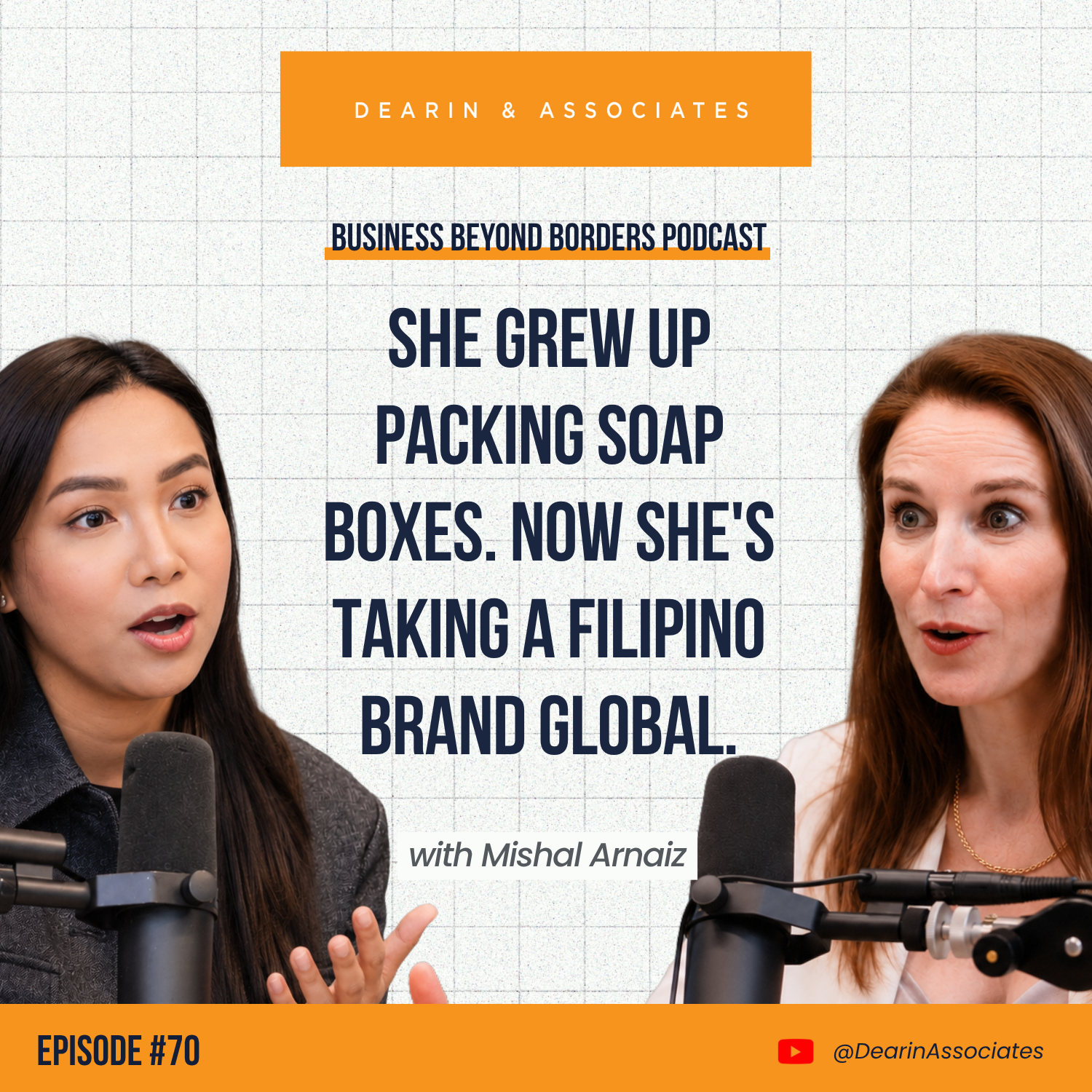
[00:00:00] Speaker A: Welcome to Business Beyond Borders. I'm Cynthia Dearin.
Many companies invest heavily in global strategy, but far fewer succeed in executing it once they encounter real markets, real partners, and real complexity. In this season of the show, I'm speaking with founders and the operators who have built businesses across borders, exploring not just how they expanded internationally, but the leadership journey behind those decisions.
My guest today is Michelle Alnaez, who helps lead Universal Skin Cosmeceuticals in the Philippines, a manufacturing company producing soaps and personal care products.
The company was originally founded by Michelle's mother, who started the business as a single parent and gradually built it into a manufacturing operation. Today, Michelle is helping guide the company through the next stage of growth, including expanding into international markets. Michelle and I met through the APEC Women's Business activator program where I had the opportunity to to work with founders and business leaders from across the region who are building internationally oriented companies.
Michelle, so great to have you on the show. Thank you for coming all the way from Manila to join us.
[00:01:08] Speaker B: Thank you for having me, Cynthia, and then the whole team.
[00:01:11] Speaker A: Well, welcome.
I want to take you back to the beginning of your story because your mom started your company as a single parent.
[00:01:22] Speaker B: Yeah.
[00:01:22] Speaker A: Can you tell us about the story of how the company first started?
[00:01:27] Speaker B: So it's not much like a formal way to start a company. Actually. I grew up in our manufacturing, so when I was a kid, my summer days, I would spend opening the boxes for the production team so they would put the soap. So it's just memories of growing up inside.
Until high school, I always stay beside her, joining her in her meetings.
So it's kind of give me an idea like from a perspective like a single parent can give you a good life.
And then it kind of inspired me to be more involved in the business itself.
[00:02:13] Speaker A: And I mean, the Philippines is in some ways still quite a traditional culture. Do you think it was hard for her as a, you know, as a mom by herself raising a daughter to do that?
[00:02:27] Speaker B: Yeah, actually she's very traditional. Like she built the business by herself. Like, no one really mentored her along the way.
So she took care of the business like her baby also. So she's kind of very. She has boundaries. Yes. So when I was kind of got involved with the business, she also had the set boundaries with me. So it's kind of like pushing and pull with her as a daughter and also as a business partner.
So also it also made us like our cons between us, one of the cons or advantages between us because I'm the more, the more not traditional. So we're just kind of balance each other out.
So it made her along the way openly think about the things that can more.
That can more open up or things more ideas that can help the business along the way.
[00:03:30] Speaker A: What was the moment that you decided you would join the business for real? I mean you said you were spending summers opening boxes and working with the production team. But do you, do you remember the day when you said, hey, I'm actually going to be part of this company and that's the thing that I'm going to do?
[00:03:45] Speaker B: Actually it was during the pandemic. Before the pandemic, I have a lot of like side quests, side jobs that I've been trying. Like at first I was like maybe joining the company wasn't for me.
So I was like different, trying a lot of different jobs, like joining TV shows, doing digital ads, more on like an artistic output. And then pandemic hit. It was the time where the business got its good push.
Like during the pandemic it was really bad. But that time it opened new doors for us because we manufacture soaps. So that time it has a demand for antibacterial soaps, it has a demand for hand sanitizers. Those things are the one we manufacture. So I saw like, oh, I need, I need some assistance on this one. And then when I kinda trying out to partner with my mom, at first it was so hard to market because the whole business name was under her name. Like the branding itself was really traditional, not old school on a traditional side. Like if I do marketing and then do sales. So I started with sales.
What was it called when people ask me, so what's your business name? So I would say ngr. Nice Enterprises.
It was my mom's name. So it was really hard to market.
They felt like it wasn't really serious business at first.
So that's a turning point on me. Like I need to change the whole branding on this.
[00:05:26] Speaker A: What did your mom say when you said, hey mom, your branding's not working and I'm going to just change it. Is that what you said to her?
[00:05:34] Speaker B: Yeah, but at first she was like, oh, but everything's working good right now, why need the change? But I said if we don't, if we didn't do this now, I think people would do it first, something like that. Because that time the branding and then marketing is not yet really focused in the Philippines.
So I said we need to do it first and then we have to do it. Like it looks like the Company is like, oh, I would trust this company. It looks like really legit or formal. And then so at first she was really hesitating back and forth until like I made the whole plan and then show it to her. And then I helped her set up the whole manufacturing plant and then the rest is like history.
[00:06:22] Speaker A: How did you choose what the new name was going to be?
[00:06:25] Speaker B: So I wanted to make it science focused. Like we produced scientifically based product, but at the same time aesthetic. More on aesthetically pleasing products. Yes. So more on that category, that target output.
So yeah.
[00:06:48] Speaker A: And so you were saying that you help your mom to set up the manufacturing facility.
Did. What did the factory look like at the beginning? I mean, did much change from the original setup to when you then set up the manufacturing plant?
[00:07:03] Speaker B: So before we just. My mom just started with manufacturing just soap. So it was just like really small space. And then we were just renting that time. But since Pandemic really was good to us, so they given us the budget to buy a lot and then it was just like a blank lot. So from there we really created what fits for us from the setup layout of everything.
So from the zero to all planning, from writing the SOPs and everything, I was really involved along the way.
[00:07:41] Speaker A: Wow. And did the. Did the team grow as you built that manufacturing plant?
[00:07:45] Speaker B: Yes, because when starting during that time, we were just like, I think around four people, five people. But now my mom has a team on the production and I have a team on different city for sales and marketing. So we're kind of.
[00:08:01] Speaker A: So where are your two locations in the Philippines?
[00:08:03] Speaker B: So the manufacturing plant is based in Bahor, Cavite. And then our showroom and sales and marketing is in Makati.
[00:08:11] Speaker A: Okay. And so do you go back and forth between the two?
[00:08:15] Speaker B: Yes, go back and forth between the two. But Cavite is the nearest province in Manila, so it's kind of a bit faster than further province.
[00:08:30] Speaker A: I want to talk to you a bit, just to go back. I'm just interested in this piece with you and your mum running the business together.
Because from what I have experienced, family businesses often struggle to. To balance tradition and innovation.
[00:08:50] Speaker B: How.
[00:08:52] Speaker A: Tell me about how you've navigated that dynamic. I mean, are you. Are you the only child or have you got siblings?
[00:08:58] Speaker B: Yep, I'm the eldest, so I think the pressure is with me or on me or. She passed the pressure on me.
But I accepted that path because I really like. I think I like challenges or I like solving problems.
But growing up and then growing in the business, it Made me understand that business is just making solutions for problems.
That's a whole business. At first I was like, how can I do this? How should I do this? But it's just keep a series of problems that you should solve and then you'll create a system that fits with your team, around your team.
So that's also I shared with my mom because at first she was also navigating. So it's more like a give and take.
[00:09:46] Speaker A: Yeah.
[00:09:47] Speaker B: So that's the dynamic that we worked on.
[00:09:51] Speaker A: Do you clash or do you work well together?
[00:09:54] Speaker B: Actually, we clash.
I think it's normal for like two women and then mother and daughter set up and then we're both like, I don't know if you believe it's so jack sign, but we're both Scorpios.
[00:10:12] Speaker A: Me too.
[00:10:13] Speaker B: So we're very strong, opinionated women. And then at the end of the day, it's just someone will have to give way for the idea. So I think we both understand that along the way it was a hard path, but now we have to accept, like, yep, if we want to move on, one of us should give way or the best solution. Who gives? I think we both need to agree on that.
[00:10:41] Speaker A: And apart from the clash, do you guys like working together?
Is that an enjoyable thing for you?
[00:10:50] Speaker B: Yeah. Also, actually, it's really enjoyable also when we're traveling together, do business trips together because we both know what we like after work, so we enjoy going around after.
If we go abroad for conventions and other events for work, we know what we like every after work. Like, okay, let's finish this and then we will go to this place and then we will eat out and then buy some stuff.
So that's the best part of working together.
[00:11:25] Speaker A: That does sound like fun.
[00:11:27] Speaker B: And then also after work, she's my mom, so I will ask some stuff for her to buy for her to shop. Like after work, we're not coworker anymore, so you're my mom. Can you buy me this?
So it's like working together in the morning and then mommy and daughter set up after work. So it's really, really advantage and fun for me.
[00:11:51] Speaker A: That sounds pretty good, I have to say.
This episode is brought to you by ofx. One of the things we see all the time with companies expanding internationally is that the strategy might be sound, the market choice might be right, but the financial plumbing is just not keeping up.
Managing global finances can quickly turn into juggling currencies, unpredictable cash flow, and far too much admin.
OFX helps take that friction out they're trusted by more than 37,000 businesses worldwide. And they make it easier to pay international suppliers and teams and local currencies while saving on FX fees and simplifying the admin through one platform.
If your business is operating across borders, OFX gives you clearer visibility and more control over your cash flow. You can find out
[email protected] and we'll put a link.
When we were talking before we started to record, you said to me that people often misunderstand manufacturing.
What do you think surprises them most when they see what you've built with your facility?
[00:12:59] Speaker B: Yeah, for me, from our call before, it's the system we made the system that works for us. I think that's what surprises people.
We didn't really add on like, how can I say, more experienced people. We just figure it out by ourselves on how to really build a team, a system or like a flow.
So it's more like a trial and error. So they thought manufacturing, you would just hire people to do this. People on this one. So that's one of the surprising.
When people ask or like, how can I say about the manufacturing. But most surprising thing, not on the manufacturing side, but on the product regulatory side of things is the ASEAN region has a, A ACD or ASEAN Cosmetic Directive. So we follow one set of regulations.
So I think for me it's the most surprising one because it's much more easy to trade within our neighbor in ASEAN because we follow one set of guidelines or regulations. So what the Thailand are regulating is the same one in the Philippines. So for me it's much better to trade within the region.
[00:14:26] Speaker A: And your whole manufacturing team is female, is that right?
[00:14:29] Speaker B: Yeah.
[00:14:29] Speaker A: How come, how did that happen?
[00:14:32] Speaker B: I think because of the industry itself. Like if you think of personal care and cosmetics, you think of like women who really like getting, putting on makeup, taking care of skin care. So mostly people who are interested within the industry are female. So we kind of, most of our employees, all of our main employees are female. And then it's much more easier because they're very.
They know what to do or have an idea with the products already. So it's much more easy to communicate.
[00:15:10] Speaker A: It's something they would use themselves anyway.
Now these days you've expanded the businesses. The businesses reach outside the Philippines.
How did that, how did you get started in export?
[00:15:26] Speaker B: Actually we just before my mom also does the exportation, but we're kind of like manufacturing the product and then the brand owner set up the exportation itself. So there's really a market Already like from UAE and different part. And as the time grows I also noticed that the market isn't just inside the Philippines anymore. Like I think most of people outside are looking for something new to sell on their area. So I think there's a market on that. So I kind of took an initiative like oh, we should join on expos locally first. So maybe procurement team of different companies are going to expos.
So I think we can tap international clients by joining local expos. So we started joining just last year June in Cosmo Beauty, Filipino Philippines. It was held in World Trade Center.
So that itself we had gathered some clients that are foreign clients that wants to enter Philippine market.
Then I said oh, there's really a market on this one. So I told them we should be more present on this kind of events until we have inquiries from Japan, we have increase from Canada and then most of them are Filipino who are based abroad and then want to sell there.
So I think the selling point would be like a natural product that is made in the Philippines and then they want it to sell abroad. Because I had a thought that if they wanted a very innovative product they would go to China, Japan. But if they want a really natural and then it was sourced out by the farmers in the Philippines and then made it to the. To a cosmetic product, it would be the selling point.
So that's the kind of consumers that I'm targeting.
[00:17:32] Speaker A: Yes. So people who are quite discerning about their products.
[00:17:35] Speaker B: Yeah.
[00:17:36] Speaker A: Can you share with me some of the products that you're working on at the moment?
[00:17:41] Speaker B: So we have a client from Japan and then they.
Their main products are coconut oils. So they sort. They source out coconut from the Philippines and then they have farmers in the Philippines who getting coconut. So they wanted the first they entered the food industry. I think they have coconut cooking oil and etc. They're in the food and then they're taking or checking the personal care industry in Japan because it's really big there. But most of their products are really innovative or really modern. So they wanted to check out how they would enter the personal care market. So when they went up to us, we offered them because we do end to end from product conceptualization to designing the product itself. So we offered them a coconut lip balm.
Coconut based lip balm.
[00:18:38] Speaker A: And is that one of the ones that you brought today?
[00:18:40] Speaker B: I have it because we're still doing the R D stuff.
[00:18:44] Speaker A: That's what I'm working on.
[00:18:46] Speaker B: Current project right now.
[00:18:48] Speaker A: Do you want to share some of the ones that you Brought along I've
[00:18:52] Speaker B: brought this glycerin based soap. So this was just an experimental for the team during the Valentine's last February because it was like heart season.
And then one of our team members, actually one of our team leaders, she handles the whole plant or coordination with the plant and the sales and marketing. Her son has a heart disease. So I think so that's came up to us like oh, we should like. And then the. Sorry before that she also like opened up about how much should be for the whole operation and then the medication and then et cetera. So we kind of thought about for sure you're not the only one who's experiencing this one.
So that's the idea came up to us like we should help kids with heart disease and then families who also having like a daughter or son with this kind of disease. So we created the heart shaped soap and then the base is glycerin 1. So it's hypoallergenic. It wouldn't irritate the skin. Usually the clinic and then the skincare clinics back in the Philippines use this soap for their clients. So I think we went to that route so we can target different kind of skin types without having irritation.
So easier to reorder for them also. So yeah. So the heart 50% of this one goes to the kids with heart disease.
[00:20:24] Speaker A: And if I put a link to the show notes to that, can people go and get a heart soap?
[00:20:28] Speaker B: Yes. Okay, link below.
[00:20:31] Speaker A: Yeah, we'll definitely link below the show notes so everybody can see that. But that that is a really cool and innovative idea and I love, I love the fact that that's come out of your team and somebody sharing something that is going on in their life.
[00:20:44] Speaker B: Yep. At first we're just thinking just for the whole February, but it got hit. I mean it got popular in Facebook.
Like we also got increase from America. Like he wanted to buy 1,000 pieces soaps and to export it in America.
[00:21:03] Speaker A: That's pretty cool. Well, I hope you get a million soaps going to the United States. That's very cool.
[00:21:08] Speaker B: Yeah.
[00:21:09] Speaker A: Now you. It look very easy but I know when you're running an international business there are lots of challenges. Was there ever a time in the business when you.
When it wasn't obvious that it would work out. Can you remember a time when you thought don't know if this will work
[00:21:28] Speaker B: actually when setting up the.
It was last year when I was. Or the whole team was setting up the extension office in the city.
We it's just an idea because most of the brand owners or the companies or the offices of the companies are in the city. So it was a kind of blurry situation for us. Or should we go to the city nearby with them so they can reach us faster or we just stay here in our manufacturing and then let them come visit to us.
So it was kind of push and pull decision for us, the whole team to. To go to the city be also one of.
So we kind of test the market or check the profiling of our clients before we really get into that decision.
[00:22:19] Speaker A: Yeah.
[00:22:20] Speaker B: And then we first tried different events first before like going into like okay, let's move to the city. So that's the time actually we spent like one whole year pushing and pulling back if we're gonna go there until.
Yeah. When we joined the first event last July that where when most of the clients are just visiting the Philippines and then they don't want to go farther than Manila. So that's really pushed us like okay, we need to really set up an office in Manila or in Makati.
[00:22:59] Speaker A: And you foresee that you'll have lots of international clients coming in to meet you in Manila.
[00:23:05] Speaker B: Yeah, that's also like more clients reaching out and then always their inquiry would be like we'll be visiting Manila on this date and time. Can we just drop by from the airport or nearby airport? So really it made us like a sign to really stay in the city.
[00:23:27] Speaker A: Yeah, that makes a lot of sense. What's your, what's your vision for universal skin cosmeceutical for the next five years? If we have another chat, you know, if we did another podcast episode in 2031, what What do you think it will look like then?
[00:23:43] Speaker B: I'm hoping to expand more with a lot of products to offer.
If one of our vision board would have like different categories that we can sell, like we could enter supplements also so we can offer in and out beauty category.
That's one of the goals. And then set up a different marketing for just basically for cosmetics and personal care. We wanted to help startup explore the whole industry because the type of profile also that we cater are the end to end startup business from conceptualizing the brand, helping them secure their business permits, their legalities, up to manufacturing the product and then up to selling it to the market. So since we started just manufacturing, I think it's better to separate from the manufacturing itself. So in five years I hope we have a separate entity for the solely for sales and marketing of the brands.
[00:24:51] Speaker A: And so does that mean for example that if an influencer Said, I want to start a personal beauty brand. They could come to you and you would do everything from conceptualizing it to formulating it, to packaging it up to getting it out to market.
[00:25:05] Speaker B: Yes. Currently we have different set of influencers now that we're helping.
We're also helping them what kind of product that they need to put out there. Like for sure it should be in line with their branding as an influencer also so that people would really be interested. Oh, that's why she has this glowing skin.
[00:25:29] Speaker A: So yeah, I like it.
And so what? You know you're in the middle of this journey where you're scaling the company internationally and reaching clients from all around the world.
What is your advice for anybody who's on a founder going on that journey and maybe especially a female founder going on that journey of building out a business.
[00:25:50] Speaker B: I'm sorry, I kind of burnt a little.
[00:25:53] Speaker A: That's all right. Do you want me to ask a question again? Like the question?
[00:25:57] Speaker B: Sorry, sorry.
[00:25:58] Speaker A: Yeah, that's all right.
No.
[00:26:05] Speaker B: So what was going to say?
[00:26:06] Speaker A: So you're on this journey of scaling your business internationally and reaching clients from around the world.
What's your advice for founders and especially female founders who are on that same journey?
[00:26:20] Speaker B: For me, the main advice I would give them as I'm still navigating this journey, is just to always say yes.
If you think that's your niche or one of your niche, just do it. Don't be scared if you got mistake. If you have a mistake, accept it. But if you had a success on that decision, celebrate. So just like easy, don't complicate things. Just always say yes and always be open minded for opportunities that can come.
[00:26:52] Speaker A: That is great advice. Michelle. It has been so much fun chatting to you today and I'm so honored that you came all the way down to Sydney to be on the show and that we got to hang out.
Looking forward to linking everything in the show notes and spending some more time with you after the show and hope to see you back on here in the future.
[00:27:14] Speaker B: Yes, I have a reason to go back.
Thank you so much.
[00:27:19] Speaker A: It's my pleasure.