Episode Transcript
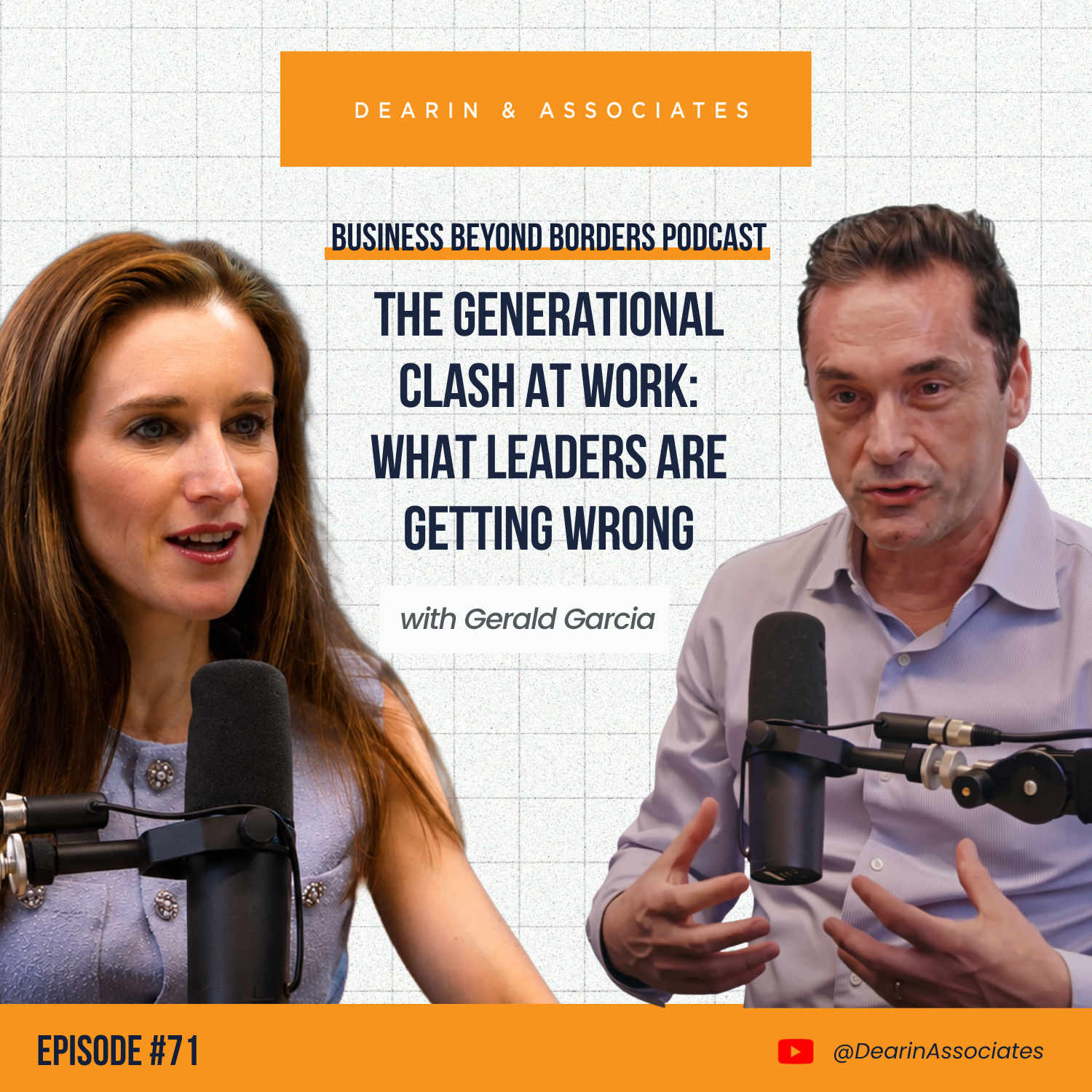
[00:00:00] Speaker A: Welcome to Business Beyond Borders. I'm Cynthia Deiren. When companies expand internationally, leaders tend to focus on markets, partners and strategy. But one of the biggest challenges inside global companies today is actually people. For the first time in history, we have four generations working side by side, often with very different expectations about work, technology, leadership and loyalty. Today we're exploring what that means for companies trying to build global teams. I'm joined by my colleague Gerald Garcia, who has been thinking deeply about how generational differences are shaping the future of work. And we're also joined by several leaders who bring different perspectives on how organizations are navigating these changes in practice.
[00:00:44] Speaker B: Very happy to see you guys for this generational clash.
Based on McKinsley report, 72% of CEO wake up with the intention to grow.
But you know what, when we ask them, do they have the right people in place?
Only 22% of them say they do.
So it's a challenge and it's a concern.
And when we continue to talk to them, they say, oh, it's a skill shortage, it's skill shortage, we cannot find the staff and. But it's more than a skill gap. This is actually a philosophical gap.
Different generations have different expectations on how the work should function.
And today I hope you can help us to understand what's going on in the workforce.
[00:01:46] Speaker A: So today we are very lucky to have with us four leaders who each bring a different perspective to how work is changing. We've got Rod Lewis, who's the CEO and co founder of Xtracta and Medicain. We have got Keith Barreto, who is the general manager of bluelink Australia, which is a subsidiary of Air France Carelem, specializing in high end global customer relationship management. We have Marianne Poiret from Four Frogs.
Marianne is the co founder and MD of Four Frogs, which is a successful hospitality group based here in Sydney, Australia. And we have Andy Calloway, the principal consultant at Freightwise. So welcome to the show, everyone.
[00:02:29] Speaker B: Welcome.
I will start to warm up the room. We start with a simple question, so if you can respond by yes or no and why.
Right, so the first question is around the university degree.
Is university degree becoming irrelevant?
Andy, what do you think?
[00:02:53] Speaker C: No reasoning.
It's a little bit nuanced, I would say for a lot of business services, administrative tasks, et cetera. I think work experience is probably more important as you enter the workforce versus the level of degrees you have, especially when we talk about advanced secondary degrees. However, there's a variety of technical things out there, especially in the age of AI.
And then obviously you're always going to have your disciplines like law, medicine, et cetera, where a university degree is never going out of style.
[00:03:27] Speaker B: Thank you. Talking about medicine, Rod, what do you think?
[00:03:30] Speaker D: No, absolutely. The reason that I favor people with good degrees is not because of the degree or the technical knowledge or whatever it is, although that can help. But it primarily because, you know, they've been disciplined enough to get that. Whereas some people wander through life, particularly at their very early stage, and then don't do much except have fun and laugh. But if you've gone to university and you qualified as one or two degrees, you've actually knuckled down and done something.
[00:03:59] Speaker B: Okay, thank you. Good. Keith, what do you think?
[00:04:02] Speaker E: Well, it's interesting because I never did that university route myself, so for me it's actually I had to go through the hard way. So I actually back people that go to university exactly for what you said. They did the hard work, they got the base knowledge and things like that. But if you don't, then you've got to be willing to put in the hard work. So. And you've got to go above and beyond what other people have had to do because they've got that base knowledge. How do you build that when you haven't been in that classroom, in that.
[00:04:33] Speaker D: Yeah.
[00:04:33] Speaker E: Seminar. So.
[00:04:34] Speaker B: And Marianne?
[00:04:36] Speaker F: Well, I grew up into the French culture where diploma and degrees are important.
And when I joined, you know, when I went to Australia, even in England, the British way is more into the way of doing so basically they're willing to learn to show capacity and improvement. And because I'm in hospitality, so depending on which area you want to grow, like if, for example, you're a waitress, I'm not going to look specifically on the degree, but I'm going to look on the way of being the emotional intelligence.
So I would say yes and no. I think it is important to have degree to validate some skills. The more you grow into a certain level of expertise or if it's just in a way of a professional on the floor or in a kitchen, I think experience on the floor, as we could on the ground, is very important.
So I think it's a balance of both. It's hard to say yes or no, but it's a true, true.
[00:05:31] Speaker B: I've got a sub question to that now with the emergence of AI and we'll have a topic about AI, but just to get your opinion on that, recruitment agencies or even HR departments are relying seem to rely more and more into ATS or applicant tracking system and use some AI. Tools to filter the candidates. What do you think about this system, this way of thinking?
[00:06:03] Speaker C: I think that loses touch with the humanity aspect of what good people are all about and what bringing on good people who are going to help your organization grow and thrive and bring a fresh perspective into things. I think that's.
I would hate to see things go down that road too far.
[00:06:21] Speaker F: Well, same I'm on my hospitality level. They come straight away in the restaurant so we really see them face to face. I would say 80% of the CV that I have, they are coming on site to meet and to see. And I think we, for me, as an hospitality person, we need interaction with the customers and I need to feel the vibes of the person.
So, yes, AI does help in terms of selecting according to my criteria, of course, because, for example, we have this, what we call a vie in our business and we receive 500 resume to apply for that job. So it was so much and they have so many people without experience.
So for me I've been very specific on that. I say, look, I want only people who's got experience in hospitality. So it did the first selection so easily, instead of going through 500 resume, I say no, I'm looking really for someone with expertise in hospitality. So it does help according to what I'm specifically looking at.
But I still in somehow need the feeling because this person will be in contact with my clients.
So at some point I need the face to face to feel a bit Keith.
[00:07:27] Speaker B: I think it's similar.
[00:07:28] Speaker E: Yeah, it will be very similar. The, the reality is if I had I AI looking at my resume as I was growing through my, I would have been filtered out very quickly. At the same time, when you've got hundreds of resumes, how do you filter out that many to a select few? The thing is the selection process still. You look at body language, you look at how much do they really want it and the AI is not going to tell you that they're going to look at data rather than the actual human context.
[00:07:56] Speaker A: I've got a question for Rod. One of the biggest changes we've seen since COVID is the rise of distributed teams. Do you think remote work is strengthening companies or making them weaker?
[00:08:06] Speaker D: No, strengthening. Strengthening, absolutely. Because you can see and work with more different types of people in different environments and homework. I'm a great believer in it because people are relaxed and they feel good about it as long as they're doing the right thing, which most do.
I think you get much more out of people when I motivate People, I want them to feel valued and happy and enjoying each other. And you can do it on zoom to a degree.
But they've got to feel valued and if they're valued, they'll do any of them for you.
[00:08:35] Speaker A: And what do you think, Marion? Because you're working in a very hands on kind of environment where, I mean, how do you serve?
[00:08:45] Speaker F: Well, in my case we don't.
But what's been happening, because I'm a multi site, I do have multi site venues. So it's much more on my perspective managing my managers because I'm not with them every day. So what has been really increasing is the communication.
Like if you have a clear and constant communication and working remotely for hospitality, it's not possible.
Like on a perspective ground, it's not possible with contact with the customers.
So it's.
For me, working remotely doesn't match very much with my industry. So it's. Yeah,
[00:09:24] Speaker E: well, I guess I agree with what said. Basically when you have a team working remotely, I think the biggest challenge is how do you manage them, how do you keep them engaged, how do you make sure they feel valued? And I think what you lose is that, you know, they call the having the drink break and you pass by in the office.
Yeah, the water cooler, that's the one.
You miss out on those unstructured conversations, but you have to manufacture them by actually structuring and planning this contact throughout the day, the week and the month.
[00:09:55] Speaker B: Yeah.
[00:09:55] Speaker D: I look back on the people that have worked for me and there have been some fantastically capable people that had to stop working full time. Almost all of them were women that got pregnant. And if I could let them work from home, this is before it was common.
They still contributed and they felt good because they wanted to. And they'd come in once a week, bring in the kid, they'd talk to the team. But they were motivated as hell and they work really efficiently at home and appreciated the fact that someone was prepared to let them work from home. This was before it was common and
[00:10:31] Speaker B: there are some workspace where we can bring also you dogs or you pets and all that.
But on another end or the flip side, there are some organization who work totally remotely. So what do we learn from them and how can they, if you want, build up this culture working remotely? What do you think, Andy?
[00:10:53] Speaker C: Yeah, it's a difficult thing to do when you're 100% remote because a lot of building up a culture, it is about kind of a common vision. It's about aligning in a way that it's just really difficult when you're 100% remote. It really all depends on the team in question, what the company does. And I can say, having begun my career with one of the largest companies in the US with Home Depot fully remote. My department didn't even exist prior to Covid and then they had to build it to deal with really just the shipping challenges they were facing during that time.
Being 100% remote, when you're starting your career, you feel very, very siloed. It's hard to get an idea of where your team fits into the larger organization.
It's in other ways. For technical tasks, it was almost better because you could just sit there on a zoom call with someone for two hours and screen share and comb through code and figure out what you're doing. So there's definitely pros and cons to it. I just think I would caution anybody starting their career, especially if they're doing something where the networking is going to be very important. We're making connections, which is going most roles.
You know, just tread carefully and really consider your options because there are, there are drawbacks to that as well.
[00:12:13] Speaker D: Can I. During COVID my team got forced into and it worked really well, but we were already a team. But even then, to take your point, we had to get together occasionally just because face to face and the coffee and the cooler and this interpersonal stuff matters. You haven't got to do it every day.
[00:12:33] Speaker F: Yeah, that's the connection. That's what is missing. Work on remotely.
[00:12:37] Speaker A: I was just recording an episode of the show earlier and the guest on the show was saying she didn't expect her team members to stay forever.
I was wondering, Keith, do you think that we are seeing the end of long term loyalty between employees and companies?
[00:12:56] Speaker E: Not the end of it. I think it's, you know, there's going to be people that love what they do and what they're doing now and they see that, you know, as long as they're valued, as long as they're learning, growing and looked after. But the reality is, let's say depending on where you are in your career and your ambitions, if you're looking at growing a lot more people are going to be jumping around just purely out of not having that speed of ascension that they want.
[00:13:23] Speaker A: And Marianne, I mean, how would you see it? Because you're in a totally different kind of industry.
[00:13:28] Speaker F: Yes, we. Every three months, it's kind of a fast pass.
So I think it's also, if we talk, we can talk quickly about generational like As I said maybe before, we tend to stay 10 years growing about 40 years in the same company.
Now we really see the difference over the past decades now that even for my generation, where I think 10 years was all right, but it's good to move and grow on something different. And because I'm in hospitality, I used to, every summer I used to travel overseas to work and do different experience because I was encouraged to learn new skills. So it became normal to go in different restaurants, even to work for free for some famous chef to learn new skills.
So until you kind of set at a certain age, yeah, you, hospitality, the turnover is huge because, well, let's face it, the job is hard and usually after two to three years for a manager, they tend to want to see something different and move on. So it's a very fast environment.
[00:14:30] Speaker B: We've been brought up, I mean, being the same generation, you are rewarded by merit, you know, and so then it's, you acquired your skill set and after a certain time, because what you've done, what you've achieved, you reward it and you promote it. This is a totally different mindset, I would say, for you. Andy, what do you think of these new generations coming to the market?
What are the expectations of.
[00:15:00] Speaker C: Well, the expectations I think we set for ourselves in my age group are pretty high. And I think a lot of this is social media driven, frankly, probably to an unhealthy extent. I think a lot of people, especially in the corporate and professional world, if you don't have your own business, it's turning over seven figures in revenue by the time you're 30, you feel like you're left behind.
And that is unhealthy because it kind of, it applies maybe too much pressure on, on yourself. But at the same time, also I think there's a good aspect of that pressure as well.
There's a serious drive to achieve. You realize, like you don't have to go through.
It's not about how many years you put in. It's about, like you said, the merit. It's what did I actually do, what did I, what did I produce, what did I create for value of this company and this organization? And what did I learn from that and how have I learned to manage people?
And I think from that standpoint, it's actually pretty exciting. I think there's, there's actually in a generation that's often blamed for being overly pessimistic, I think in terms of what's possible for yourself, I think there's a lot of optimism.
[00:16:17] Speaker A: So, I mean Given how many opportunities are out there, sort of everywhere, how, how should organizations, and especially ones that are looking to be global, how, how should they go about keeping talent? I mean, I'd love to hear maybe from Rod and from Andy.
[00:16:32] Speaker D: Well, I disagree with the, the merit thing because I've worked in some big companies and I've never felt that I got a merit bonus. I, if I worked hard and I achieved a lot of stuff, I got big bonuses, but I never got one because I was there a long time.
In fact, interestingly, when you say I was thinking I was able to move from job to job because I was fortunately headhunted. And interestingly there was my salary worked up for five years somewhere inflation plus a bit. If I was a good boy and suddenly someone wants me and therefore it's a significant leap. One was 30%, one was 35.
So there's no merit in that. So in my experience, so my, because I've jumped around from industry to industry and job to job, I see huge benefit in doing that.
And I don't think long term employees are particularly valuable. I think you're more valuable if you move from place to place.
[00:17:33] Speaker C: I 100% agree and really I think I was speaking more from the, the personal perspective and like how I think people my age view themselves in the workplace, not the companies that they're working for. 100%. I think people now for good reason are extremely opportunistic in terms of, you know, where they're working and the loyalty is ultimately always going to be to themselves because I mean, let's face it, you know, the companies have a, have a responsibility to at the end of the day return profit to their shareholders. And that responsibility is first and foremost over any responsibility that they have to you. So you kind of owe it to yourself to always get the, get the best deal for yourself.
[00:18:18] Speaker A: Well, I have to say that is a particularly American point of view. Much less,
[00:18:24] Speaker C: and certainly I wish, I wish it wasn't maybe as cutthroat as that. But I think at the end of the day that's, it's, you know, there's some truth to that.
[00:18:34] Speaker D: Well, I'm not an American and I agree completely though. I think a person is better off to go from thing to thing, job to job, opportunity to opportunity, and if it doesn't work, okay, it doesn't work. You go somewhere else, but you make yourself employable.
[00:18:49] Speaker A: What I meant though was, you know, the company culture here is a little less hard edged. I think you see people as a little less possibly A little less expendable.
[00:18:56] Speaker D: I worked. I worked at the brewery or one of the breweries, the best brewery in the country.
And there were people there that had been there three generations, and they were painfully boring and useless.
They were.
And I was brought in because I was, I'm saying this, a stirrer. There's a better word for it. But I was a stirrer and that's why I was brought in.
[00:19:18] Speaker B: A brewery, that's good to be a stirrer.
[00:19:20] Speaker A: Right.
Keith, what do you think? What's your experience of how people, our organization, should hold on to their talent in their opportunity?
[00:19:29] Speaker E: Well, you know, I think the way I've always looked at it, managing my teams is the best sign, is when someone actually goes and then comes back. So they've done exactly what you said. They've jumped because they did get a better salary, because that can happen.
And then they've come back because the culture wasn't right. The way they treat me, the environment, the, you know, and the respect that you have. And so that's what I think. It's what keeps people there growing. In my career, I always said, if I'm not learning, I'm leaving.
And that's another big thing. You know, someone might stay for that less pay maybe than what they could get out in the market as long as they're growing and developing. But someone's got to be doing that, helping them, and there's got to be mentoring and coaching, and that's a responsibility of managers and leaders as well as themselves to engage in it. You know, it's not always greener on the other side. But if you want more money, I've always said, go and look for it, because that's what you need for yourself, then. Then go for it. And I think that's an individual decision, but from the company, you do want to manage your costs. You do don't want staff turnover, and you have to train and recruit and all of that turmoil that you know and cost that it brings. But at the same time, if that person's been there for so long, they're not motivated anymore.
[00:20:47] Speaker D: No.
[00:20:47] Speaker E: And what they want is maybe a bit more money. Then let them go and find that thing that they're looking for.
[00:20:53] Speaker D: And one of the things from what occurred to me, what you said, you want to make sure the company encourages people to do whatever they need to do. In other words, value them. Because if I leave on a good note, they're much more likely to come back.
And that if they're coming back, then they're probably going to stay a bit longer anyway, because they love it.
[00:21:14] Speaker B: Marianne, would you say beyond generation of a generational clash we're talking about, is there another component that would say people are. Are different with each other?
[00:21:26] Speaker F: Okay. What I learned with my experience is also to always try to understand who I'm talking to and who is working with me.
I know also that those person will follow a leader. It used to be in the past you work for the company. If it's. You are a very famous company, it can give you so much on your resume. And now I see the difference. When they also give the interview to the manager, I say, yes, but what do you do for me? So we really are into a different level of recruitment because they just don't come for the culture. They come also for the manager, the leadership that they're going to work with.
Because as I mentioned, as a French, when I came to Australia, I had to review my management style because I came a bit with my French experience, which didn't always work here quite well.
[00:22:13] Speaker A: Tell us about that.
[00:22:15] Speaker F: So I'm someone very straightforward. For example, I tend to say things the way they are, and it was not always well received, which I didn't understand why the person said, yes, yes, no problem, but she left and never come back. So, okay, maybe there is something there. So it's always trying to first understand the culture, understand who I'm talking to, the person that I work with.
And then if at some points we had this conversation with the different generations and different. So it's how do I adapt to that? Because down the line, we are in constant evolution in terms of work, industry, and people.
So I'm always the kind of person who kind of asks myself, all right, it doesn't work that way or my way doesn't work. So maybe it's time to understand what to do, what to change.
[00:23:02] Speaker B: Kief is probably the same with different backgrounds in your contact center.
[00:23:08] Speaker E: Yeah, we have different cultural backgrounds. It's very multicultural office and actually serving in different languages. So that makes it very interesting. And you might have a leader, team leader, supervisor that's of part speaks a different language. So, you know, we, we've had challenges in the past. Where is it, you know, you talk about generations, but what about the cultural? And in our culture, we do it this way. In our culture, we do it that way. And so you do have to respect that and learn the, the different nuances at the same time.
As an Australian company, how do we create our own team culture? And that's, I guess, what What I've tried to do with my team, with my leaders, is really teach them. Okay, well, that's what we do. And when we're serving the customer, we respect that. But here we're in Australia and we've got to respect Australian laws and Australian way of working at the same time. How do we want to work? How does our, you know, team want to work? And so we build a team culture and I think that's what works best.
[00:24:04] Speaker B: Rod, in your specific industry, how did you experience the culture, environment or different background?
[00:24:13] Speaker D: Well, in the current one, we created our own culture because it's a startup and we engaged people that were passionate about what we were trying to do.
We've only had to.
What's the correct word? Invite to opportunities elsewhere. Some people call it firing, but it's nasty.
We've only fired three people.
[00:24:34] Speaker C: First time I've heard that. I like that.
[00:24:38] Speaker D: And so we've got a great culture and people enjoy each other. And yeah, we have arguments. In fact, if you have to have arguments, if everyone agrees, then you don't have a good team because you need different opinions.
But the cultures that I came from, the brewery was horrible culture. It was a boys club and it was just the worst, imagine, you can imagine of a boys club. And it didn't matter what was going on. If the boys liked it, it was good. Losing money was okay. Telling customers off because they didn't, they might have taken a competitor's product was awful. And so, yeah, I was a little disruptive too, and I didn't get fired, but I probably should have.
[00:25:26] Speaker A: Now I'm. I'm curious to get people's thoughts on AI because we're seeing that it's making a lot of change in, you know, in a lot of different ways.
Can I just get a thought from each of you about the biggest change that you've seen AI create in your industry or your company?
[00:25:44] Speaker C: Yeah, I'll start. I think AI, I think it's making traits that were only sought after in management positions really valued across the board. You have to be very cerebral. You have to understand your business. You have to understand in the grand scheme of things, where your team fits in, because it's just tool.
You can sit there on ChatGPT all day, but if you don't actually understand your industry, if you don't understand the needs of your customers, then it's going to be rather useless. But when you do, then you can tap into resources that just even a few years ago were unthinkable and work a Lot faster, work more efficiently. And I think even in call them entry level positions even, it's enabling anybody with creativity and a vision to execute big projects, think big and drive serious results, maybe beyond what we would expect of those kinds of positions initially in the past.
[00:26:50] Speaker A: Thank you, Marianne. What are you seeing? What's the biggest change you're seeing?
[00:26:53] Speaker F: Well, first, I'm very excited about AI because so much efficiency improved in terms of reporting, digging further into the data of the company. Like for example, if I need to understand where are my slowest hours, where could I maybe improve?
So for me, having AI was a massive push in terms of reacting faster on some problematics that in the past would take me hours to dig here in that software and go back to this one. So having AI and centralizing many information, that's a huge gain of time, which is amazing. And it keeps improving, which is great. And even in terms of, for example, ordering for my chefs, same, we can all centralize and it makes so much more efficient. We gain time because if my managers on the ground spend already so many hours working and then they, on top of it, have to do their admin reporting and ordering, if I can help them to gain that time on their work, it's fantastic.
I'm not concerned about AI taking the job of my waitress because I think people still need to be all connections and contacts. I'd be scared the day when robots gonna arrive more. But today, no. But in terms of helping on data and everything, it's fantastic.
[00:28:08] Speaker A: Keith?
[00:28:09] Speaker F: Yeah.
[00:28:09] Speaker A: What are you seeing and is it shrinking your contact centers at all?
[00:28:12] Speaker E: Well, it's huge in our industry.
It's touching every part of what we do. It's very big disruptor. Is it shrinking? In some parts, yes. But it's basically what, what's happening is you've got some that are going whole, whole in, all in. And they're using AI to answer calls, to make calls, to answer everything almost in a, let's say automated service. And you've got some that made mistakes doing it and then they're rolling back. And so I think the key thing is designing it and using it as a tool tool to actually facilitate experiences. So there's some things that, sorry, as humans, we don't want to do the mundane robotic and same as a customer, you don't want to be pressing 20 different buttons to get through to someone when you could just tell them what you want, answer a question. It filters you to who you need to speak to or maybe to an automated service because that's actually Indeed what you need, but you get there faster and easier. And I think in terms of experience, that's great. On the reverse side, actually it's helping our teams a lot. What we don't see is the basically agent assist is what we call it, but basically there's so many tools that are helping our staff to gain knowledge of the customer, to have the answer prompt ready for them to support and that's facilitating a much better experience.
The whole thing is how do we keep it human, how do we design it so it is efficient but without being robotic and lose that, lose that experience and efficient because customers do want that. So we, we do need that. That doesn't mean we don't need people because the human element is really, you know, you talked about connection. How do you make that connection? How do you make a memorable experience? How do you keep that loyalty with a customer? Customer. If you never spoke to them, they just spoke to that robot. They're, they're going to be happy, maybe that they resolved it quickly, but that doesn't make them loyal. That doesn't make a memorable experience.
[00:30:07] Speaker B: None of you, as I mentioned the word emotions, but this is all what we're talking about. Obviously the human component is important.
[00:30:15] Speaker A: Brian, you're working with product. I mean, is it the same for you or good, bad, indifferent?
[00:30:20] Speaker D: I think it's a great innovation because it saves doing mundane tasks. I'm a believer in using it for CV selection. I mean I manually went through 80 cvs one time because I did it quick. I eliminated one guy because he spelled my name wrong. Well, you've got to, you've got to eliminate them as efficiently as you can. AI is good at it.
Well, it doesn't get you an answer. All you really want is to get the right person. It doesn't matter if you cast a few aside on the way through. It's nasty, but it doesn't affect the bottom line. So now it's, I think it's been good for us so far. We use it to try and figure out the marketing positions and spends and use of which social media type and how often and all that stuff. None. I don't think anyone's an expert in that now because it changes every few months. So we, we use it for that and it's been good so far.
[00:31:20] Speaker B: I guess we coming to an end these sessions and thank you very much. It was, what was interesting is that you, you haven't met before. None of you has met and it's good to have four people together. We have challenged you with some of our questions.
And it was actually interesting to see that there are some synergies in between the generations.
And I just want to finish on a light note to bridge the gap. So if you're looking at your person to the left, to the right, just to the left or just to the right with these sessions today, what did you learn from them? What is the. If you want the skill set or the value that you say, oh, this is a different generation, but I like this value, I like this skill set from your neighbour, let's say the left one or the right one. Who wants to start?
[00:32:18] Speaker D: Can I start? Because I've thought about it before this, when I read your questions and my first degree was genetics.
And it's crystal clear that any real differences in human beings, apart from race and all that stuff, takes thousands of generations. So we're all the same. I'm old and he's young, but when I was his age, I was the same.
What's changed massively is the environment, particularly with communications. AI, the phones we've all got these days, that's. And if I had been, you know, this age when the phone. I would probably behave the same. Well, I'm not American, but we don't change, in my opinion, over three generations.
[00:33:07] Speaker B: So you say it's the society and the environment that make us.
[00:33:11] Speaker D: I think it's the environment and in my observation, almost entirely the connectivity that we've now got at our fingertips that's dramatically changed all of us. Even Aldi's. When you go to a McDonald's and you watch all these gray hairs reading their phones.
Well, that didn't happen when I was 20.
[00:33:30] Speaker C: Yeah, I agree with all of that. I think human nature is.
I think it's the constant in all of this. And what's changed is our environment. I think expectations, both that are placed on us, that we place on ourselves. I think all of this is what's changing around us. But the end of the day, and especially in terms of how different generations interact in the workforce, I think there's just timeless truths and timeless values. Like something that's been discussed around this table a lot today is, and I've heard it from multiple panelists here, good management is all about investing time and also, like, emotionally in your people and understanding that, you know, their value isn't ultimately just what they're doing for the organization. Everybody has intrinsic value and you want to.
You want to make sure to understand how people can move forward in their careers and help them move forward. And that kind of management style. I think it's always, it's going to return good things always. And that's one timeless truth in the professional world that is never going away.
[00:34:41] Speaker F: But we are all leaders so I think we will have the same goal, making sure the company thrive, the culture thrive, the employees thrive. So for my ex, as I said I like to understand who I'm hiring and I'm adapting also because we are evolving as I said, different generation, different mentality, different needs.
I understood for example that the Gen Z they are more self aware than ever. Like they prioritize well balance. They have this self awareness, this emotional intelligence I think way more aware than in the past I think and I find it fascinating because we were from somewhere where you work hard and this is the way it is to questioning things and saying no.
And I find it interesting because if we want to evolve we need to adapt to the generation also. So the same way as we adapt our customer needs and our customers are also the Gen Zs or the boomers or the Gen Y. So at some point if we adapt to our customers or to the markets we also have to adapt to people that we work with. I mean that's the way I would
[00:35:45] Speaker E: see it I think just shows me the value of the different generations. I love the mix.
You know I think of let's say the youngest generations coming through. If you talk about what Andy said, the expectations from that they build and put on themselves to achieve these unreachable goals for most people that's a lot of pressure. So they're obviously it's coming out in their actions and behaviors but it's not from a bad place. It's just trying to do the best with what they have in the environment that they've been growing up in.
And then you know, I think on the other side what shines. True. You talk about leadership and the attitude and mindset. The same sort of attitude and mindset is still there. It's just coming out in different ways because we're in a different, let's say different society, different tools, different yeah different totally different environment. So yeah, interesting.
[00:36:44] Speaker A: Ladies and gentlemen, it has been fantastic to have such a diverse and intelligent panel in the room.
Thanks for sharing all your ideas and thoughts and we look forward to having you back in the future.
[00:36:57] Speaker F: Thank you.
[00:36:58] Speaker C: Absolutely.
Putting this together.